Purchase Order vs. Invoice: Key Differences and How They Work Together

Purchase Order vs. Invoice: Key Differences and How They Work Together
The difference between a purchase order (PO) and an invoice feels straightforward until you're managing spend across multiple locations, vendors, and approval paths. Both documents play distinct roles in the procure-to-pay process, and keeping them connected gives teams clearer spend visibility, fewer AP reconciliation headaches, and the insight to make faster, smarter financial decisions.
Key takeaways: purchase order vs. invoice
- A purchase order authorizes spend before delivery, while an invoice requests payment after fulfillment.
- Once accepted, a PO becomes legally binding, locking in price, quantity, and terms before the business is obligated to pay.
- A connected PO-to-invoice process gives AP, procurement, and finance a shared record of what was approved, ordered, received, coded, and billed, reducing manual reconstruction and giving teams better visibility for spend management decisions.
- Order.co connects purchasing, PO creation, line-item coding, vendor payment, and billing in one system so buyers, finance, and AP share the same purchase context.
Download the free ebook: The Procurement Strategy Playbook for Modern Businesses
Purchase order vs. invoice at a glance
A purchase order authorizes spend before delivery. An invoice requests payment upon receipt of goods or services. Here's how they differ:
| Aspect | Purchase Order | Invoice |
| Issued by | Buyer | Vendor |
| When issued | Before delivery | After delivery |
| Purpose | Authorizes purchase, sets terms | Requests payment for delivered goods/services |
| Legal status | Binding once the vendor accepts | Enforceable record of transaction |
| Authorizes | Spend approval pre-money moves | Payment after delivery confirmed |
What is a purchase order?
A purchase order (PO) is a buyer-issued document sent to a vendor before goods or services change hands. It lists:
- Goods/services requested
- Price and quantity per line item
- Expected delivery date
- Payment terms
- Approver name
- Unique PO number
Once the vendor accepts, the PO becomes a legally binding contract. It anchors the entire workflow: receiving teams match deliveries against it, AP verifies incoming invoices, and finance tracks spend against budgets.
If you're managing multi-location spend, the PO creates that visibility at scale, where email chains and verbal deals often fall apart.
The Procurement Strategy Playbook for Modern Businesses
Want to know more about strategic buying? Read our Procurement Strategy Playbook for even more valuable insights.
What is an invoice?
An invoice is a vendor-issued document requesting payment after delivery. It itemizes:
- Goods/services provided
- Agreed price per line
- Payment terms
- Total due
- Due date
- PO reference (ideally)
Invoices create the legal record for both parties and trigger AP processing, cash flow management, and audits. A strong invoice links back to the originating PO—without that context, AP has to reconstruct purchase details from scratch.
The biggest differences between POs and invoices come down to timing, ownership, and the role each document plays in keeping purchasing and payment aligned.
Why does it matter to keep PO and invoice context connected?
When POs and invoices are disconnected, teams lose the context they need to approve, code, reconcile, and pay accurately. AP can still process the invoice, but often only after extra follow-up and manual review. As purchases spread across more locations, vendors, and approval paths, those gaps become harder to manage.
PYMNTS Intelligence research found that 45% of small and mid-sized businesses cite manual invoice review as a problem when making payments, and the issue scales with complexity, not just company size.
When PO and invoice context stay connected, it does more than simplify reconciliation:
- Finance can see what’s committed, pending, and soon to affect cash flow before purchases become payment obligations.
- Procurement can spot vendor, category, and pricing trends sooner, while there’s still time to act.
- AP can process payments with fewer questions because approval, item, vendor, location, and coding details stay attached.
That shifts POs and invoices from documentation to decision support, helping teams move faster, prevent avoidable costs, and make smarter spend management decisions before payment obligations create issues downstream.
When to use a PO vs. an invoice
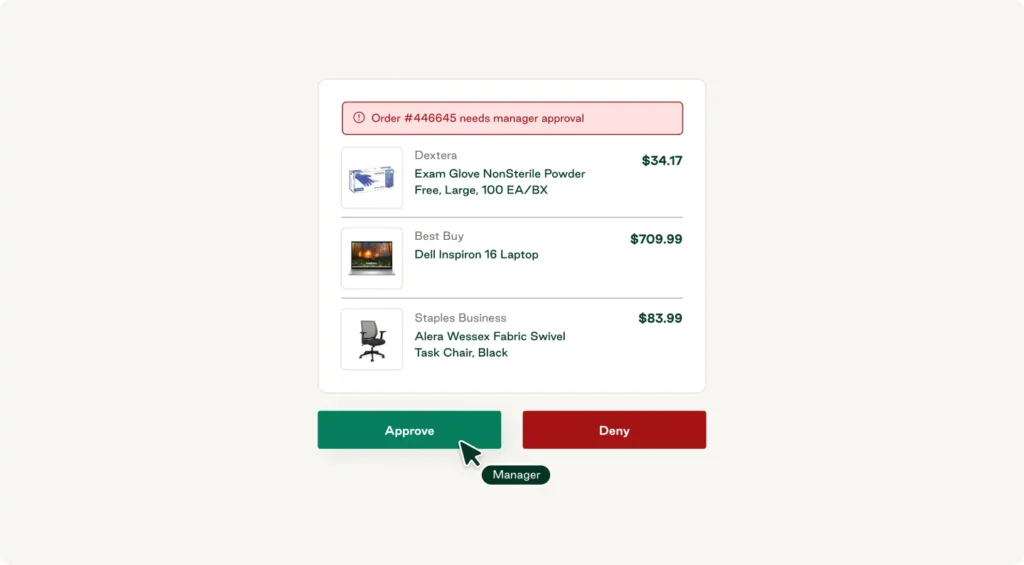
The choice between using a PO and an invoice depends on the level of approval, visibility, and payment context required for the purchase. Some low-risk purchases can move straight to invoice, while higher-risk or higher-value purchases need a PO before the vendor fulfills the order.
When an invoice without a PO works
Invoice-only workflows can work for predictable, low-risk purchases from trusted vendors, such as utilities, fixed monthly services, or small recurring expenses.
For instance, a predictable $200 monthly subscription for a SaaS project management tool is often managed via an invoice-only workflow. Since the cost is fixed and the vendor is established, issuing a formal PO each month creates unnecessary administrative overhead without adding significant security.
The key is that AP still needs clear ownership, coding, and payment context. If the invoice arrives without enough detail to confirm who bought what, where it belongs, or whether the amount is expected, a simple invoice can still create manual review work.
When skipping the PO creates risks
Skipping the PO can save time up front, but create cleanup later. Without a PO, AP loses the pre-purchase record showing what was approved, at what price, and for which location or department. That increases the risk of duplicate invoices, coding delays, unexpected spend, and extra back-and-forth before payment—and for multi-location teams, those gaps can compound quickly.
For example, if three locations order the same supplies from the same vendor without a PO, AP may receive multiple similar invoices with no clear way to confirm which purchases were approved, which cost center they belong to, or whether any charges are duplicates.
When a PO is required
A PO is the better choice when a purchase needs approval before money is committed. Many organizations set a dollar threshold—often $1,000 to $5,000—above which a formal PO becomes mandatory.
POs are also useful for regulated categories like safety equipment or food service supplies, where the document acts as an audit trail, and for indirect spend categories like facilities maintenance, IT equipment, or professional services, where it serves as the approval gate before purchase.
For recurring purchases, blanket POs can reduce repeat admin while still setting clear limits around vendor, time period, quantity, and spend. The goal is to give buyers enough flexibility to keep work moving while preserving the context that finance needs later.
The Procurement Strategy Playbook for Modern Businesses
Learn the key pillars of a strong strategy, valuable procurement metrics to track, and initiatives you can start implementing today.
"*" indicates required fields
How POs and invoices work together
Purchase orders and invoices connect the pre-purchase and post-fulfillment sides of the same transaction. The standard procure-to-pay sequence has several steps, and the quality of the process depends on how well purchase context travels through all of them.
In a disconnected setup, that context gets recreated at every handoff. Connected systems capture the context once, at the point of purchase, and keep it attached to the order through to payment.
Here's how the process looks when it runs on a single platform like Order.co:
- A buyer submits or creates a purchase request: With Order.co, buyers choose from a curated catalog of pre-approved products and vendors, enforcing compliance from the start. The sourcing algorithm finds the best price across the network and surfaces alternatives when items are out of stock, so buyers don't go off-catalog when their first choice isn't available.
- The purchase is approved and converted into a PO: Approvals route automatically to the right people based on dollar thresholds, location, and category. Once approved, the PO generates with line-item GL coding, location, and approver already attached, then goes to the vendor in the format each vendor prefers.
- The vendor fulfills the order: Order status updates back to the platform automatically, so finance can see committed spend in real time rather than waiting for invoices to reveal it.
- The business confirms receipt: Receiving is logged against the original order, keeping the line-item record intact for AP downstream.
- The vendor sends an invoice. Instead of AP processing dozens or hundreds of individual vendor invoices, Order.co pays vendors via their preferred method on Net 1 terms and consolidates everything into a single bill per location, with every order's purchase details attached.
- AP processes payment. Traditionally, this is where three-way matching happens— comparing PO, receipt, and invoice to confirm everything lines up before payment. But when line-item details, GL coding, and approval all travel with the order from step one, the matching step becomes unnecessary. AI anomaly detection and pricing-drift alerts catch the edge cases—like duplicate charges, price creep, and irregular spend— before they become AP cleanup.
In this kind of connected workflow, the PO and invoice are no longer treated as separate documents that AP has to reconcile later. They become two views of the same purchasing record.
For teams managing multiple locations, vendors, approval paths, and spend categories, that continuity matters. APQC benchmarking data shows that bottom-performing organizations process only 88% of payments error-free the first time, leaving 12 out of every 100 payments late or otherwise incorrect. Keeping PO, receipt, invoice, approval, and coding details connected helps reduce the handoff gaps where those errors often start.
Keep PO and invoice context connected with Order.co
PO and invoice issues usually trace back to disconnected workflows that require manual cleanup, and the complexity only compounds as you add locations, vendors, and approval paths.
Order.co brings purchasing, PO creation, vendor management, line-item coding, payments, and billing into one system. It fits the buying processes your team already uses, giving procurement, finance, and AP a shared source of purchase context across the entire procure-to-pay workflow.
Order.co gives teams:
- Curated catalogs of pre-approved products and vendors, so compliant purchasing is the default path before approvals or matching ever come into play
- Auto-generated POs that route to the right approvers and vendors with line-item details, location, and GL coding already attached
- Direct vendor payments via each supplier's preferred method, rolled into customized bills that fit your bookkeeping — purchase details, location, and GL coding already attached
- AI-powered spend insights that flag pricing changes, unusual patterns, and lower-cost alternatives before spend happens
- Real-time visibility across vendors, locations, and categories for stronger spend management
Book a demo to see how Order.co eliminates the manual cleanup and complexity between purchase and payment.
FAQs about purchase orders vs. invoices
The purchase order comes first. The buyer issues a PO to authorize the purchase and lock in pricing, quantity, and terms before any goods or services are exchanged. The invoice comes later, after delivery, and requests payment based on what was authorized in the PO. Skipping the PO step and paying from the invoice alone removes the upstream approval layer that protects against unauthorized spend, overbilling, and duplicate charges.
Yes, it's common to skip POs for recurring, low-value purchases or established vendor relationships. Many teams process non-PO invoices for monthly software subscriptions, utility bills, or small office supply orders where spend is predictable. However, invoices without POs are harder to validate against authorized amounts, easier to accidentally duplicate, and leave no upstream approval trail for audits. A PO issued up front prevents most of that manual verification work.
When amounts don't match, the invoice typically gets flagged as an exception, and payment is held until the discrepancy is resolved. AP looks for reasons like partial shipments, price changes, or incorrect invoicing. Someone must contact the vendor, check the receipt, and decide whether to adjust the invoice or PO. In a well-controlled process, mismatches trigger an approval workflow where the original requester reviews and authorizes the variance before payment.
Get started
Schedule a demo to see how Order.co can simplify buying for your business.
"*" indicates required fields