Centralized vs. Decentralized Purchasing: How to Choose The Right Model

Centralized vs. Decentralized Purchasing: How to Choose The Right Model
In many multi-location organizations, purchasing follows two conflicting paths. Corporate locations follow approved vendor lists and route requests through the central team, while field locations put supplies on personal cards and sort them out at month-end.
Neither approach is inherently wrong, but each reflects different priorities: control and cost savings on one side, speed and operational flexibility on the other.
The choice between centralized vs. decentralized purchasing is about finding a structure that gives finance visibility, helps operators move quickly, and scales as locations, vendors, and purchasing volume increase.
Key takeaways: Centralized vs. decentralized purchasing
- Centralized purchasing gives you strong spend visibility and negotiating leverage, but often creates approval bottlenecks that slow local operations as the business grows.
- Decentralized purchasing lets local teams move fast, but fragments supplier relationships and leaves finance chasing spend data after the fact.
- Center-led models offer a practical middle ground: finance and procurement set policy, while local teams buy within established guardrails.
- The right purchasing model should support both current workflows and future scale as locations, vendors, purchasing volume, and AP workload increase.
- Order.co supports centralized, decentralized, and center-led purchasing on one platform with curated catalogs, automated approvals, real-time spend visibility, AI-assisted sourcing, and automated AP workflows.
Download the free ebook: The Procurement Strategy Playbook for Modern Businesses
Understanding centralized, decentralized, and center-led purchasing models
The difference between these models comes down to one question: who has the authority to make a purchase? That choice shapes vendor relationships, approval flows, spend visibility, and how fast teams can move.
Centralized purchasing
In centralized purchasing, all buying decisions flow through one procurement team. They own purchasing, manage vendor relationships, and handle contract management. For every purchase request, centralization adds a step between the person who needs an item and the person who approves it.
- Single point of control: A single department manages vendor sourcing and selection as well as contract terms.
- Standardized approval workflows: Requests follow a consistent process regardless of location.
- Consolidated vendor relationships: Centralized systems use fewer total vendors, with all locations buying from the same suppliers.
- Centralized budget oversight: Finance has clear visibility into all purchasing activity.
Decentralized purchasing
In a decentralized model, buying authority sits with individual departments or locations. Each site manager or department head selects vendors, negotiates terms, and places orders based on local needs without routing requests through a central team.
- Local vendor relationships: Each location builds its own supplier network.
- Minimal approval layers: Purchases happen at the location level within budget parameters.
- Operational flexibility: Different departments respond to urgent needs without waiting for centralized process approvals.
- Independent budgets: Accountability rests at the site or team level.
Hybrid and center-led purchasing models
Hybrid models run two parallel systems: some categories follow centralized rules, while others operate independently. While this purchasing system has its benefits, it makes approval handoffs and vendor ownership hard to navigate consistently.
Center-led is more practical, with the central procurement department or finance team establishing the framework, and local business units making day-to-day purchasing decisions within it. Center-led works best with a few key mechanics in place:
- Curated catalogs: Only pre-approved products and vendors are available to buyers.
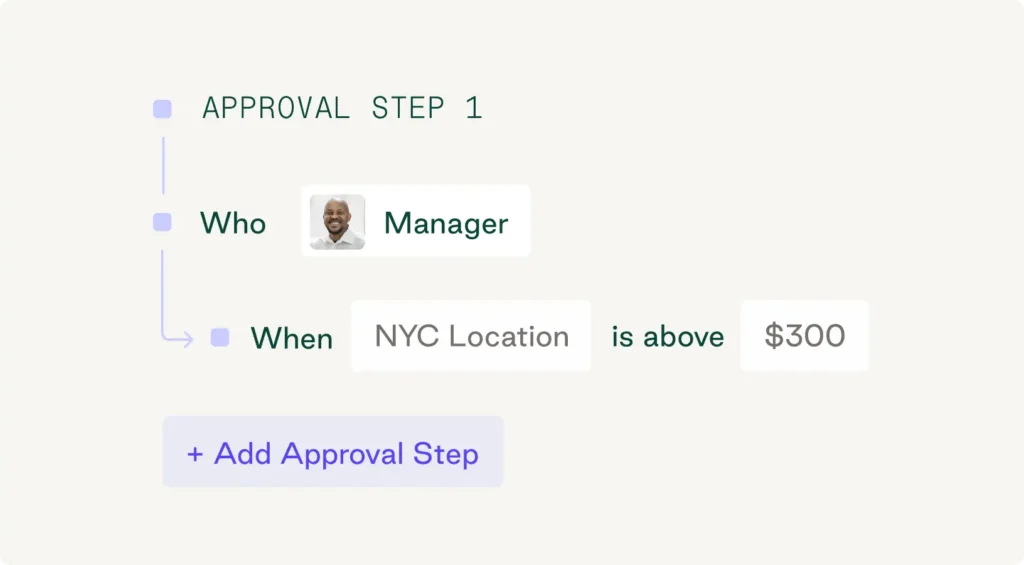
- Embedded guardrails: Budget limits, category rules, and approval thresholds enforce policy automatically.
- Strategic categories stay central: High-value contracts like software licenses, equipment leases, and enterprise agreements still route through the central procurement team.
- Operational speed for the rest: Everything else moves at location speed, within the established guardrails.
The Procurement Strategy Playbook for Modern Businesses
Want to know more about strategic buying? Read our Procurement Strategy Playbook for even more valuable insights.
What are the pros and cons of each purchasing model?
No purchasing model is objectively best. The right one for your organization is the one whose trade-offs you can actually live with at your size, stage, and structure.
Centralized purchasing
Centralized purchasing typically works best for smaller organizations, highly regulated environments, or companies with limited location-level purchasing needs. It can also make sense when procurement headcount is sufficient to manage daily requests without slowing operations.
- Pros: Better pricing and standardized processes. Volume discounts are easier to negotiate, contract management is more consistent, and finance has fewer invoices to reconcile.
- Cons: Slow operational speed. Every purchase request goes through the same approval queue, which means field locations may wait several days for office supplies while the central team handles higher-priority requests.
Decentralized purchasing
Decentralized purchasing can work for organizations where local speed matters more than centralized control, especially early-stage companies, loosely connected business units, or teams with highly location-specific purchasing needs. However, it becomes harder to sustain as vendor and location counts, and reconciliation work, increase.
- Pros: Faster decision-making. Teams buy what they need without waiting for corporate approval, and location managers don't have to factor in extra lead time for purchase orders.
- Cons: Rogue spend, higher costs, and accounting inefficiencies. Finance doesn't see purchases made outside approved channels until it's too late, fragmented vendor relationships eliminate volume leverage, and AP teams spend hours reconciling expenses that were never properly documented.
Hybrid models
Hybrid purchasing can work for organizations transitioning away from a fully centralized or fully decentralized model. It’s often a useful interim step when the business needs more flexibility but hasn’t yet defined the policies, systems, or ownership structure required for a true center-led approach.
- Pros: Flexibility. Central teams handle strategic categories while local teams focus on daily decision-making.
- Cons: Complexity. Unclear boundaries often result in slow approvals and fragmented spend, and it's hard to tell who owns the vendor relationship when a location needs an exception.
Center-led models
Center-led purchasing typically works best for growing, multi-location organizations that need both local autonomy and centralized visibility. It’s especially useful when finance and procurement need to control spend, consolidate vendors, and improve reporting without forcing every routine purchase through a central approval queue.
- Pros: Strategic balance with operational speed. Central teams set approved catalogs, budget thresholds, and approval rules—enforced at the point of purchase—so local teams can move fast within shared guardrails.
- Cons: Platform dependency. Without a system that enforces policy automatically, a center-led strategy becomes a policy document that locations don't consistently follow.
How to choose the right purchasing model for your organization
The right purchasing model should fit how your organization buys today and support where the business is headed next. What works for a 10-location retail chain won’t work for a 200-location restaurant group, and what made sense at 50 employees may break down at 500.
As you evaluate each model, look for the structure that shortens approval cycles, gives finance and procurement real-time spend visibility, and helps buyers make decisions with accurate budget and vendor data. For many growing organizations, this points toward center-led purchasing: local teams can move quickly, while finance and procurement maintain shared control over vendors, budgets, and policy.
Use the following steps to evaluate which model fits your organization:
Assess your current purchasing pain points
Start by mapping where time and money are leaking out of your current process. Common pain points include:
- Spend you can't track: Purchases happening outside approved channels, often on personal cards or with unapproved vendors, obscure total spend.
- Approval bottlenecks: Routine purchases are stuck in a queue while a central team works through backlogs, slowing down operations.
- Duplicate vendor relationships: Multiple locations negotiating separately with the same supplier, resulting in missed volume-based savings.
- Month-end reconciliation burden: Finance is scrambling to reconcile purchases they didn't know happened.
- Compliance gaps: Locations bypassing required approvals or documentation standards, disrupting risk management.
- Decisions made on stale data: Buyers and budget holders making calls without insight into current spend against budget, what's been committed but not yet invoiced, or how a vendor's pricing has shifted since the last contract review.
If you're seeing pain from both sides—slow approvals and untracked spend—a center-led model may be the right fit. Look for patterns where maverick buying happens most often. Process defiance and workarounds usually happen when the current model doesn't fit how your teams operate.
Evaluate your organizational structure and growth plans
Your purchasing model should reflect how responsibility is distributed across the business. If location, regional, or department leaders own budgets or performance, they need enough purchasing authority to act quickly. But that autonomy still needs to come with corporate visibility, vendor consistency, and budget control.
At that stage, center-led purchasing often becomes more practical than choosing between full control and full autonomy.
A center-led model may fit when:
- Local leaders are accountable for results but still rely on HQ for routine approvals
- Locations need flexibility, but finance needs consolidated reporting
- Vendor relationships are becoming harder to manage across teams or entities
- Procurement headcount isn't scaling with location or department growth
- The business is expanding, restructuring, or acquiring new locations
Getting the structure right has operational and financial upside. McKinsey's procurement benchmarking finds companies with the most mature procurement functions post EBITDA margins at least five percentage points higher than peers.
If your organization is changing quickly, avoid choosing a model that only solves today's workflow. Build for the next stage of complexity, with a process that can flex as teams, vendors, and reporting needs evolve.
Consider your procurement and finance team's capacity and priorities
Your procurement and finance teams’ bandwidth should directly inform your model choice. A three-person AP team supporting 40 locations can’t manually review every purchase request, and a lean procurement team can’t police every off-catalog purchase after the fact.
Look at where your team spends its time:
- Strategic work: Vendor negotiations, spend analysis, process improvement, and supplier diversification
- Tactical work: Chasing receipts, fixing coding errors, reconciling surprise invoices, and cleaning up duplicate vendor records
If most of the work is tactical, your current model is pushing problems downstream that should be prevented upstream. A center-led model with embedded spend controls can reduce that burden by giving buyers clear guardrails before they purchase and giving finance cleaner data before close.
The Procurement Strategy Playbook for Modern Businesses
Learn the key pillars of a strong strategy, valuable procurement metrics to track, and initiatives you can start implementing today.
"*" indicates required fields
Recognize that speed and control aren't mutually exclusive
When choosing between models, it’s easy to assume you’re trading speed for control. Centralized purchasing gives finance more oversight but can slow teams down. Decentralized purchasing helps teams move faster, but often creates visibility and compliance gaps.
Modern, AI-powered purchasing platforms can collapse that trade-off. Instead of relying on manual reviews, policy documents, or after-the-fact reconciliation, they enforce budgets, approvals, vendor rules, and catalog access directly in the buying workflow.
Research from The Hackett Group shows what that looks like in practice: top-performing procurement organizations that use intelligence-driven platforms execute requisition-to-PO cycles 58% faster than their peers and lose 60% less of their negotiated savings to maverick buying and contract noncompliance.
If location managers are waiting on approvals for routine purchases, finance is discovering spend only when invoices land, or AP is still manually coding and correcting transactions after the fact, your model—and platform—may be to blame. The center-led approach only works when your platform makes it the path of least resistance.
Test and iterate your chosen model
No purchasing model is permanent. Start with the structure that addresses your most urgent pain points, then test it with a subset of locations, teams, or categories before rolling it out organization-wide.
Track metrics such as:
- Approval cycle times
- Rogue spend percentage
- AP hours per invoice
- Vendor consolidation rate
- Time-to-decision on budget and vendor questions
- Hours saved per close cycle
Set a quarterly review cadence for the first year to assess whether the model still fits. The strongest purchasing systems evolve as locations come online, vendor relationships shift, and procurement priorities change.
Scale efficiently across any purchasing model with Order.co
The best purchasing model is the one your teams can actually follow. Whether your organization centralizes purchasing, gives locations greater autonomy through a decentralized approach, or moves toward a center-led structure, the challenge remains the same: ensuring policy and purchasing behavior align.
Order.co helps teams do that by building guardrails directly into the buying process. Procurement and finance can define approved vendors, catalogs, budgets, approval workflows, and coding rules, while buyers get a simple purchasing experience that keeps them compliant by default.
With Order.co, teams can:
- Move faster without losing control: Automated approvals and budget rules help routine purchases move quickly while routing exceptions to the right stakeholders.
- Improve spend visibility: Finance and procurement can see committed spend, budget status, vendor activity, and purchasing trends in real time.
- Reduce manual AP work: Automated GL coding, invoice consolidation, and reconciliation reduce the cleanup that typically happens after purchases are made.
- Make better buying decisions: AI-assisted sourcing and spend insights help teams identify savings opportunities, vendor issues, and pricing changes before they become bigger problems.
- Support center-led purchasing at scale: Central teams can set the strategy, while local teams buy what they need within approved catalogs, budgets, and workflows.
Book a demo to see how Order.co enforces your preferred purchasing model without slowing you down.
FAQs about centralized vs decentralized purchasing
Centralized purchasing typically delivers stronger cost savings through volume discounts and consolidated vendor negotiations, but the advantage is narrower than most teams expect. The bigger driver of savings is spend visibility: knowing what you're buying, from whom, and at what price. A center-led model can capture most of those benefits while preserving operational speed.
Switch from centralized to decentralized when approval bottlenecks consistently slow operations and local teams can manage purchasing responsibly within budget. Conversely, switch from decentralization to centralization when rogue spend is growing, vendor relationships are fragmenting, or procurement can't get clean spend data without manual effort. In most cases, the right answer isn't a full pivot. It's moving toward a center-led model that addresses the specific pain points driving the change.
Purchasing platforms with configurable approval workflows, curated catalogs, and budget controls support both models. The key capability is embedded controls: enforcing purchasing policy at the point of purchase rather than through manual review after the fact. This lets you support decentralized procurement with centralized visibility, which is the core requirement for any center-led model. Order.co is built for this across multi-location procurement teams.
Get started
Schedule a demo to see how Order.co can simplify buying for your business.
"*" indicates required fields