What Is Procure-to-Pay (P2P)? Process, Steps & Platforms

What Is Procure-to-Pay (P2P)? Process, Steps & Platforms
Procure-to-pay, often shortened to P2P, is the process a business follows from identifying a need to paying the vendor. It covers everything from purchase requisitions, approvals, and purchase orders to product receipt, invoice matching, and payment. Whether through a formal system or a chain of emails and spreadsheets, every company runs some version of this cycle.
The process itself has changed little in decades. What has changed is how much of it can run without someone re-keying the same PO data three times. Automation lets procurement, accounts payable, and finance teams execute the process at scale instead of drowning in manual work as purchase volume grows.
Quick answer:
- The process. Procure-to-pay runs from purchase requisition to payment, covering requests, approvals, purchase orders, receipt, matching, and payments.
- Why it matters. Small errors turn into real costs when manual, disconnected steps hide spend visibility until it's too late.
- Where it breaks down. Paper trails, email approvals, and spreadsheet matching result in rogue spend, errors, and issues with cash flow.
- The fix. P2P automation connects every step, handling requisitions, approvals, purchase orders, matching, and payments without manual re-entry.
- Where Order.co fits. Order.co runs procure-to-pay from requisition to payment on one platform: curated catalogs guide buyers to approved products, approval workflows route requests to the right person, and AI sourcing and spend analysis give you the visibility to make smarter buying decisions.
Download the free ebook: The Procurement Strategy Playbook for Modern Businesses
What is procure-to-pay (P2P)?
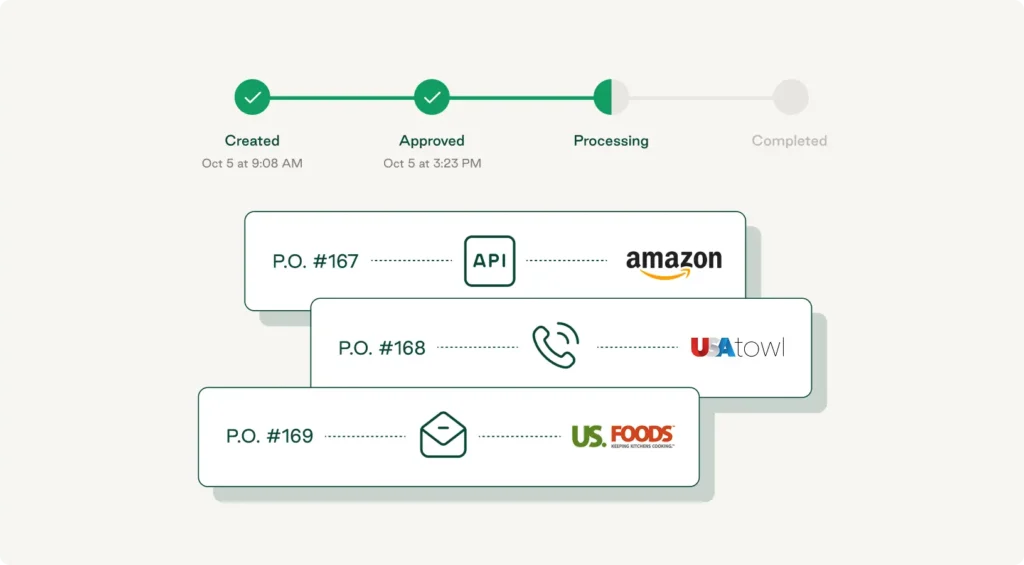
Procure-to-pay describes the full purchase-to-pay cycle, where a purchase requisition is submitted, routed through approval workflows, converted into a purchase order, matched against what's received and invoiced, and paid. It's slightly narrower than source-to-pay, which begins with sourcing and supplier selection before moving on to the remaining P2P steps.
P2P sits within the broader discipline of supply chain management, marking the point where a need turns into an order. Procurement teams historically ran this process by hand: paper purchase requisitions, email approval chains, purchase orders keyed into an ERP, invoices matched line by line. Automating it (sometimes called digital procurement) replaces these manual handoffs with automated workflows, but the process and what a procurement or accounts payable team is responsible for remains the same.
Why P2P matters
A manual P2P process doesn't just take longer. Handoffs, including an email approval here and a spreadsheet there, are places where spend visibility disappears and small errors compound into real costs.
P2P matters for a few concrete reasons:
- Spend visibility. When every requisition, purchase order, and invoice lives in one place, you can see what's being bought, from whom, and at what price instead of piecing it together after the fact. That visibility also doubles as security: AFP's 2025 Payments Fraud and Control Survey shows that 79% of organizations were targets of payment fraud in 2024, which makes replacing manual, low-visibility payment processes with P2P automation essential.
- Cash flow and cost reduction. Structured payment terms, on-time payment processing, and fewer duplicate payments protect cash flow while helping you capture early payment discounts.
- Better decision-making. Centralized purchase and vendor data provides you with the information necessary to negotiate better contracts, consolidate preferred suppliers, and build procurement strategies around real spend patterns.
- Procurement efficiency. Automated workflows free your team from manual data entry so they can spend time on supplier relationships and sourcing instead of chasing approvals.
Examples of procure-to-pay automation
Procure-to-pay automation turns theoretical efficiency gains into measurable results. Here's how automation changes each stage of the P2P cycle:
- Requisition management. Automated intake forms route purchase requisitions to the right approver instantly, replacing email chains and manual tracking.
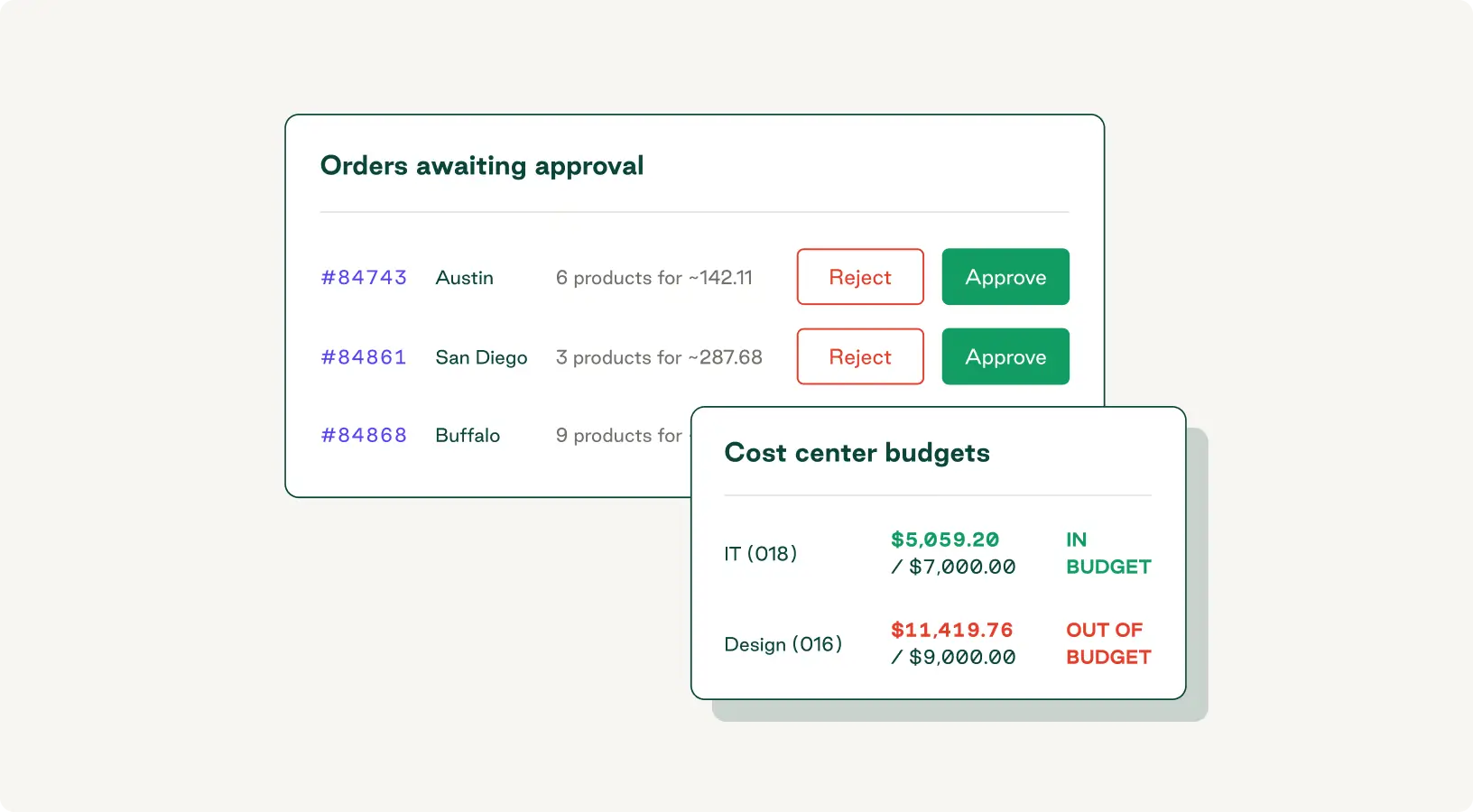
- Approval workflows. Rules-based automation enforces spending thresholds automatically. A $5,000 purchase can require CFO sign-off while smaller purchases process immediately.
- Purchase order generation. Once approved, systems auto-populate purchase order data from the requisition, eliminating re-keying errors and cutting PO creation time.
- Vendor communication. Automated PO transmission replaces phone calls and email attachments, and suppliers receive standardized POs through integrated portals.
- Invoice matching. P2P systems automatically scan incoming invoices and match them against purchase orders and receipts, flagging discrepancies for review instead of holding up the entire payment queue.
- Payment processing. Automated systems schedule payments, prioritize invoices, and time them to protect cash flow and capture early payment discounts.
- Spend analysis. Real-time dashboards surface spending patterns, vendor performance, and budget utilization without spreadsheet reconciliation.
The Procurement Strategy Playbook for Modern Businesses
Learn the key pillars of a strong strategy, valuable procurement metrics to track, and initiatives you can start implementing today.
7 steps for procure-to-pay automation
P2P automation software speeds up the purchasing process, reduces rogue spend, sharpens procurement strategies, and increases stakeholder satisfaction. Here's how to run your procure-to-pay cycle end to end:
Step 1: Identify needs
Guided requisitioning starts with smart intake forms. Intelligent catalogs suggest preapproved items, flag budget constraints, and recommend alternatives based on past purchases to build compliance in from the start.
Step 2: Submit purchase requisitions
Digital forms autofill requester information, cost centers, and delivery details. Template-based purchase requisitions speed up recurring purchases, capturing everything up front instead of triggering back-and-forth later.
Step 3: Accelerate approvals
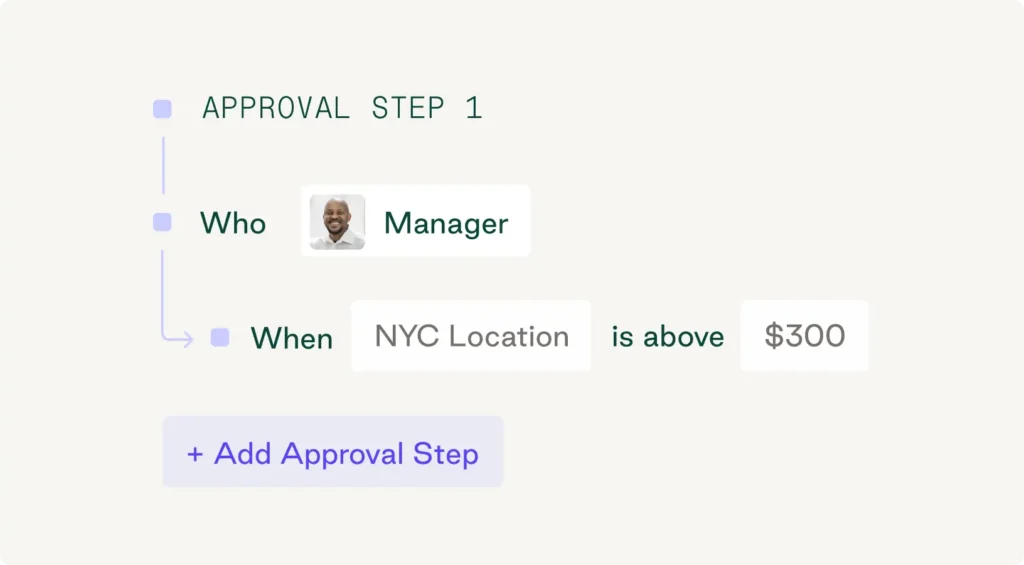
Rules-based approval workflows route requisitions to the right approver by amount, category, or department, without manual handoffs. Automated escalation keeps requests from sitting in an inbox, cutting approval cycle times from days to hours.
Step 4: Generate purchase orders
Once approved, purchase order automation converts requisitions into purchase orders without manual data entry, thereby reducing errors. The system validates supplier information and applies contract terms before transmitting the PO.
Step 5: Perform matching
Automation extracts line-item data from invoices and checks it against purchase orders and receipts, effectively performing the three-way matching process that's traditionally run as a separate manual step. It flags exceptions like price variances or missing documents for review while clearing clean matches for automatic invoice approval.
Step 6: Optimize payments
Automated payment processing prioritizes invoices and schedules payments to capture early payment discounts, improving cash flow while creating complete audit trails.
Step 7: Enable analytics
Every transaction feeds into centralized dashboards, which helps eliminate the need for manual spend analysis. Automated analytics surface spending trends and cost-saving opportunities and track KPIs in real time, freeing finance teams for strategic work instead of data compilation.
Best practices for automating your P2P process
Choosing P2P automation software is the easy part. It's how your team rolls it out that determines whether it sticks.
Standardize approval workflows
Approval workflow automation enforces consistency and removes variability. A well-documented process gives employees fast access to what they need, maintains budget oversight, and provides real-time spend visibility.
Integrate contract management into approvals
Building contract management into approvals reduces errors and keeps purchases compliant. Routing requests through legal, security, and finance, as well as the department lead, prevents bottlenecks and keeps procurement aligned with negotiated terms.
Leverage automation to scale
Since purchase volume typically rises faster than procurement headcount, manual procurement processes tend to break down with growth. Ardent Partners' AP benchmarking research shows that the average processing cost per invoice is $9.40, but best-in-class organizations have used automation to lower this to just $2.78. Automated procure-to-pay systems reduce AP costs without proportional headcount growth, freeing teams for strategic sourcing, supplier performance monitoring, and supplier relationship management as opposed to data entry.
The Procurement Strategy Playbook for Modern Businesses
Learn the key pillars of a strong strategy, valuable procurement metrics to track, and initiatives you can start implementing today.
"*" indicates required fields
How does procure-to-pay automation software work?
Modern procure-to-pay platforms create one automated workflow that covers every step, from requisition to payment. They integrate with your existing ERP systems and accounting software, connect procurement to accounts payable and the general ledger, and route approvals through configurable rules-based logic instead of forcing you to make decisions on a case-by-case basis.
AI-driven capabilities layer on top of that foundation. Sourcing algorithms surface better prices or backup vendors when preferred suppliers are out of stock. Anomaly detection catches unusual spend patterns, which can be a sign of duplicate invoices or a fraud attempt. Vendor recommendations surface better-priced alternatives at the moment of purchase, before the order is placed.
Some procure-to-pay software has even begun to introduce AI agents: automated systems that can execute routine purchases within preset guardrails rather than merely flagging them for manual approval.
P2P platforms
Buyers choosing a procure-to-pay solution, or P2P solution, are usually picking between a handful of categories, most of them covering only part of the P2P cycle:
- ERP modules. Enterprise systems like NetSuite, SAP, or Workday often bundle procurement alongside broader financials, inventory management, and HR. They're comprehensive, but P2P-specific workflows can feel like an afterthought inside a much larger system designed for other priorities.
- Dedicated procurement software. Built specifically around requisitions, approval workflows, sourcing, and vendor selection, these platforms are usually stronger on the front half of the P2P cycle than on payment and reconciliation.
- AP automation tools. These tools focus on the back half of the accounts payable process, which includes invoice capture, invoice processing, matching, and payment processing. They speed up accounts payable but often plug into a separate system for the requisition and approval side.
- E-procurement platforms. These platforms enable catalog-based buying from preferred suppliers, making them closer to an online marketplace experience for requestors, but often lighter on the payment and reconciliation end.
- End-to-end P2P platforms. Purpose-built platforms like Order.co and Coupa cover the full cycle, from requisition and approval through purchase orders, matching, and payment, in a single system. The tradeoff is fit: they vary in how much they flex to the way your team already buys, and in how much implementation effort they need.
Companies that don't use an end-to-end platform often end up stitching two or three of these tools together: an ERP for the general ledger, a procurement tool for requisitions, and a separate AP tool for payment. That creates the same manual handoffs P2P automation platforms are designed to eliminate.
What this looks like in practice
WeWork's P2P volume outgrew its manual process fast: roughly 3,000 invoices and 2,400 purchase orders a month across its locations. Before automating with Order.co, the finance team estimated it would need to hire 150 AP specialists just to keep up with invoice processing.
Instead, WeWork consolidated 110 vendors onto Order.co. "Being able to automate our thousands of invoices was a huge time and money saver—it makes our lives so much easier," says Kyle Ingerman, Finance Transformations Senior Manager.
How Order.co's P2P automation improves efficiency and savings
WeWork's numbers show P2P automation at enterprise scale. The same mechanics apply to any growing multi-location team.
The best P2P process is the one your team actually uses. When requesting, approving, and buying fits how people already work, they stop reaching for personal cards and side-channel emails, and the benefits above follow: spend visibility you can trust, payments that move on schedule, and vendor data that shows where your spend is actually going.
Order.co puts that into practice. Curated catalogs make the approved choice the easy one, approval workflows route requests to the right person, and POs go to each vendor in the format that works best for them. Payment is part of the same flow: Order.co pays your vendors via their preferred method, so your team isn't chasing individual vendor invoices, and every order carries line-item GL coding, so accuracy is built in before invoices arrive. AI sourcing finds better prices and alternatives for out-of-stock items, which frees you to focus on vendor relationships and strategy.
Ready to see your own procure-to-pay cycle running end to end instead of across three separate systems? Schedule a demo with Order.co.
FAQs about P2P
Look for centralized catalog management that enforces vendor agreements across every location, location-specific approval workflows that respect local budgets, and line-item GL coding that keeps every purchase accurate in your accounting system. You also want real-time spend visibility dashboards covering both individual sites and the full organization, so you can compare locations and catch problems early.
AI-driven procure-to-pay automation categorizes spend across departments and vendors, surfaces better-priced alternatives at the moment of purchase, and flags purchases that bypass preferred vendors. Anomaly detection catches spend that deviates from established patterns, like duplicate invoices, so you see problems as they happen instead of during a month-end review. The sourcing algorithm finds the best price or an alternative when a preferred item is out of stock.
Yes. Automated procure-to-pay workflows maintain complete audit trails for every transaction, enforce location-specific approval hierarchies and spending thresholds consistently, keep purchases aligned with documented procurement policies regardless of where they originate, and generate reports that demonstrate compliance with internal controls. Auditors get a clear record of who requested, approved, and paid for every purchase, without anyone rebuilding it from email threads.
Get started
Schedule a demo to see how Order.co can simplify buying for your business.
"*" indicates required fields