Order.co vs. Precoro: Which Fits How Your Team Buys?

Order.co vs. Precoro: Which Fits How Your Team Buys?
Precoro tends to show up early on procurement shortlists, and for good reason. It gives the buying process a clear workflow, with published pricing and a feature set that grows by tier. If it's already on your list or already running your purchasing, the useful question is how it compares to other top options, like Order.co.
Precoro is a procure-to-pay platform that structures requests, approvals, purchase orders, invoices, and payments, with AI agents across the process. Order.co is an AI-powered procurement and finance automation platform that goes a step further by completing the order. It checks out with the vendor, codes every line item, tracks the order, and pays the vendor.
Whether you're replacing Precoro or comparing platforms for the first time, the differences start after approval. They show up in who completes the order, how much cash flow room each purchase gets, and how quickly your team can get up and running.
Quick answer:
- Precoro brings structure to procure-to-pay. Requests, approvals, POs, receipts, and invoice matching all follow a consistent workflow, with more automation on higher tiers.
- The platforms split after approval. Both platforms route requests through multi-level approvals. After that, Precoro sends the PO, and your team handles checkout, delivery follow-up, and returns vendor by vendor. Order.co places the order and manages fulfillment through delivery, handling any order issues along the way.
- Payments and float work differently. Precoro captures and matches invoices, then pays vendors by ACH, wire, or card. Order.co bills weekly on Net 30, so each purchase gets 30 to 37 days to pay.
- Setup support differs. Precoro assigns a dedicated customer success manager to guide onboarding, with an optional paid concierge service that takes setup off your hands. Order.co's dedicated onboarding team sets up your vendors, catalogs, and accounting integrations, so core purchasing is typically running within 4 to 6 weeks.
- Order.co handles everything after approval, from checkout through delivery and payment. It places each order with the vendor, tags every line item to your GL, resolves returns and order issues, and pays your vendors while you pay on Net 30.
Evaluating Precoro? See how Order.co stacks up
Order.co vs. Precoro at a glance
Here's how the two platforms line up on the points procurement teams raise most often:
| Precoro | Order.co | |
| Purchasing model | Requests move through approvals and become POs sent to vendors | Buyers shop a curated catalog, approvers sign off, and Order.co carries the order through to payment |
| What happens after approval | The PO goes to the vendor; checkout, follow-up, and returns stay with your team | Order.co places the order, manages fulfillment, and resolves any order issues |
| Vendor access | Catalogs, plus PunchOut on Automation and above | Orders placed with any vendor, including vendor portals and e-commerce sites |
| Invoice handling | Invoices captured and matched to POs and receipts (2- and 3-way match) | Every line item coded at purchase, and bills generated from the order itself, so there's no separate matching step |
| Payments and float | Invoice payments by ACH, same-day ACH, or wire, plus prepaid virtual cards | Weekly billing on Net 30 (with the option to extend net terms), giving each purchase 30 to 37 days |
| AI capabilities | AI Crews on Automation and above, including document processing, invoice matching, and an AI assistant | Sourcing algorithm, AI fulfillment and tracking, and AI that flags order issues |
| Implementation | Core plan described as quick to implement | Dedicated onboarding team, with core purchasing running within 4 to 6 weeks |
| Pricing model | Published starting prices by tier, plus custom Enterprise | Custom; current pricing shared during a demo |
| Accounting integrations | QuickBooks Online and Xero on Core, with a wider range on Automation and above; API available for custom integrations | QuickBooks Online, NetSuite, Sage Intacct, Workday, and custom data integrations |
Where Precoro fits
Precoro is a procure-to-pay platform built in tiers. Its Core plan covers the basics of the procurement process, and its Automation and Enterprise plans add AP automation, supplier collaboration, and AI. That structure is a big reason Precoro is the benchmark many teams use when they weigh Precoro alternatives.
Precoro's core capabilities include:
- Requests, approvals, and purchase order management. Purchase requests route through automated, multi-level approvals and become POs with custom fields and workflows.
- Receipts and matching. Receipts are logged against POs, and invoices go through 2- and 3-way matching before payment.
- Budgets and vendor management. A vendor database and contract repository support spend management, with real-time budget tracking on Automation.
- Invoices and payments. Invoices are paid by ACH, same-day ACH, or wire, and prepaid virtual cards cover card spend.
- PunchOut and RFPs. The Automation tier adds PunchOut catalogs with vendors like Amazon Business, Staples, and Grainger, plus RFPs and a supplier portal.
- AI Crews. On Automation and above, AI Crews handle document processing, invoice matching, and spend questions, with more agents listed as coming soon.
Best for: Procurement and finance teams that want a structured, tiered P2P platform for purchasing and supplier management with published starting prices.
Considerations: After approval, checkout, delivery follow-up, and returns still fall to your team, vendor by vendor. PunchOut, RFPs, and AI agents require the Automation tier or above.
Where Order.co fits
Order.co is an AI-powered procurement and finance automation platform built for multi-location businesses simplifying purchasing as they grow. Buyers purchase from a curated catalog of pre-approved products and vendors, and Order.co completes the order, including with vendors that only take orders by email or phone, as well as on vendor portals and e-commerce sites. It then manages fulfillment through delivery, including returns and order issues.

Order.co's core capabilities include:
- Curated item catalogs. Control starts at the catalog level since buyers see only the products and vendors you've approved.
- Customizable approvals. Multi-level and mobile approval workflows can be based on order size, vendor, product category, user, location, cost center, and more, and budgets are checked before an order is approved.
- Automated ordering and fulfillment. Order.co places each order with the vendor, manages fulfillment, and keeps tracking in one place.
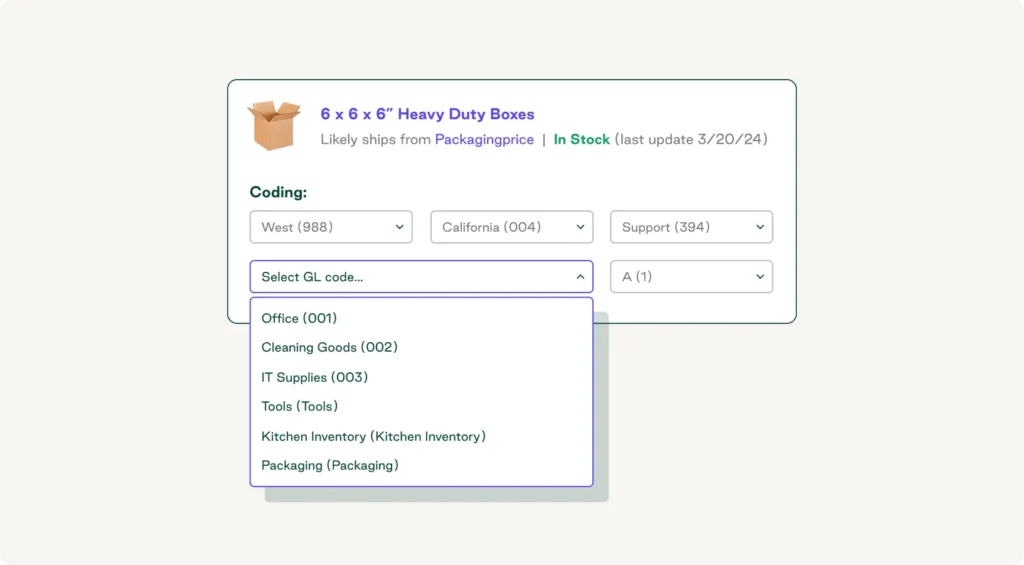
- Line-item GL tagging. Every line item gets the correct GL account, cost center, and entity at the moment of purchase.
- Vendor-agnostic catalog. Since Order.co is a vendor-agnostic procurement platform, its catalogs draw from the vendors you already use and a 40,000+ vendor network.
- AI sourcing. The sourcing algorithm finds the best price or options for out-of-stock goods, delivering an average of 5% in hard-dollar savings.
Best for: Multi-location businesses simplifying purchasing as they grow, whose buyers order from many different vendors.
Considerations: Order.co is built for indirect purchasing rather than formal RFQ-driven direct sourcing. Pricing isn't publicly listed, so expect a conversation with sales before you see numbers.
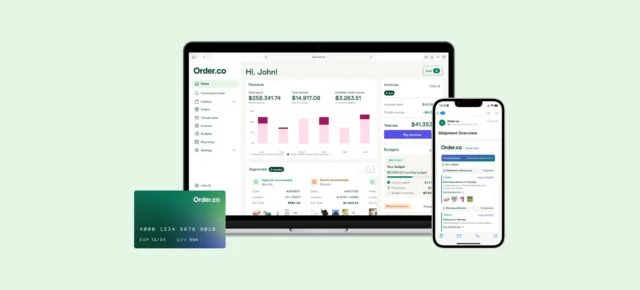
See how Order.co handles ordering for you
Precoro routes purchase requests for approval. Order.co also places the order with any vendor, tracks delivery, and codes every line item.
What happens after approval
Approval speed gets most of the attention in procurement software, and that focus pays off. The Hackett Group found that top-performing procurement teams run 58% shorter purchase requisition-to-PO cycle times than their peers. Yet a faster PO only solves half the problem. Someone still has to place the order, track delivery, and handle payment.
Precoro handles the approval and sends the PO, but placing manual web orders, tracking shipments, and managing returns still fall to your team. In Order.co, those steps run inside the platform, which is the core of an automated purchasing system.
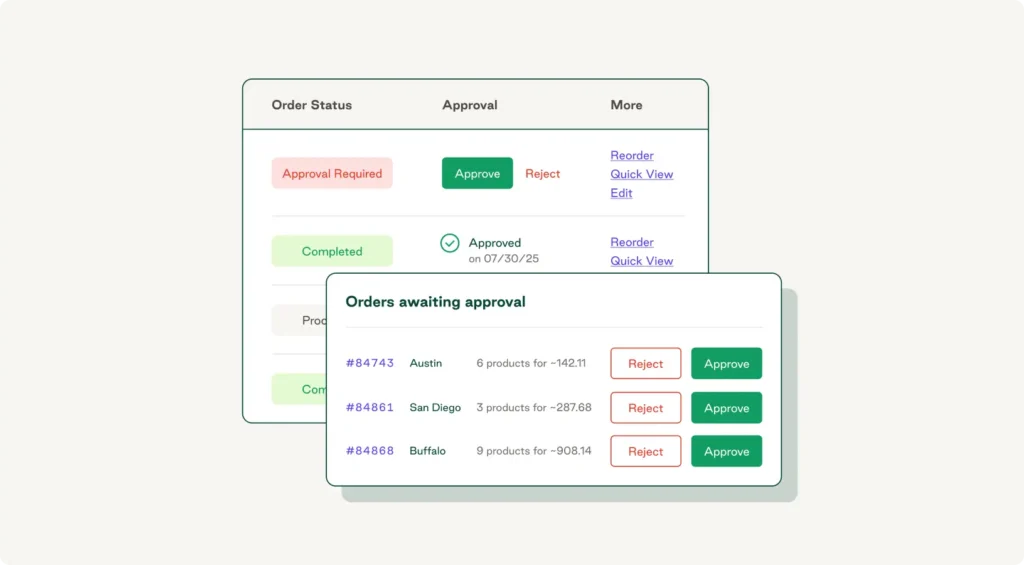
Here's the same request moving through both platforms, with a location manager needing paper towels from one vendor and cleaning supplies from another:
| Step | Precoro | Order.co |
| 1. Request | The manager submits a purchase request or builds a cart through PunchOut (on eligible tiers) | The manager adds both items from your curated catalog |
| 2. Approval | The request routes through your approval chain | The order routes through approval workflows you set by order size, vendor, location, cost center, and more |
| 3. PO and checkout | Precoro creates a PO for each vendor and sends it; your team confirms or checks out where a vendor needs it | Order.co sends each vendor a standard, consistent PO and completes checkout, online or offline |
| 4. Delivery | Your team follows up with each vendor and logs receipts | Order.co tracks both orders in one view and surfaces delivery changes |
| 5. Issues | Your team works with each vendor on returns or missing items | Order.co's support team manages the resolution with the vendor |
| 6. Coding and billing | Invoices arrive and get matched to the PO and receipt | Every line item is already coded and lands on your weekly bill |
Recurring orders show the difference most clearly. EPIC4, which runs 55 orthodontic and pediatric dental locations, uses scheduled lists so several practices reorder gloves and brackets every month without anyone stepping in. "Set it and forget it. Don't have to touch it again," says Sam Jenio, Director of Procurement & Business Development.
AP, payments, and float
Float is the time between buying something and the cash leaving your account. Order.co bills weekly on Net 30 (with the option to extend net terms), so each purchase gets 30 to 37 days before payment, and spend goes out in smaller weekly amounts that are easier to forecast. Ardent Partners points out that the rising cost of capital has put new weight on how and when suppliers get paid, which makes those extra days worth more.
Invoice processing works differently, too. Precoro captures invoices and matches them against POs and receipts, which keeps payments accurate after the invoice arrives. In Order.co, every line item is coded to your GL at the moment of purchase. Your bill is also generated from the order itself, so accuracy is built in earlier and there's no separate matching step for your accounts payable software to run.
Order.co pays your vendors via their preferred method, Net 1, and consolidates payments into customized bills that fit your bookkeeping. For services and subscriptions, vendor-locked virtual cards come with approvals and AI receipt matching.
For EPIC4, that payment timing changed how the team manages cash. "The ability to pay the suppliers immediately and then for us to be able to pay weekly in batch with net terms is huge for us for cash flow," Jenio said.
Feature comparison
Here's a side-by-side on the points that most affect day-to-day purchasing, sourced from each platform's own site:
| Feature | Precoro | Order.co |
| Requests and approvals | Purchase requests with automated, multi-level approvals and custom workflows | Catalog-based requests with customizable multi-level and mobile approvals based on order size, vendor, product category, user, location, cost center, and more, plus AI that flags orders needing attention |
| PO creation vs. checkout with the vendor | Creates POs and sends them to vendors | Generates POs in a standard, consistent format and completes checkout with the vendor |
| Delivery tracking and returns | Receipts logged against POs; returns handled with each vendor | All orders tracked in one place, with Order.co's support team resolving returns and order issues |
| Vendor access | Catalogs, plus PunchOut on Automation and above | Orders placed with any vendor, including those that only take orders by email or phone, plus vendor portals and e-commerce sites |
| Invoice handling | 2- and 3-way matching, with AI document processing on Automation | Every line item coded at purchase, and bills generated from the order itself, so there's no separate matching step |
| Vendor payments | ACH, same-day ACH, and wire, plus prepaid virtual cards | Vendors paid via their preferred method, with weekly billing on Net 30 (with the option to extend net terms) |
| AI capabilities | AI Crews on Automation and above for document processing, matching, and spend questions | Sourcing algorithm, AI fulfillment, AI tracking, and AI issue detection |
| Implementation support | Core plan described as quick to implement | Dedicated onboarding team that brings in your vendors and sets up catalogs and integrations |
On pricing, Precoro publishes starting prices, with Core at $499 per month and Automation at $999 per month, both billed annually, plus custom Enterprise pricing. Order.co shares current pricing through a demo.
See how Order.co handles ordering for you
Precoro routes purchase requests for approval. Order.co also places the order with any vendor, tracks delivery, and codes every line item.
Getting started with Order.co, whether you're replacing Precoro or buying your first platform
If you're moving off Precoro, most of what you've built carries over. Your vendor relationships and negotiated pricing stay in place, and your approval logic moves into Order.co as catalog rules and approval workflows. What changes is where orders get completed. Instead of a PO going out for your team to follow up on, the order is placed and tracked inside Order.co.
If this is your first procurement management platform, the setup looks much the same. Order.co's dedicated onboarding team handles the documents and forms to bring your existing vendors in, then sets up your catalogs and accounting integrations. Core purchasing is typically up and running within 4 to 6 weeks, at the faster end of a typical P2P implementation timeline for mid-market teams.
Before go-live, map these three things:
- Current approval chains. Note who approves what today and at which thresholds, so the same logic carries into your workflows.
- Vendor list. Pull the vendors your locations buy from to seed your curated catalog.
- GL coding rules. Document how you code each spend category so line items arrive the way your team already closes the books.
Which one fits your team
Choose based on how much of the purchase you want the platform to carry out after approval. Precoro gives you a structured path from request to PO to matched invoice. Order.co completes the order with the vendor and manages it through delivery, gives every purchase 30 to 37 days of float, and gets your team ordering within weeks.
Want to see what happens to your orders after approval when nobody has to chase them? Schedule a demo.
FAQs about Order.co vs. Precoro
Core purchasing on Order.co is typically up and running within 4 to 6 weeks. A dedicated onboarding team brings your existing vendors into the platform, handles their documents and forms, sets up your catalogs and accounting integrations, and ensures your approval logic carries over as catalog rules and approval workflows. Your exact timeline will depend on how many locations you're onboarding, the size of your vendor catalog, and how many approval steps you need.
Yes. Order.co is vendor-agnostic, so you can bring your existing vendors into the platform or choose from its network of more than 40,000 vendors. A dedicated onboarding team handles the documents and forms to set up your vendors, and your negotiated pricing stays in place. Order.co then places orders with those vendors directly, including vendors that only take orders by email or phone, as well as through vendor portals and e-commerce sites.
Order.co does. When something goes wrong with an order, Order.co's dedicated support team manages the resolution with the vendor on your behalf. Every order is tracked in one place, and AI flags order issues and delivery changes as they come up. Your team doesn't have to contact each vendor separately or track down who shipped what across locations.
Get started
Schedule a demo to see how Order.co can simplify buying for your business.
"*" indicates required fields