Procurement Agents: What They Do and How to Evaluate Them

Procurement Agents: What They Do and How to Evaluate Them
Every procurement platform on your shortlist now talks about AI agents. Some of those agents place orders. Others summarize data and hand the work back to you. In a demo, the two might look almost identical.
Gartner estimates that only about 130 of the thousands of vendors marketing agentic AI offer real agentic capabilities. It says the rest are “agent washing,” or rebranding products that already exist.
Meanwhile, the work an agent is supposed to absorb keeps landing on your team. Buyers keep five vendor tabs open to check whether the price of paper towels moved this month. Your procurement lead re-runs the same alternatives review every quarter, exporting order history into a spreadsheet to see whether a cheaper or faster vendor exists for the items your locations buy most.
The Hackett Group projected procurement workloads would rise 10% in 2025 while budgets grew just 1%, creating a 9% efficiency gap that new headcount alone won't close.
The procurement agents worth investing in fit how your team already purchases, speed up the sourcing tasks that repeat every week, sharpen decisions with your own order history, and turn what they find into savings.
Order.co AI makes a useful test case because its agents run inside the platform where your team places its orders.
Quick answer:
- Procurement agents are AI software that plan and carry out multi-step procurement tasks, like evaluating vendors, analyzing sourcing options, and screening requests, with people approving key decisions.
- Rules-based automation follows fixed if-then logic, and AI assistants answer questions when asked. Agents work toward a goal across several steps and produce work you can act on.
- Where an agent lives determines what it can do. An agent inside your purchasing platform can reach the purchase itself, while one on an intake or orchestration layer usually hands execution to another system.
- Before you buy, test whether the agent acts or only makes recommendations, what data it learns from, where humans stay in control, whether it fits how your team buys, and how you'll measure its impact.
- Order.co AI works at each step of buying, from building your catalog and sourcing better-priced vendors to approvals, placing orders, tracking deliveries, and processing payments. Command Center (beta) sits on top, so your team can ask Order.co AI to evaluate vendor alternatives or analyze order history and act on the results in the same platform where you buy, approve, and pay.
Evaluating your options? Take a self-guided tour of Order.co
What counts as a procurement agent?
A procurement agent is AI software that plans and executes multi-step procurement tasks, such as supplier evaluation, sourcing analysis, and request screening, within your policies and with human approval on key decisions.
The same term also describes a human job title: the person who buys goods and services on an organization's behalf. Here, it means the software.
Plenty of procurement automation tools already handle parts of the workflow, so the useful question in any demo is which kind of tool you're looking at. This comparison is the first test you can apply.
| Rules-based automation | AI assistant | Procurement agent | |
| What it does | Runs a fixed step when a condition is met | Answers questions and summarizes data when asked | Works toward a goal across several steps |
| How it decides | If-then rules someone configured in advance | Responds to each prompt, and you decide what happens next | Plans the steps using your data and policies, and asks for approval at key decisions |
| What it produces | A routed approval, a reminder, or a status update | An answer, a summary, or a draft | Work you can act on, like a vendor comparison or a ready-to-order list |
| Example task | Send any order over $5,000 to a finance approver | Summarize last quarter's janitorial spend | Find lower-cost alternatives for top recurring items and build the order |
If a vendor's "agent" only does what the middle column describes, you're looking at an assistant with a new label.
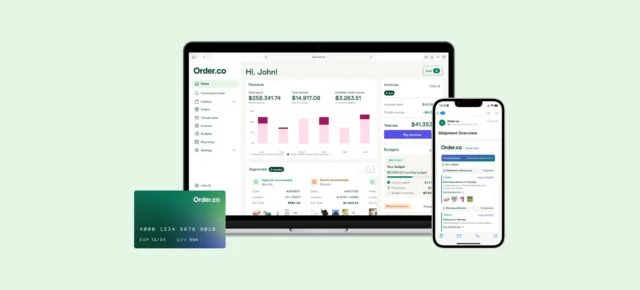
See how Order.co stacks up
Tour the product yourself now — no demo request, no waiting.
How procurement agents work in Order.co
Order.co AI learns from every purchase your team makes and works at each step of buying, from building your catalog to paying the vendor. Because every step runs on the same platform, a better-priced option found during sourcing moves through approval, ordering, tracking, and payment without anyone re-entering it.
Catalog management
Buyers start in a custom catalog that Order.co AI builds from your purchasing history, so the products your locations already order are the first ones they see. Because the catalog only shows approved products and vendors, the compliant choice is also the easiest one, and your team stops rebuilding product lists in spreadsheets.
Sourcing
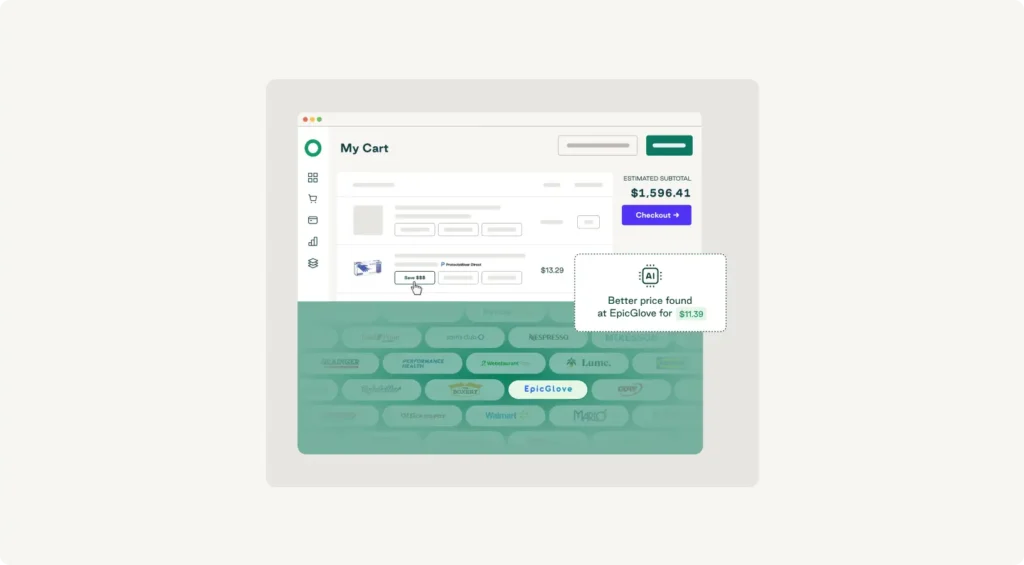
Say your locations reorder the same cleaning supplies every two weeks from a vendor someone picked three years ago. AI sourcing compares that recurring purchase against alternative vendors, weighing price alongside delivery speed, availability, and reliability. When another vendor offers the same or a comparable product for less, or keeps it in stock more reliably, Order.co AI surfaces the option. It also recommends alternatives when an item is out of stock or at risk of delay, so a backorder doesn’t stall a location.
That turns a quarterly vendor analysis project into a standing check. Businesses using AI sourcing save an average of 5% on products, and your buyers stop re-checking prices across five vendor tabs.
Approvals
Order.co AI guides which orders get approved and which need additional attention, so budget holders spend their time on the exceptions. Approval workflows are customizable by order size, vendor, product category, user, location, cost center, and more.
Fulfillment
Once an order is approved, Order.co generates the PO in a standard, consistent format and places the order with any of your vendors, including those that only take orders by email or phone. For vendor portals and e-commerce sites, Order.co AI logs in and places the order for you. From there, Order.co manages fulfillment through delivery.
Tracking and issue resolution
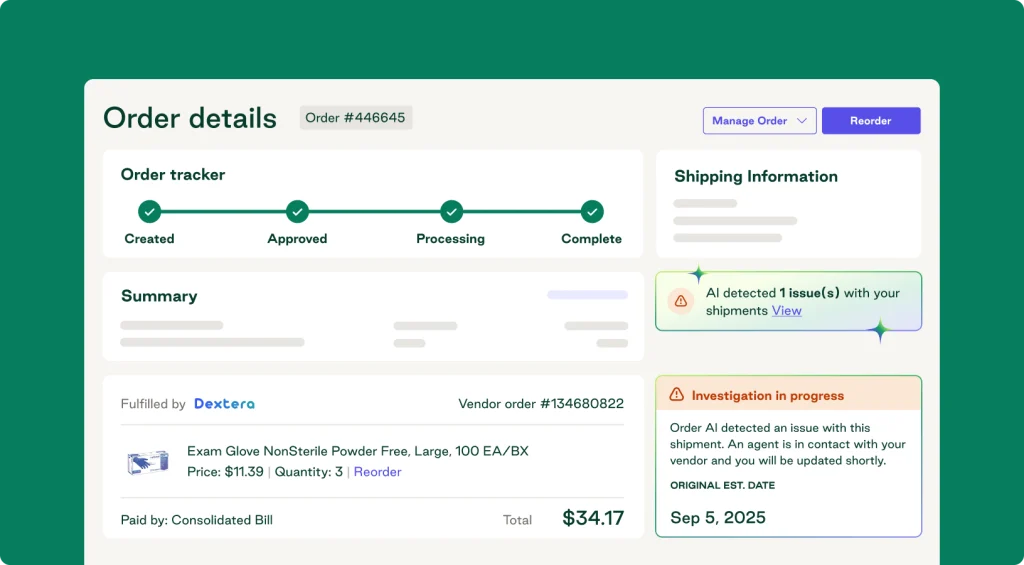
Order.co AI scans vendor updates and surfaces what matters, like tracking information and delivery changes, so no one has to dig through vendor emails for shipping updates. When an order runs into a problem, Order.co AI detects the issue and resolves it before you notice.
Payments
Order.co AI delivers line-item reconciliation and processes vendor payments. Order.co pays each vendor via its preferred method and rolls payments into customized bills that fit your bookkeeping, with every line item coded at the point of purchase.
Directing Order.co AI from Command Center
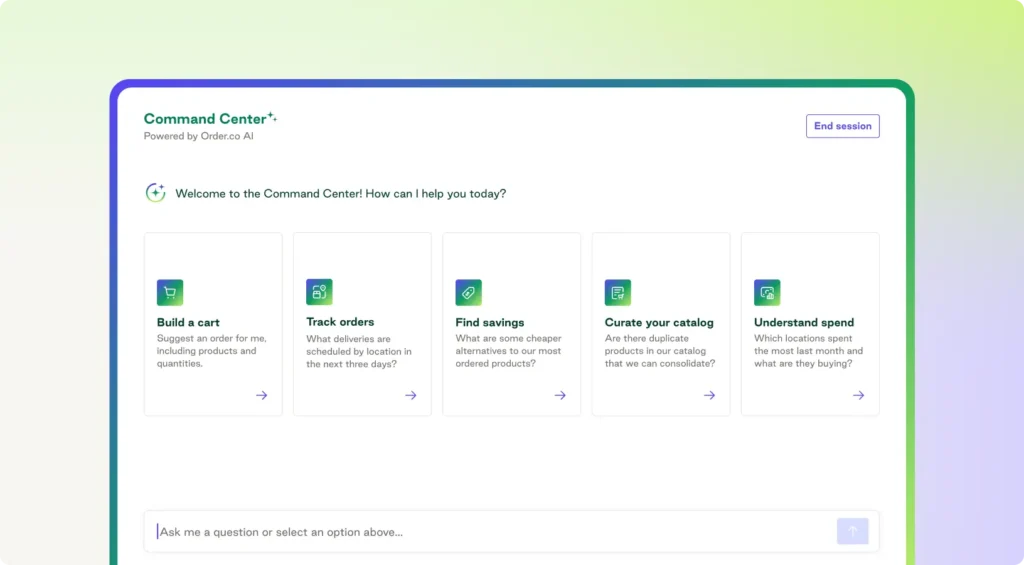
Command Center (beta) sits on top of Order.co AI as the place where your team asks questions and directs work in plain language. It’s built for the sourcing questions that don’t come up at checkout. Ask it to evaluate vendor alternatives for your top recurring items or analyze order history across locations, and it surfaces patterns like prices that have crept up since your last review, or the same product bought from different vendors at different prices. Those findings show your procurement lead where a renegotiation or strategic sourcing review will pay off, without the data export and blank pivot table.
Requests can go beyond cost, too. A team with a sustainability goal can ask Command Center to find greener versions of products it already buys at the same or lower price, and get back a ready-to-order list. Teams also use it to build carts, clean up duplicate or stale catalog items, and pull spend reports.
Where procurement agents live, and why it changes what they can do
An agent can only act on what its platform touches, so where it runs decides whether it can reach the purchase. Most procurement agents fall into one of three categories:
- Agents inside source-to-pay suites. Large suites are adding agents across sourcing, contracting, and invoicing. They work best when your organization already runs that suite, since the agent relies on the suite's data and modules to act.
- Agents on intake and orchestration layers. These agents route requests, screen them against policy, and move approvals along. The purchase itself often happens in another system, so the agent's job typically ends once the request is approved.
- Agents inside the purchasing system. These agents sit where orders are placed so they can reach the point of purchase and act on it. Order.co is in this category.
Your current stack is the best guide. If you've standardized on a suite, its native agents have the most data to work with. If you already have a purchasing system your buyers like and mainly need cleaner intake, an orchestration layer may cover it.
If your team's buying is spread across vendor websites, personal cards, and email threads, an agent that lives where purchases happen will change more of your day-to-day work.
See how Order.co stacks up
Tour the product yourself now — no demo request, no waiting.
What to look for in procurement agents
Every demo shows an agent doing something impressive. These five questions show whether it will be useful to your team.
Does the agent act, or only recommend?
An agent that only recommends still leaves your team to copy its output into a cart, an approval request, and a PO. Look for agents that carry a recommendation through to the order with your approvals in between.
In Order.co, when a buyer picks a better-priced alternative, the order moves through your approval workflow, and Order.co places it and manages fulfillment through delivery on the same platform.
In any demo, ask, "Can you show me an agent recommendation becoming a placed order without anyone re-entering it?"
What business data does it learn from?
Generic models don't know your locations, your reorder cadence, or which vendors deliver on time to your sites. Agents grounded in your own order history and vendor data make recommendations that match how your team buys.
Check the vendor side too. An agent limited to one marketplace can only recommend what that marketplace sells. Order.co works with any vendor, including the ones you already use, plus a 40,000+ vendor network for alternatives.
In any demo, ask, "Which of our own data does the agent use, and can it recommend vendors outside your network?"
Where do humans stay in control?
Good agents take work off your plate and leave the decisions that matter with your team. Look for human approval on key decisions, approval rules the agent can't bypass, and settings that govern how much the AI does on its own.
In Order.co, admins decide how much AI acts on their behalf and how much it powers specific workflows, so you can set the level that fits each part of your process.
In any demo, ask, "Which actions can the agent take without approval, and who sets that limit?"
Does it fit how your team already buys?
An agent only sees purchases that run through its system. When buying through the system takes longer than buying around it, people look for alternatives, with a personal card for one order and a vendor's website for the next.
Look for agents built into a platform your buyers would rather use than their workarounds, with curated catalogs that make the approved option the easiest one to pick.
In any demo, ask, "How do buyers at our locations place an order, and how many steps does it take?"
How will you measure its impact?
Set your baseline before a pilot starts. Useful measures include:
- Hard-dollar savings on items where the agent recommended a switch
- Hours your team spends on recurring sourcing and vendor reviews
- Time from recommendation to placed order
- Share of agent recommendations your team acts on
- Share of spend going through approved catalogs and vendors
In any demo, ask, "What results have customers like us seen, and how did you measure them?"
Agents earn their place by acting inside the purchase
A procurement agent's value depends on how far it can reach. The ones worth buying:
- Fit the way your team already buys
- Speed up the sourcing work your buyers repeat
- Sharpen decisions with your own order history and vendor data
- Turn what they find into hard-dollar savings, because they reach the point where buying decisions happen
Order.co builds its agents into the same platform your team uses to buy, approve, and pay, so a recommendation becomes an order without changing hands.
That reach shows up in results. For example, AvantStay saved $190K on products with Order.co AI sourcing. "Sourcing replacements and substitutions saves the company time and money," says Jack Langenhorst, Senior Manager of Onboarding & Supply Chain at AvantStay.
Request a demo to see Order.co AI take a recurring order from sourcing through approval, placement, and payment, with your team signing off where it matters.
FAQs about procurement agents
Procurement agents take on the repetitive parts of the job, such as re-checking vendor prices, rebuilding the same sourcing analysis each quarter, and assembling recurring orders. That frees your team for work that needs judgment, like negotiating with key vendors and setting purchasing policies. Humans still approve key decisions. The Hackett Group found that 64% of procurement leaders expect AI to transform their roles within five years, which points to roles that change shape as agents absorb routine tasks.
It depends on the platform. Some agents can only recommend vendors from a single marketplace or a network the platform controls, so the comparison never includes the vendors you already trust. Order.co works with any vendor, so its procurement agents can weigh your current vendors against alternatives from a 40,000+ vendor network. Your team keeps the relationships that already work and switches only where a better option shows up.
Most procurement agents focus on indirect spend: the recurring operating purchases like cleaning supplies, packaging, office supplies, and MRO items. Those categories have high order volume and repeatable patterns, which is where agents add the most value. Order.co focuses on indirect procurement and supports all types of spend. Manufacturers sourcing production materials through formal RFQ processes often pair their purchasing platform with a dedicated strategic sourcing tool for those inputs.