Autonomous Procurement: How It Works and Where to Start

Autonomous Procurement: How It Works and Where to Start
"Autonomous" now shows up in nearly every procurement pitch. Yet most AI tools still hand the work back to you. They find information, summarize it, and recommend a next step, but you still have to log in somewhere and act on it. Gartner describes the practice of marketing existing assistants and chatbots as agents without substantial agentic capabilities as “agent washing.” It estimates "only about 130 of the thousands of agentic AI vendors are real."
The gap matters most in indirect purchasing. Cleaning supplies, packaging, and breakroom goods get ordered across every location, every week, which makes it exactly the kind of high-volume, repetitive work an AI that takes action should own.
When autonomous procurement works, it gives your team back the hours spent on repetitive buying, finds savings nobody has time to chase, and keeps every purchase coded and visible as it happens. It also depends on something less flashy: purchasing that runs through one system your buyers actually use.
Quick answer:
- Autonomous procurement is an operating model. AI agents carry out defined procurement jobs within your policies and escalate to a person only when human judgment is needed.
- It goes a step past automation. Automation follows fixed rules you set, while autonomous agents interpret inputs, choose among options, and move the work forward.
- It needs a place to act. Agents can only work on purchases that run through one system, with clean catalogs, clear approval rules, and connected vendors.
- You can start small. Most teams begin by letting AI recommend, then handing agents low-risk, repeatable jobs like reordering and delivery tracking.
- Order.co AI works inside the same platform where your team buys. Its agents handle catalog management, sourcing, approvals, fulfillment, tracking, and payments, and the Command Center lets your team ask questions and direct that work in plain language.
See purchasing automation in action — take the 2-minute Order.co product tour
What is autonomous procurement?
Autonomous procurement is an operating model where AI agents carry out defined procurement jobs, like sourcing, reordering, placing orders, or reconciling spend, within the policies you set. It’s also sometimes called agentic procurement. It's where AI in procurement moves from analysis to action, with agents escalating to your team when a situation falls outside your policies.
Autonomy doesn’t mean agents act without limits. An agent reordering paper towels for 30 locations is only useful if it buys from approved vendors, stays inside each budget, and flags anything unusual.
The shift is coming from both sides of the transaction. Gartner predicts that by 2028, 90% of B2B buying will be AI agent-intermediated, so the systems your team buys through will increasingly be talking to other machines.ment teams generate 2.6 times greater return on investment (ROI) compared to their peers while operating at 19% lower cost as a percentage of spend. They also invest 1.8 times more on procurement technology, freeing their analysts to focus on higher-value work rather than manual data collection.
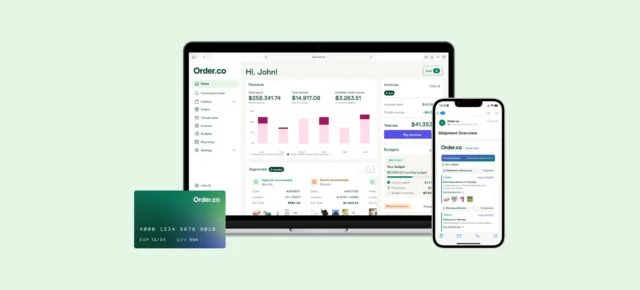
Less manual work. More control over every purchase.
See how Order.co brings purchasing, approvals, and payments together—so your team can automate routine work while keeping spending rules in place.
Autonomous procurement vs. automated procurement
Procurement automation follows fixed rules. If an order is under $500, approve it. If an invoice matches the PO, pay it. It's fast and reliable until something falls outside the script, and then a person has to step in.
Autonomous procurement handles the judgment calls. An agent reads the situation, weighs the options, and moves the work forward. Here's how the two compare:
| Automated procurement | Autonomous procurement | |
| How it works | Follows rules you define in advance | Interprets inputs and chooses among options within your policies |
| When something changes | Stops and waits for a person | Adapts, or escalates with context when judgment is needed |
| Out-of-stock item | Order fails or sits in a queue | Agent finds an in-stock alternative at a comparable price |
| Typical jobs | Approval routing, purchase order generation, invoice matching | Autonomous sourcing, cart building, order placement, delivery follow-up |
| Your team's role | Handles every exception | Sets policy and reviews escalations |
Gartner recommends using AI agents when decisions are needed and automation for routine workflows, so you’ll likely need both.
How autonomous procurement works
Autonomous procurement rests on three foundations: one system where buying happens, agents with clearly defined jobs, and guardrails that tell them when to hand a decision back to your team.
A single place where buying happens
Agents can only act on what runs through the system. If half your locations order on vendor websites, by phone, or with personal cards, those purchases bypass the agent's spend visibility entirely. An automated purchasing system that handles ordering, tracking, and payment in one place gives agents the full picture of what your team buys.
Agents assigned to defined jobs
Autonomy works best when each agent has a clear job with a clear finish line. One agent builds a weekly cart for a location. Another finds a cheaper or in-stock alternative. Another reports on spend trends. Narrow jobs are easier to measure, trust, and expand.
Guardrails and human escalation
Approved vendors, budgets, approval thresholds, and brand standards tell the agent what it can do alone and what needs a person. Escalations should arrive with context, so the reviewer sees why something was flagged and decides quickly.
Fitness Formula Clubs experienced the value of these guardrails across its 11 locations when AI flagged an order for a product the company hadn't approved. "[The AI] helped us stop the issue before it created an avalanche effect," said Lucky Weeras, Procurement Manager.
What autonomous procurement looks like in day-to-day purchasing
Most coverage of autonomous procurement uses direct-materials or freight examples. For multi-location teams, the bigger opportunity is indirect purchasing, where the same supplies get ordered over and over.
Keeping catalogs current
Catalogs drift as products get discontinued and duplicates pile up. An agent can build a catalog from your purchasing history, remove duplicates and stale items, and keep each location's approved list clean.
Sourcing the best price and in-stock alternatives
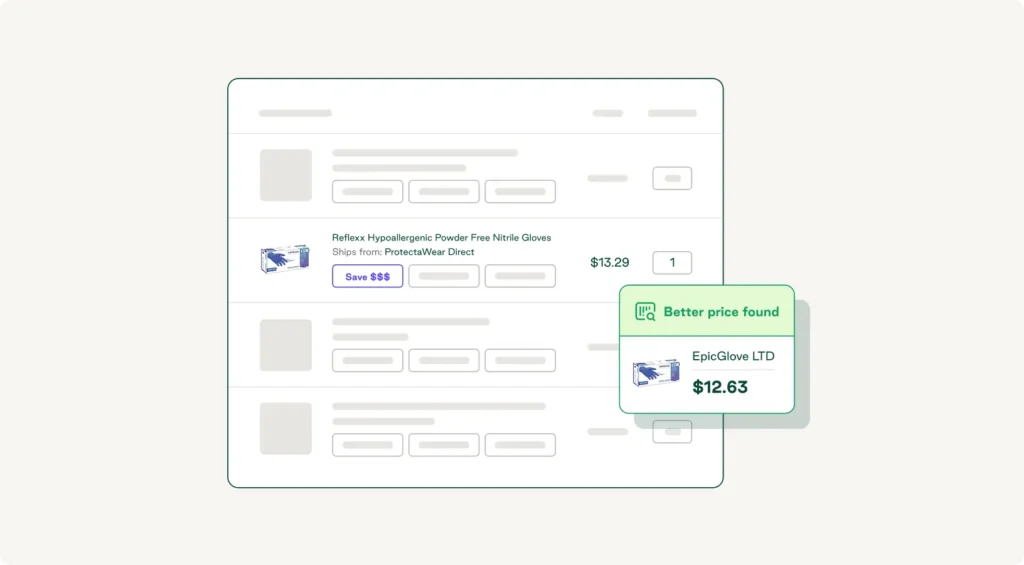
When the usual vendor runs out of nitrile gloves or raises the price on trash bags, someone has to find a substitute. AI for sourcing handles that search, comparing price, availability, and delivery speed across vendors before the shortage reaches the location.
Building carts and reordering supplies
Most locations order the same things on a predictable rhythm. An agent can use a location's order history to prepare the week's cart, so the shelves still get stocked when the person who usually orders is out. Your team just reviews and approves it.
Placing orders and tracking deliveries
Here's where many artificial intelligence tools stop. Placing the order means checking out on vendor portals or e-commerce sites, then watching shipping updates across carriers, and an agent that does both closes the loop.
To keep sight of purchasing across all 16 of its childcare locations, First Learning uses Order.co AI tracking to follow every order in one place. "It's so easy to track every order in a consolidated space and see at which stage each order is in the fulfillment process," said Molly Colbey, Accounting Specialist.
Coding and reconciling every line item
When every purchase happens inside one system, coding can happen at the moment of purchase. Each line item gets the right GL account, cost center, and entity before the order goes out, which moves procurement control ahead of the invoice and leaves far less for finance to reconcile at month-end.
Where Order.co fits
Order.co is an AI-powered procurement and finance automation platform built to act, not just advise. Purchasing happens inside the platform, so Order.co AI works on real orders from real locations. Its agents cover the full purchasing cycle:
- Catalog management. AI builds catalogs tailored to your business from your purchasing history, then enriches and maintains them automatically.
- Sourcing. AI identifies the best supplier based on price, availability, delivery speed, and reliability, and recommends alternatives before a shortage causes delays.
- Approvals. AI learns from past purchases to guide what gets approved and what gets flagged as an exception.
- Fulfillment. AI logs into vendor portals or checks out on e-commerce sites to place orders for you.
- Tracking. AI scans vendor updates and flags what matters most, like delivery status, delays, and changes.
- Payments. AI delivers line-level reconciliation and processes payments.
The Command Center sits on top of these agents as one place to ask questions and direct work, whether that's building a cart, checking a delivery, finding savings, or pulling a spend report.
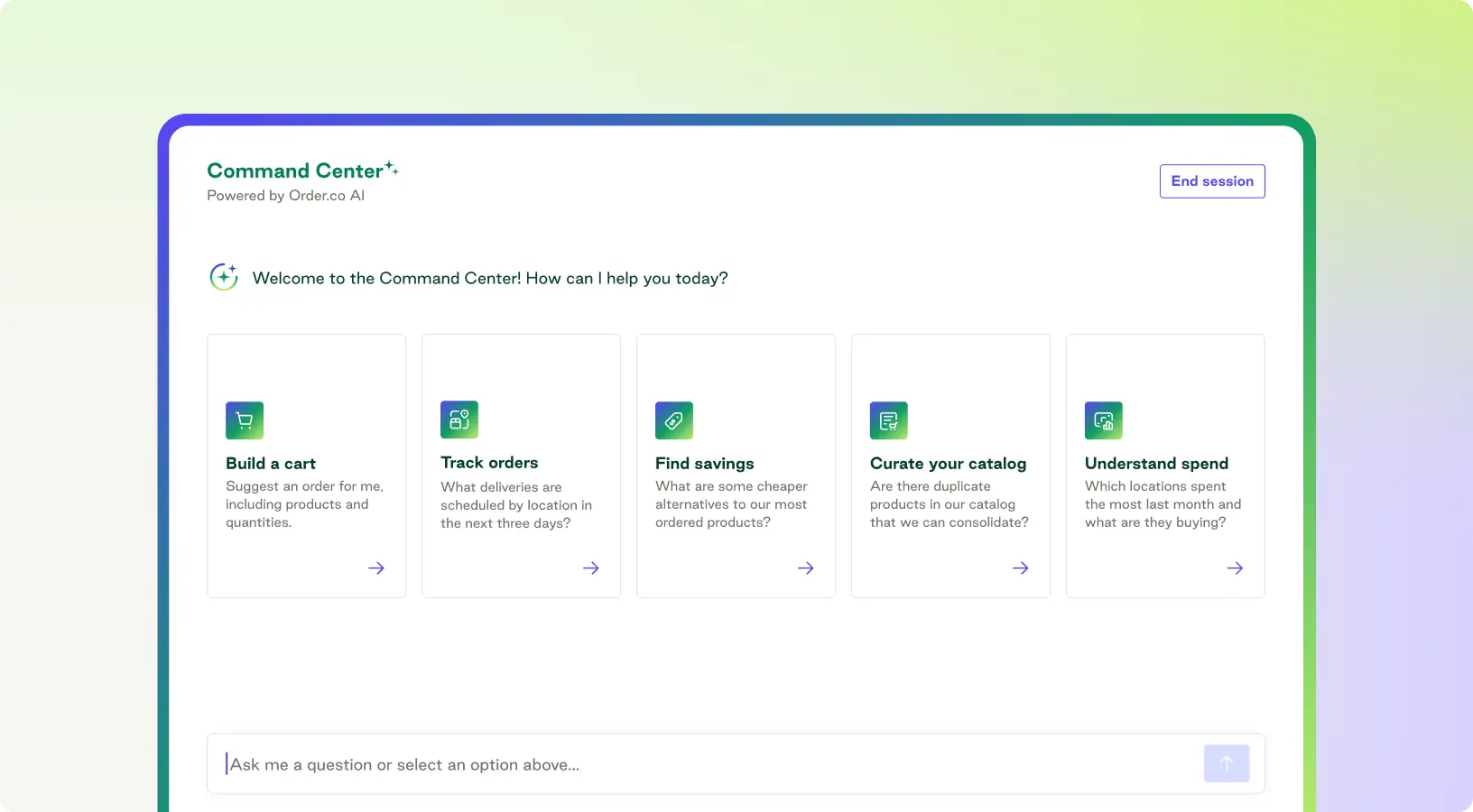
Order.co AI is trained on real B2B buying behavior, so recommendations reflect how your business buys.
Benefits and limits of autonomous procurement
When agents handle the repetitive parts of purchasing, the payoff shows up in your team’s time and your bottom line, though a few limits are worth planning for before you hand anything off.
Faster cycles and more capacity for your team
Every order an agent places, tracks, or codes is one your team doesn't touch. Across many locations, the hours once spent on vendor sites and tracking numbers go back to vendor strategy and spend management.
Hard-dollar savings from smarter sourcing
An agent that checks prices on every order catches savings that manual buying misses. Order.co AI finds the best price or options for out-of-stock goods, and customers realize hard-dollar savings of 5% on average.
With AI catching automated savings across 2,300 vacation rental properties, AvantStay saved $190K on products. "Sourcing replacements and substitutions saves the company time and money," said Jack Langenhorst, Senior Manager of Onboarding & Supply Chain.
Where autonomy still needs people
Agents are only as good as the data and rules they work from. Three limits are worth addressing as part of your risk management approach:
- Data quality. Messy catalogs, inconsistent product names, and missing GL rules lead agents to incorrect conclusions.
- AI governance and human oversight. Someone has to own the policies agents follow and review what they escalate.
- Getting buyers onto the system. If purchasing happens outside the platform, agents can't see it, and the benefits shrink.
Gartner expects over 40% of agentic AI projects to be canceled by the end of 2027 due to rising costs, unclear business value, or weak risk controls, which is why clear jobs and clean foundations come first.
How to move toward autonomous procurement
Each stage builds on the last. Find the one that matches where your team is today.
1. Centralize purchasing in one system
If your locations still buy across vendor websites, email, and cards, start by moving your procure-to-pay process into one place. Procurement software that handles ordering, tracking, and payment together gives you the purchasing history agents need later.
2. Curate catalogs and set approval rules
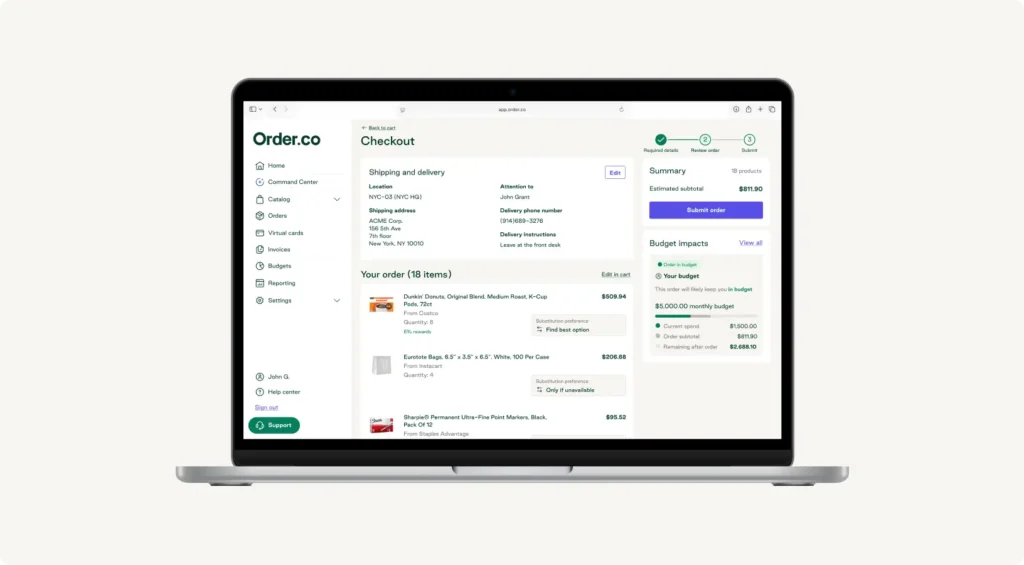
Control starts at the catalog level. When buyers see only pre-approved products and vendors, compliant purchasing becomes the easiest path, and agents inherit clear boundaries. Set approval thresholds and budgets alongside the catalog so the rules are written down before anything acts on them.
3. Let AI recommend before it acts
Start with AI that suggests. Let it flag unusual orders at approval, recommend cheaper alternatives, and summarize spend. You learn where recommendations are reliable while your team stays in the loop. Generative AI in procurement is a natural first step because it supports decisions without making them.
4. Hand agents low-risk, repeatable jobs first
Once recommendations prove reliable, give agents small-stakes jobs like weekly reorders, delivery tracking, and catalog cleanup. Treat it like a procurement automation pilot program with a defined scope and success metrics, then expand as results come in.
Less manual work. More control over every purchase.
See how Order.co brings purchasing, approvals, and payments together—so your team can automate routine work while keeping spending rules in place.
Autonomy needs a place to act
Autonomous procurement depends less on the model and more on whether purchasing runs through a system that can actually place, track, and pay for orders. When it does, your team gets hours back from repetitive buying, captures savings nobody had time to chase, and sees every line item coded and visible as it happens.
That's the idea behind Order.co. Your buyers order from one platform they actually use, and Order.co AI works on that real purchasing.
Want to see what your team's week looks like when agents handle the reorders, tracking, and coding? Schedule a demo.
FAQs about autonomous procurement
No. Autonomous procurement shifts people from doing every task to setting the rules and handling the exceptions. Your team decides which vendors are approved, how much each location can spend, and which purchases need a review. Agents then handle the repetitive work inside those boundaries and escalate anything unusual with context. People stay responsible for policy, supplier relationships, and the judgment calls an agent shouldn't make on its own.
It changes what procurement jobs involve more than it removes them. Agents take on high-volume, repetitive work like reordering, tracking deliveries, and coding purchases. That frees your team for work that needs people, such as supplier management, setting purchasing policy, managing budgets, and reviewing escalations. For multi-location teams, it often means supporting more locations as you grow without adding headcount.
Procurement agents are the specific tools built for defined jobs, and autonomous procurement, often called agentic procurement, is the operating model they make possible. An agent is AI assigned to a task, such as building a cart, sourcing an alternative, or reporting on spend. Autonomous procurement is what happens when agents like these work together inside one purchasing system, carrying out defined jobs within your policies and escalating to people only when judgment is needed.
Get started
Schedule a demo to see how Order.co can simplify buying for your business.
"*" indicates required fields