How Modern Procurement Workflows Enable Faster, Smarter Buying

How Modern Procurement Workflows Enable Faster, Smarter Buying
Procurement teams are stuck in a paradox: the business wants to move faster, yet the tools in your stack are designed to slow it down. Spreadsheets to track requests. Email threads to chase approvals. A dozen disconnected vendor portals. By the time a PO clears, the person who requested it has either found a workaround or put it on a personal card.
It's not a niche problem. According to Deloitte's 2025 Global CPO Survey, 57% of CPOs named “siloed ways of working” as a top barrier to delivering procurement value.
Modern procurement closes this gap by combining three things older systems treat as separate problems: controls that live inside the buying experience, AI that surfaces the right context at the right moment, and automation that executes the transaction end to end. The result is a system that doesn't just record what your team buys, but actively runs the process on their behalf.
Key takeaways: Modern procurement
- Modern procurement combines embedded controls, AI-powered insights, and automation that executes the full transaction.
- AI surfaces the right context at the point of purchase, flagging anomalies, recommending approvals, and routing decisions, so buyers and approvers move faster without sacrificing accuracy.
- Centralizing strategic sourcing, vendor management, and invoice management across your entire supplier base eliminates the fragmented buying that leads to rogue spend.
- True automation goes beyond approval routing—it includes generating POs, sending them to vendors, and handling fulfillment without manual intervention.
- Order.co is the AI-powered procurement platform that executes purchasing on your behalf: curating approved vendor catalogs, enforcing approvals and budgets at the point of purchase, and automating the full transaction through to payment and line-item GL coding.
Download the free ebook: The Procurement Strategy Playbook for Modern Businesses
What are the core components of a modern procurement strategy?
A modern procurement strategy rests on three elements that each address a different gap in legacy procurement: how you manage suppliers, how you use data to inform decision-making, and how you embed compliance into the buying experience. Together, they replace fragmented buying and reactive cleanup with a centralized system that supports faster, smarter purchasing across your supplier base.
Strategic supplier relationship management
Modern procurement maintains visibility and consistency across your vendor base with:
- Centralized onboarding workflows that capture details, payment terms, and compliance documentation for new suppliers in one place
- Performance tracking that enables you to see which vendors deliver on time, which create invoicing friction, and where pricing has drifted from original agreements
- Consistent communication workflows that ensure you and your vendors are always working from the same source of truth
When every supplier partnership runs through the same procurement system, you eliminate the chaos that comes from each team managing vendors their own way. You also gain data you can use when it's time for contract negotiation or to evaluate alternatives.
Data-driven decision making and spend analytics
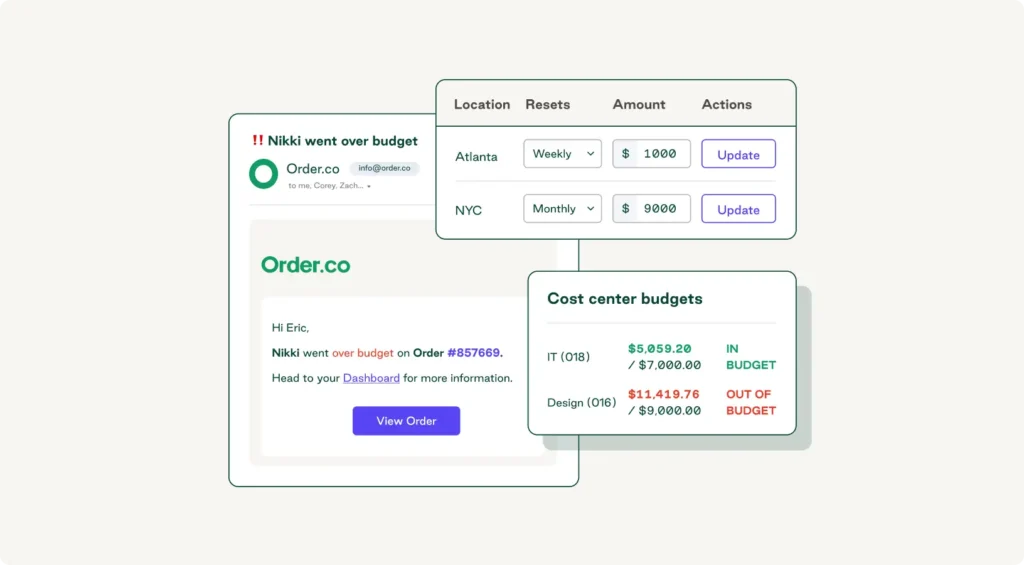
Most procurement teams don't discover spending problems until it's too late to act. Real-time visibility into purchasing patterns, vendor performance, and budget utilization changes. Instead of discovering budget issues during reconciliation, you see exactly where you stand at the point of purchase.
According to Mordor Intelligence, the procurement analytics market is projected to grow from $7.11 billion in 2026 to $20.72 billion by 2031, reflecting how central data visibility has become to procurement operations.
When your team can see which categories are trending over budget or where purchasing volume could unlock better cost savings, procurement analytics shifts from a reporting function to a real-time decision-making tool. This can help strengthen your supply chain and optimize your bottom line.
The Procurement Strategy Playbook for Modern Businesses
Want to know more about strategic buying? Read our Procurement Strategy Playbook for even more valuable insights.
Risk management and compliance integration
Regulatory compliance shouldn't depend on employees remembering the rules. When the approval process, budget controls, and policy guardrails are embedded directly into the buying process, teams follow the right procedures because they’re the easiest path forward.
This means implementing:
- Vendor catalogs that surface only approved suppliers
- Approval routing that triggers based on spend thresholds
- Department budgets that update in real time as purchases are made
Compliance becomes invisible to the buyer while remaining fully visible to finance and procurement teams who need oversight.
These three components reinforce each other: supplier management provides the foundation, spend analyses surface patterns across that foundation, and compliance integration ensures every purchase follows policy without slowing you down.
What modern procurement workflows look like in practice
Modern procurement brings together controls, AI, and automation at every stage of the buying process. Here's what that looks like across the core workflows, from vendor onboarding through invoice processing.
Vendor approval and onboarding
Traditional vendor management is a documentation exercise: someone keeps a list of approved vendors in a spreadsheet, and buyers are trusted to check it before placing an order. In practice, they don't. AP ends up with invoices from vendors no one recognizes, and procurement spends time reverse-engineering what got bought and why.
Modern procurement flips this by making the approved vendor list the only list a buyer can see:
- Curated catalogs put compliance into the environment itself: you decide which vendors and products are available, and those are the only options that appear when someone places an order.
- New vendor requests route through a single approval workflow that captures documentation, payment terms, and performance data.
- AI matches incoming requests against your existing supplier base to flag duplicates, surface better-priced alternatives already in the network, and pre-populate compliance docs, so onboarding doesn't stall on paperwork.
For distributed teams buying the same categories across locations, this means 12 sites order from one standardized catalog instead of 12 different vendors, turning vendor management into a single, governable workflow.
Purchase order creation and management
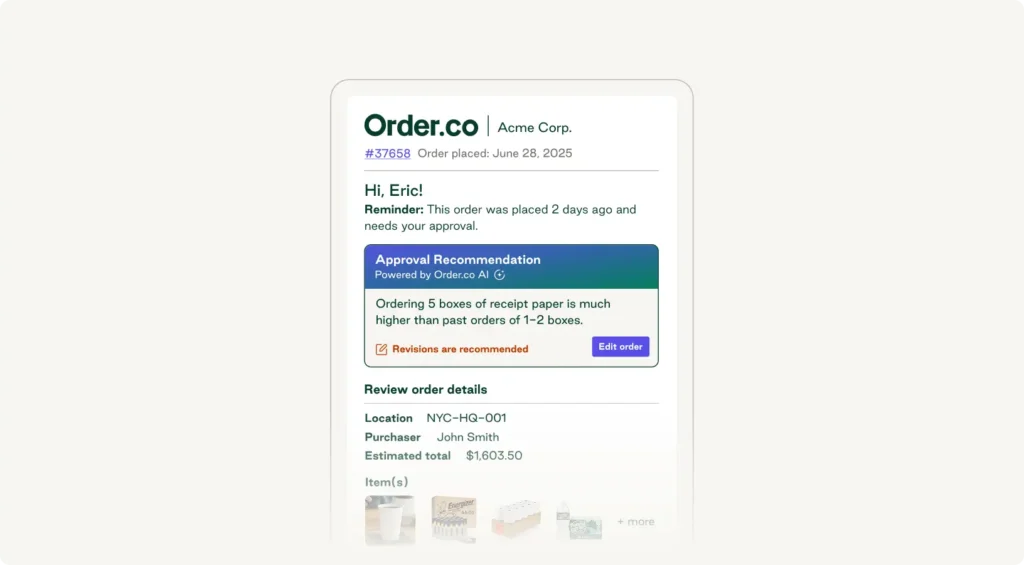
If you've worked in procurement for a while, you've seen POs created in disconnected systems. Modern procurement makes PO creation the mechanism that connects approvals, budgets, and vendor compliance to the transaction itself.
The defining shift is that modern platforms don't stop at routing the request. Most procurement tools generate a PO and hand it back to a buyer who still has to go place the order somewhere else, leaving the most error-prone step of the process in human hands. Modern procurement automates the purchase itself.
Once a requisition is approved:
- The PO is generated
- It's sent to the vendor in their preferred format
- The order is placed automatically
That means approvals, budget checks, and vendor compliance are documented and enforced at the moment the purchase happens, not reconstructed afterward.
Invoice processing and payment automation
In traditional setups, invoices arrive in varying formats from different vendors, disconnected from the original purchase order. Finance teams manually match invoices to POs, verify amounts, route approvals, and schedule payments—a process that's time-consuming and error-prone.
Modern procurement eliminates most of this work at the source. Whenevery order flows through the same platform, there's no separate step to match an invoice to a PO: the purchase, order, and payment are already linked.
The strongest platforms go further with line-item GL tagging: every item in every order is coded to the correct GL account, cost center, and entity, not just at the transaction level. That means a single $1,400 vendor invoice with 14 different items doesn't land on a bookkeeper's desk waiting to be broken apart. It arrives already categorized, reducing data entry errors, speeding month-end close, and reducing manual back-and-forth with finance.
Spend intelligence across the buying process
Even with the right workflows in place, valuable patterns in your spend data—pricing drift, duplicate orders, missed consolidation opportunities—only become visible when you can see your full purchasing activity at once. That's where AI in modern procurement is most valuable. It can:
- Surface duplicate orders across departments
- Find cost-effective alternatives in your vendor catalog
- Flag vendors whose pricing has drifted from agreed-upon terms
- Identify categories where consolidation could unlock savings
This only works when every purchase, approval, and invoice flows through the same platform. With one complete data set behind it, AI can do more than surface insights— it can act on them, routing approvals, recommending vendors, and flagging anomalies inside the workflows where decisions actually happen.
The Procurement Strategy Playbook for Modern Businesses
Learn the key pillars of a strong strategy, valuable procurement metrics to track, and initiatives you can start implementing today.
"*" indicates required fields
What to look for in a scalable, modern procurement platform
The capabilities described above only hold up at scale when they're built into the platform itself rather than bolted onto a tool designed to digitize manual workflows. Without that foundation, modern procurement quickly slips back into people remembering to follow steps. Use these criteria to assess whether a platform will actually support how distributed teams work:
- Does it work across all vendors? Many tools only support catalog-based purchasing from a handful of partners. That might cover 20% of your spend, but it leaves the rest fragmented. A modern platform should enable consistent purchasing workflows across your entire vendor base.
- Does it embed AI and automation in the workflow itself? Look for a platform that automatically guides buyers toward compliant purchases, surfaces approved vendors and better-priced alternatives, enforces budget limits in real time, and routes approvals based on spend thresholds, without requiring the buyer to know the rules.
- Is it user-friendly for the buyer? If the system is harder to use than a personal credit card, people will find workarounds. Modern procurement platforms make the compliant path the easiest one: simple enough that buyers choose it because it's faster than the alternative, not because they're required to.
The goal is to choose a tool that makes procurement easier for your team while giving finance the visibility and decision support they need to close faster.
Modernize your procurement workflows with Order.co
Order.co is the AI-powered procurement platform that runs the buying process end to end: generating POs, routing approvals, executing orders, and coding every line item, so your team spends less time fixing what went wrong and more time on what's next.
- Buyers select from curated catalogs of approved vendors and products.
- Approvals route automatically based on spend thresholds, budgets, and AI recommendations.
- Purchase orders are generated and sent to suppliers in their preferred format without manual steps in between.
- Every line item is coded to the correct GL account, cost center, and entity from the moment of purchase.
This means integrating compliance, sourcing intelligence, and order execution into a single workflow, so finance closes faster, buyers move faster, and procurement stops spending time on cleanup.
Whether you're modernizing procurement for the first time or replacing a system that didn't go far enough, book a demo to see how Order.co fits the way your team buys.
FAQs about modern procurement
Most teams implement foundational workflows within 30 to 90 days, depending on transaction volume and vendor complexity. The timeline hinges on how quickly you standardize vendor data, define approval thresholds, and migrate purchasing into a single system. Starting with high-frequency categories (e.g., office supplies) tends to accelerate adoption. Full modernization across all spend categories may take six months to a year, but early wins can prove value before you expand.
The biggest challenge is often changing buying behavior rather than adopting new technology. Employees resist systems that feel slower than their workarounds, even when those workarounds cause problems for others. Another bottleneck is vendor data cleanup (e.g., duplicate records, incomplete contacts, inconsistent naming), which makes centralization difficult. Finally, aligning procurement, finance, and operations on what "control" means requires clear communication. Without alignment, you'll build a system that either blocks too much or controls too little.
Modern procurement improves supplier relationships by creating consistent communication, faster payment cycles, and clearer expectations. Vendors get accurate purchase orders, fewer payment disputes, and order visibility, reducing friction and enabling better negotiations. Centralized vendor management lets you track performance across all transactions, giving you leverage to consolidate spend or address quality issues before they escalate.
Get started
Schedule a demo to see how Order.co can simplify buying for your business.
"*" indicates required fields