Common Procurement Challenges and the Tools That Solve Them

Common Procurement Challenges and the Tools That Solve Them
The most common procurement challenges are off-policy spending, slow approvals, invoice backlogs, poor spend visibility, and vendor sprawl. Platforms like Coupa and SAP Ariba address these for enterprises; for multi-location businesses, Order.co tackles them with budgets and approvals before purchase, one supplier catalog, and consolidated invoicing.
Each of these challenges starts where one team hands work to another, not with a lapse by any single group. This article takes the five in turn. For each, it names the tools that fix it and the metric that shows whether the fix is holding.
Evaluating your options? Take a self-guided tour of Order.co
Why common procurement challenges compound across locations
Across dozens or hundreds of locations, purchasing authority sits with the people closest to the work: general managers, facilities leads, and regional operators. Procurement owns vendor contracts, finance owns budgets and the ERP, and AP owns invoices. Each handoff between those teams is a point where policy, data, or timing can slip. The gaps concentrate in enterprise tail spend, where each transaction is too small to justify a sourcing event and too frequent to ignore in aggregate.
Timing connects all five challenges. Controls applied after the purchase, such as expense review, invoice matching, and month-end variance analysis, catch problems once money is already committed. Each tool below moves a control earlier in the purchase-to-pay process, to the request, the approval, or the catalog itself.
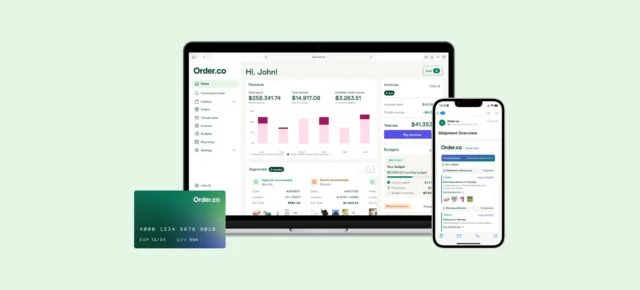
See how Order.co stacks up
Tour the product yourself now — no demo request, no waiting.
Procurement challenges and tools at a glance
| Challenge | Structural cause | Tools that fix it | Metric to track |
|---|---|---|---|
| Rogue spend | The approved path is slower than buying direct | Order.co, Coupa | Spend under management (%) |
| Slow approvals | Requests route by email with no threshold rules | Order.co, Zip | Approval cycle time (hours) |
| Invoice backlog | One invoice per vendor per order, coded by hand | Order.co, AvidXchange | Invoices processed per AP FTE |
| Poor spend visibility | Spend data split across cards, portals, and AP | Sievo, Coupa | Share of spend coded at line level |
| Vendor sprawl | Each location builds its own supplier list | Order.co, SAP Ariba | Active vendors per category |
1. Rogue spend: catalog and budget control tools
Rogue spend is any purchase that should have gone through procurement and did not. It grows when the approved path is slower than the alternative. A location manager who needs cleaning supplies today will reach for a corporate card on a retail site rather than wait on a requisition. The fix is to make the compliant route the fastest one, with a pre-approved product catalog for each location or role and budgets that check each order before it is placed.
- Order.co builds a custom catalog and approved vendor list for each location or team, with AI drawing on purchasing history to set up what each site actually buys. Every order is checked against real-time budgets before it is placed, so the compliant path is also the quickest one for a site manager. One facilities and property management customer used these controls to eliminate unapproved spending that had reached $50,000 a month.
- Coupa steers requesters through guided buying to hosted catalogs and supplier punchout sites, with purchasing policy applied across every category the suite covers. Because the same rules govern indirect, services, and other spend, it closes off-policy paths organization-wide rather than one category at a time.
Which to choose: Order.co fits when off-catalog buying comes from site managers purchasing operating supplies across many locations. Coupa fits when the organization is standardizing purchasing policy for every spend category in one enterprise suite.
Ownership of these controls splits between two teams. Procurement owns catalog content and vendor terms, while finance owns budget amounts and the cost centers they attach to. Track spend under management by location to see which sites still buy outside the catalog.
2. Slow approvals: approval workflow tools
Approval delays usually come from routing rather than from approvers. When every request lands in the same queue regardless of amount or category, a routine $80 supply order waits behind a capital request, and buyers start working around the queue. A rule-based workflow routes each request by attributes the organization already tracks. Catalog items within budget auto-approve, orders above a location's per-order threshold go to the location manager, off-catalog items and new vendors go to procurement, and multi-site requests go to finance.
- Order.co routes requests by location, cost center, user role, or spend threshold, and AI flags which orders need additional attention so routine ones move without delay. Approvers act from an email or a central approvals view, which keeps one-click approval workflows moving, and approved requests convert to purchase orders automatically.
- Zip serves as a single intake point that adapts its request form to what is being bought, then runs procurement, legal, security, IT, and finance reviews in one coordinated workflow. Approved requests pass to the organization's ERP or P2P system.
Which to choose: Order.co fits when the queue is full of routine supply orders from many locations. Zip fits when the bottleneck is multi-department review of software, services, and new-vendor purchases.
Track approval cycle time as hours from request to approved PO, and break it out by approver tier to see where requests stall.
3. Invoice backlog: AP automation tools
Invoice volume grows with every vendor, location, and order cycle the organization adds. Each invoice then needs matching against a PO and receipt, GL coding, and a slot in a payment run. There are two ways to clear the backlog: reduce the number of invoices that reach AP, or make each one faster to process.
- Order.co reduces the count. It pays vendors through their preferred method and sends the organization an itemized, pre-coded bill set up for its AP workflow, with AI handling line-level reconciliation. AP handles far fewer vendor invoices, and each line arrives already coded and synced to the ERP. Zerocater cut invoice processing time by 50x. With purchasing and payment on one record, controllers can streamline invoice approvals and vendor payments together.
- AvidXchange speeds up processing for invoices that still arrive vendor by vendor. It captures invoice data automatically, routes invoices for approval, and pays suppliers through its network, moving check payments to electronic methods. It is widely used in real estate and property management, where long vendor lists generate steady invoice volume.
Which to choose: Order.co fits when the backlog comes from many supply vendors across locations, because reducing the count does more than speeding up each invoice. AvidXchange fits invoices that will keep arriving directly from vendors, such as utilities, contractors, and services, and many organizations run both.
Track invoices processed per AP FTE alongside the share of invoices that need manual intervention.
4. Poor spend visibility: spend analytics tools
Visibility gaps come from spend data split across systems. Card transactions arrive as merchant-level summaries, vendor portal orders sit in separate accounts, and AP sees invoices only after delivery. Finance can report total spend by vendor but not what was bought, by which location, or against which budget. The fix is line-item purchase data that syncs to the ERP, so finance can control spend before month-end instead of explaining variances afterward.
- Sievo pulls spend data from ERPs and other source systems, normalizes supplier records, and classifies transactions into a consistent category structure. Procurement gets a cross-system view of where money goes without first consolidating systems.
- Coupa includes spend analysis within its suite, with dashboards built on the purchasing and invoice data that runs through the platform. Its view is most complete when most addressable spend already flows through Coupa.
Which to choose: Sievo fits organizations whose spend sits across several ERPs or acquired business units. Coupa fits organizations that already run most purchasing through its suite.
Measure progress with spend under management, defined as spend through governed channels divided by total addressable spend, multiplied by 100.
5. Vendor sprawl: supplier network and vendor management tools
Vendor sprawl builds one location at a time. Each site sets up its own janitorial supplier, office supply account, and maintenance vendor. The organization loses volume leverage and oversight together, and every added vendor brings another master-data record and another payment destination to verify. Platforms with built-in supplier networks extend category coverage without onboarding each supplier individually.
- Order.co brings supplies purchasing from more than 40,000 vendors into one catalog. Order.co AI compares the same products across suppliers on price, availability, delivery speed, and reliability, with average savings of 5%. Teams can add the vendors they already use, so consolidation does not require switching suppliers first. WeWork consolidated 110 vendors onto the platform.
- SAP Ariba manages the full supplier lifecycle, from onboarding and qualification to performance tracking, and connects buyers and suppliers through the SAP Business Network. It keeps supplier records consistent across direct and indirect spend in large enterprises.
Which to choose: Order.co fits when sprawl comes from locations each setting up their own operating-supply vendors. SAP Ariba fits enterprises managing supplier qualification and records across every category, including direct materials.
Review active vendors per category each quarter against spend concentration to find where consolidation will return the most leverage.
See how Order.co stacks up
Tour the product yourself now — no demo request, no waiting.
How Order.co solves procurement challenges for multi-location businesses
Order.co appears in four of the five challenges because it addresses them at the same point: the purchase. It is a single platform for purchasing and payments, built for supplies and indirect procurement, including facilities, MRO, back-office, and operating supplies, across locations, business units, and entities. Budgets, approvals, and GL coding apply before an order is placed, and Order.co pays vendors and bills the organization from the same record. Spend outside those categories still runs through the organization's broader procurement and analytics stack.
To see which of these five challenges Order.co would address across your locations, schedule a demo.
Get started
Schedule a demo to see how Order.co can simplify buying for your business.
"*" indicates required fields