8 Top Zip Alternatives for Full Spend Visibility in 2026

8 Top Zip Alternatives for Full Spend Visibility in 2026
For finance and operations leaders, the gap between approved and paid is hard to ignore. If you're exploring Zip (formerly ZipHQ) alternatives, you've likely felt this firsthand. To be clear, this guide covers Zip, the intake-to-procure platform for enterprise purchasing, not the buy-now-pay-later company of the same name. Zip handles intake, routing, and approvals, but it leaves you to place orders, chase invoices, and reconcile bills. If you're evaluating procurement software for the first time, these are exactly the bottlenecks a good solution should eliminate.
Quick answer:
- Key evaluation criteria include integration depth, implementation speed, total cost of ownership, and support for non-SaaS spend.
- Zip handles intake and approvals but typically relies on manual processes once a purchase is approved.
- Teams often switch to resolve purchasing control gaps, downstream AP complexity, and limited visibility into spend for physical goods.
- The right alternative embeds controls at the moment of purchase.
- Alternatives generally split into three categories: full-lifecycle platforms that handle sourcing through payment, sourcing- or approval-only tools that stop at the request stage, and finance-led spend platforms built around cards and bill pay rather than vendor-agnostic purchasing.
Download the free ebook: The Procurement Strategy Playbook for Modern Businesses
8 Top Zip alternatives for procurement teams
No one tool is right for every organization. The table below maps eight top Zip alternatives by use case, company size, and key strengths so you can quickly narrow your options.
Zip alternatives comparison table
| Platform | Best for | Key strength | Ideal company size |
| Order.co | End-to-end P2P for all business spend | Automating purchasing, fulfillment, payments, and expense coding | Mid-market to enterprise |
| Procurify | Spend control for growing teams | Intuitive UX, fast setup | Growing to mid-market |
| Coupa | Enterprise spend management | Compliance and global scale | Enterprise |
| SAP Ariba | Global supply chain procurement | Supplier network breadth | Large enterprise |
| Fraxion | Approval workflows and budget control for growing teams | Configurable approval chains with strong audit trail | Mid-market |
| Precoro | Requisition and approval structure for growing teams | Configurable approval chains and budget tracking | Growing to mid-market |
| Ramp | Card-based spend control for finance teams | Corporate cards, bill pay, and expense automation | Startup to mid-market |
| Spendflo | SaaS spend and renewal management | Managed negotiation and contract intelligence | Mid-market |
The Procurement Strategy Playbook for Modern Businesses
Learn the key pillars of a strong strategy, valuable procurement metrics to track, and initiatives you can start implementing today.
1. Order.co
Customer ratings:
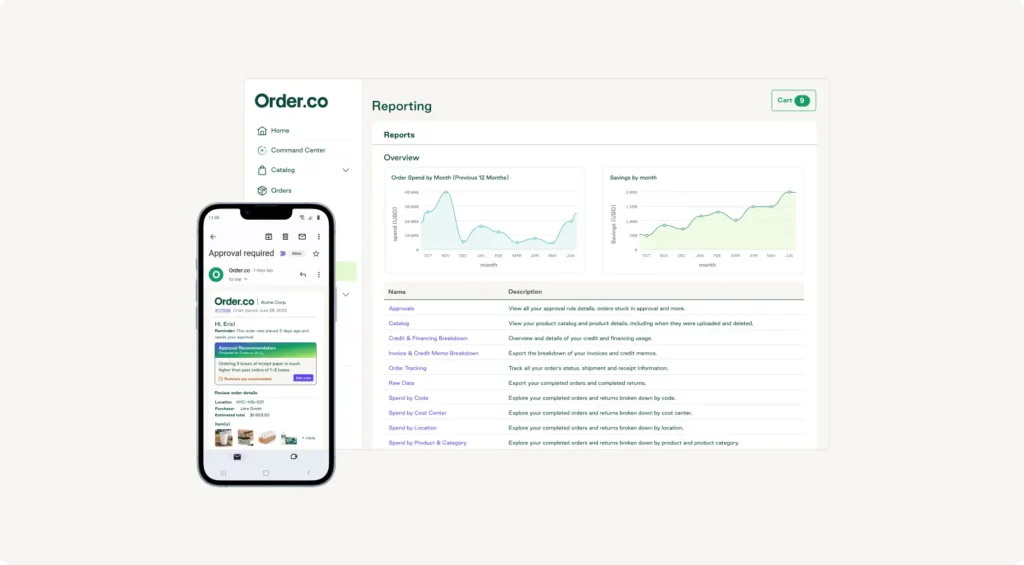
Order.co is end-to-end procurement software built for mid-market to enterprise businesses that need more than a simple approval layer. Instead of stopping at approvals, it automates what comes next: generating and submitting purchase orders directly to vendors, managing order fulfillment, and processing payments, all without manual intervention. Invoices and GL-coded line items sync to your ERP, and Order.co pays vendors via their preferred method to keep accounting simple.
Key features:
- Guided buying marketplace with a curated, pre-approved vendor catalog.
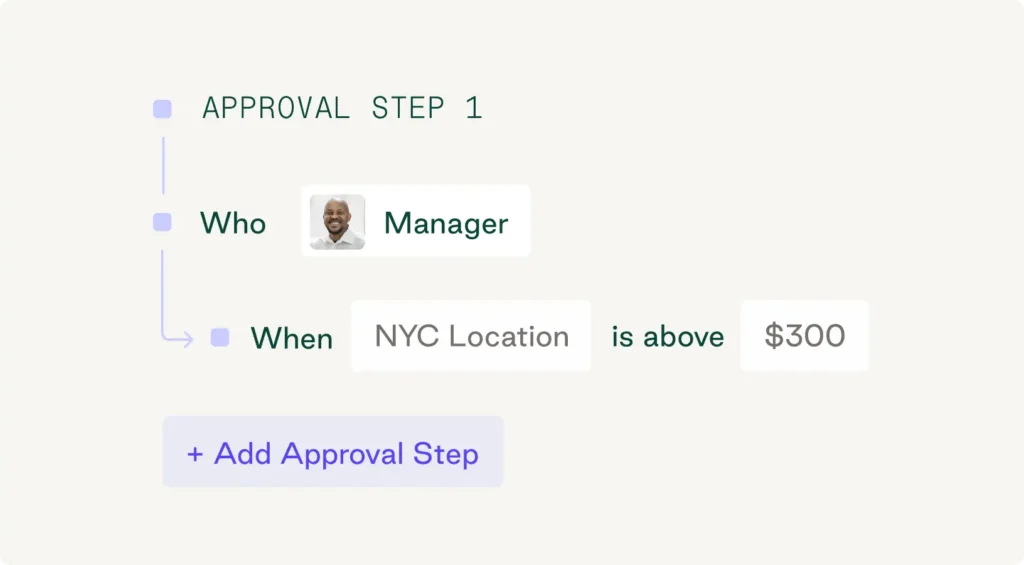
- Multi-level approval workflows tied directly to your shopping cart.
- Sourcing algorithm that scans 40,000+ vendors to surface better prices, or find alternatives when an item is out of stock.
- Automated purchasing and order fulfillment that eliminates time-consuming manual tasks.
- Invoice management feature that pays vendors for approved purchases on your behalf automatically.
- ERP integrations with NetSuite, Sage Intacct, QuickBooks, Workday, and more.
Considerations: Order.co is built primarily for US-based businesses. While it does operate in other markets, some functionality may be limited for teams operating internationally.
Why choose it: Users appreciate Order.co's ability to standardize purchasing across large networks without adding work for frontline teams, noting the platform is easy to use yet maintains strong controls, clear approval workflows, and clean reporting.
2. Procurify
Customer ratings:
Procurify is a cloud-based spend management software solution for growing procurement teams. It handles purchase requisitions, approvals, PO creation, vendor management, and budget tracking through an intuitive interface that non-procurement staff can adopt quickly.
Key features:
- Flexible approval workflows that scale with growing teams.
- Real-time budget visibility to prevent overspending.
- Mobile approvals for faster turnarounds.
- Accounting integrations with QuickBooks and NetSuite.
Considerations: Existing Procurify users have reported that the software is less flexible and customizable than they would like, particularly around reporting, purchase orders, and searching for specific features.
Why choose it: Procurify balances control and simplicity. It suits growing businesses that need straightforward purchasing controls and fast implementation without the overhead of a technical system rollout.
3. Coupa
Customer ratings:
Coupa is an enterprise-grade business spend management platform covering procure-to-pay, travel and expenses, supplier management, and contract lifecycle management. It's designed for global organizations that need deep compliance controls and sophisticated spend analytics.
Key features:
- End-to-end source-to-pay workflows for global operations.
- Advanced supplier risk management, vendor onboarding, and contract lifecycle management.
- Robust reporting and analytics.
- Enterprise ERP integrations across SAP and Oracle.
Considerations: Some Coupa users have noted that the platform's interface may not be as intuitive as some of its competitors, citing slow loading times, supplier onboarding difficulties, and an outdated format as the primary challenges.
Why choose it: Coupa delivers enterprise-grade visibility and consistent policy enforcement at scale. It's best for large enterprises with mature procurement functions and intricate global requirements.
4. SAP Ariba
Customer ratings:
SAP Ariba is a comprehensive source-to-pay solution centered on the SAP Business Network, a marketplace of over 5 million suppliers. It covers strategic sourcing, contract management, procurement, invoicing, and supply chain collaboration.
Key features:
- Global supplier connectivity through the SAP Business Network.
- Advanced RFx sourcing for complex bidding.
- Invoice management and payment automation.
- Native SAP ERP integration for seamless data flow.
Considerations: For new users, SAP Ariba's complexity can be overwhelming at times, with some users reporting difficulties navigating, configuring, and customizing the platform for basic operations.
Why choose it: Ariba provides unmatched reach for organizations already within the SAP ecosystem. It's a viable option for large enterprises with sophisticated global supply chains that need to eliminate data silos between procurement and finance.
5. Fraxion
Customer ratings:
Fraxion is a cloud-based procurement and spend management platform built around configurable approval workflows and budget controls. It combines purchase requisitions, PO automation, and AI-assisted invoice matching with real-time spend analytics, aimed at mid-market teams that need strong policy enforcement without a heavy technical rollout.
Key features:
- Multi-level, configurable approval workflows with real-time budget checks
- Purchase requisition and PO automation
- AI-assisted invoice matching and AP automation
- Spend analytics and reporting, with mobile access for requests and approvals
Considerations: Fraxion's approval and requisition structure is strong, but fulfillment and vendor ordering still happen outside the platform, so teams evaluating it for its controls should plan for that gap separately. Some users also report a learning curve with the interface during initial onboarding.
Why choose it: Fraxion suits mid-market teams whose main priority is standardizing approval workflows and building a reliable audit trail, rather than automating the purchasing and fulfillment steps that come after approval.
6. Precoro
Customer ratings:
Precoro is a cloud-based procurement platform built around requisitions, approvals, and purchase order creation. It offers customizable approval chains, budget tracking, and vendor and catalog management for teams that want a structured requisition-to-PO process without a heavy implementation lift.
Key features:
- Multi-level approval workflows with built-in budget control.
- Purchase requisition and PO management.
- Spend analytics and reporting.
- Vendor database and catalog management.
Considerations: Precoro's strength is requisition and approval structure. Fulfillment and payment still require manual follow-through once a PO is issued, so teams whose main bottleneck is downstream of approvals may find that gap persists after implementation.
Why choose it: Precoro suits teams transitioning from spreadsheet-based purchasing to a digitized approval process, with the goal of standardizing requests and sign-off.
7. Ramp
Customer ratings:
Ramp is a corporate card and finance automation platform that combines card-based spend control, bill pay, and accounting sync. It's built to catch out-of-policy spending with custom card controls and to speed up reconciliation once it does.
Key features:
- Virtual and physical corporate cards with configurable spend limits.
- Automated receipt matching and expense categorization.
- Bill pay and vendor payment automation.
- Accounting integrations with QuickBooks, NetSuite, and Sage Intacct.
Considerations: Ramp excels at card-based spend control, but it isn't built for vendor-agnostic purchasing of physical goods across multiple vendors. Teams buying from a broad, non-card-friendly vendor base will still need a separate ordering and fulfillment process.
Why choose it: Ramp fits finance teams whose primary spend runs through corporate cards and vendor bills, and who want fast implementation with strong card controls.
8. Spendflo
Customer ratings:
Spendflo is an AI-native procurement platform built specifically for SaaS spend, pairing intake-to-procure automation with managed negotiation services for software renewals and new purchases.
Key features:
- Centralized intake for software requests, integrated with Slack and Microsoft Teams.
- Managed renewal negotiation and contract intelligence.
- Shadow IT and duplicate-tool discovery.
- SaaS pricing benchmarks to inform negotiations.
Considerations: Spendflo is purpose-built for SaaS and software spend and renewals. Physical goods procurement and vendor fulfillment sit outside its focus, so teams buying supplies, equipment, or other physical goods across multiple vendors will need a separate platform for that spend category.
Why choose it: Spendflo fits teams whose main pain point is software spend and renewal cycles, especially those that want negotiation expertise alongside the software itself rather than handling vendor conversations in-house.
Why do procurement teams look for Zip alternatives?
Most procurement tools force a choice between speed and control. Intake-only platforms prioritize speed by making it easy to submit and route requests, but they often create downstream chaos by requiring you to manage purchasing, fulfillment, and payment manually.
Here are a few reasons teams often seek more robust alternatives:
Need for a true end-to-end solution
Zip organizes the intake process but leaves the most time-consuming parts, purchasing and payments, as disconnected tasks. This means you must log in to multiple vendor websites, place orders manually, and process invoices individually.
True end-to-end solutions like Order.co connect every step of the procurement cycle. Employees submit requests, receive approvals, and place orders through a single guided marketplace. This removes the need to jump between systems and automates the process from requisition to reconciliation.
Lack of control over actual purchasing
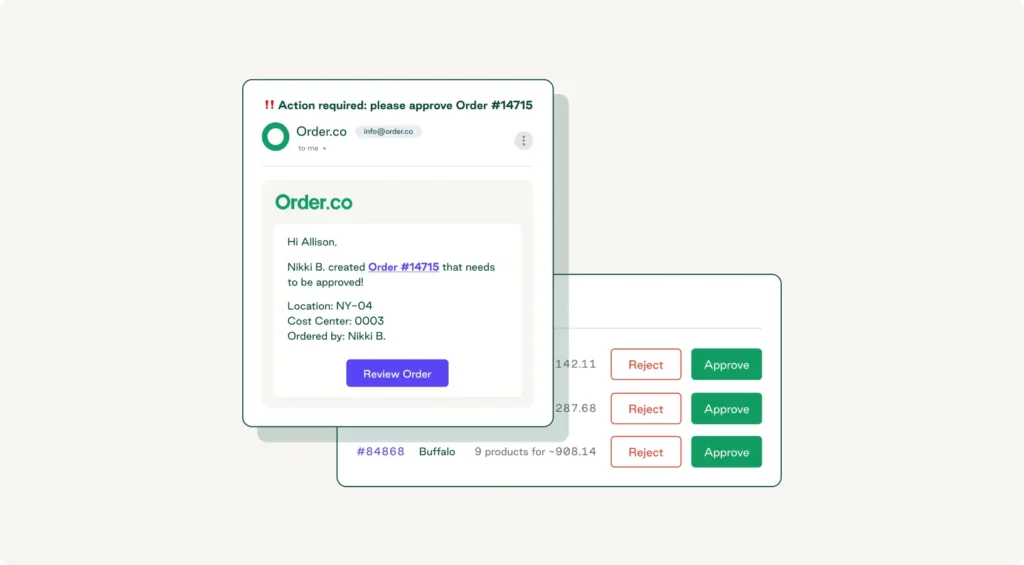
Approval workflows confirm a request is compliant, but they don't stop employees from buying the wrong item, using a non-preferred vendor, or overspending. This maverick spend undermines cost-saving initiatives and creates compliance risks.
While average organizations see rogue spend rates of 10-20%, top performers typically maintain rates under 5-10%. By centralizing approved vendors and products into one curated catalog, Order.co ensures employees only buy what is authorized, preventing out-of-policy spend before it ever reaches the cart.
To explore other options that solve the problem at the source, review this comparison of top procurement tools.
Complex invoice and payment workflows
Modern eprocurement tools increasingly include bill pay capabilities. However, in many platforms, finance teams must still manage vendor invoices and execute payments through traditional AP workflows. This requires coordination across purchasing, approvals, and accounting systems.
Instead of your team managing dozens or hundreds of separate vendor payments, Order.co pays vendors via their preferred method, Net 1, and consolidates payments into customized bills that fit your bookkeeping. Each line-item is pre-coded and synced directly to your ERP, preserving vendor-level visibility while minimizing reconciliation work. The result is fewer moving pieces for AP, without disrupting your accounting structure or month-end close.
Limited focus on strategic sourcing for physical goods
Many intake management tools are designed with SaaS and services in mind, overlooking the massive cost-saving potential of physical goods. For businesses buying office supplies, maintenance equipment, or consumables across multiple locations, these tools miss a major opportunity.
Order.co fills this gap by combining a sourcing and procurement app with a powerful AI engine. By scanning a network of over 40,000 vendors, this embedded AI sourcing engine automatically finds better prices on the products you buy every day. It delivers an average of 5-10% in hard-dollar savings without manual effort, transforming procurement from a cost center into a value driver. Physical goods are where Order.co is strongest, but the same catalog and approval controls apply to services, software, and other spend categories too.
The Procurement Strategy Playbook for Modern Businesses
Learn the key pillars of a strong strategy, valuable procurement metrics to track, and initiatives you can start implementing today.
"*" indicates required fields
How to choose the best Zip alternative for your business
Choosing the right intake-to-procure solution starts with identifying your primary procurement bottleneck. Is your biggest challenge managing initial requests, controlling what employees actually buy, or reducing your AP team's workload? Look for purchase order management that extends control beyond the request itself, into approval routing and execution.
This framework can help you evaluate your options:
- Map process gaps: Look for a platform that controls the transaction itself, beyond the request, if your main issues occur after approval.
- Assess spend categories: Select a platform built for your specific category mix. Physical goods require deeper marketplace capabilities than SaaS-only tools.
- Evaluate integration depth: Confirm how GL coding, invoice matching, and order data flow into your ERP to ensure the system reduces manual work instead of creating it. Strong ERP procurement integration is non-negotiable for finance teams.
- Calculate total cost of ownership: Factor in implementation costs, internal IT time, and change management alongside the subscription fee. Platforms with faster implementation timelines and higher user adoption typically deliver ROI faster.
- Prioritize controls at the point of purchase: Choose a solution that embeds policy compliance into the buying experience itself. Then, use procurement analytics software to establish baselines and measure whether controls are actually working once you go live.
Simplify your procurement process with Order.co
The steps between an approved request and a completed purchase, placing orders, managing vendors, processing invoices, are where procurement strategies succeed or fail. Finance and operations teams need a solution that stays in the picture through purchasing, delivery, and payment, providing genuine control without slowing employees down.
Order.co acts as a proactive operating system for the entire procurement lifecycle. By embedding controls at the point of purchase, it provides real visibility without creating friction. Deploying AI agents that source better prices, catch spend anomalies, and keep data clean without added headcount gives finance teams more time for strategic work.
For example, AKIRA, a Chicago-based fashion retailer, implemented Order.co to bring structure to a fragmented purchasing process, saving $10K in 6 months and reclaiming 160+ hours per month previously lost to manual AP work.
When every purchase flows through a single, controlled system, month-end becomes predictable, spend data becomes actionable, and the gap between approved and paid closes.
Ready to close the gap between approved and paid? Schedule a demo to see how Order.co gets there.
FAQs about Zip alternatives
The clearest signal is when your procurement problems live downstream of intake: rogue spend that slips past approval, an AP team buried in manual invoice work, and spend visibility that stops at the request instead of the actual purchase. If your team can't trace a transaction through the audit trail without pulling records from three systems, it's time to evaluate procurement software built for the full purchasing cycle.
Whether or not to replace ZipHQ entirely depends on where your stack breaks down. If the gap is in purchasing execution and AP automation, an end-to-end platform can replace multiple point solutions and simplify your tech stack. If you have a significant existing ERP investment, look for a platform that integrates deeply rather than duplicating functionality. The goal is fewer systems handling more of the process.
Focus on metrics tied to real business impact: rogue spend rate, monthly invoice volume, time-to-close at month-end, category-level cost savings, and user adoption. If a sourcing algorithm is part of your evaluation, track hard-dollar savings per category as your baseline. Spend analytics tools can help you benchmark these figures before go-live, then monitor them across the full procurement lifecycle as your accounting systems and vendor management processes mature.
For most teams, yes. Order.co covers the same intake-to-procure steps as Zip, then continues through ordering, fulfillment, and payment, functioning as workflow orchestration for the entire cycle. Running both at once usually duplicates the request and approval step, adding a system instead of removing manual work. Teams with substantial Zip configuration and ERP integrations already built should weigh migration effort against the manual work an end-to-end platform would remove.
Get started
Schedule a demo to see how Order.co can simplify buying for your business.
"*" indicates required fields