The misconception about the vendor selection process
Vendor selection is typically thought of as a five- or six-step process that ends with a contract. In reality, the vendor selection process shouldn’t have a definitive end at all.
Businesses change over time — yours will, and so will your vendor’s. It doesn’t make sense to approach vendor selection with a linear mindset and be bound to a contract in perpetuity. In fact, inefficient contracting with suppliers and vendors is responsible for an estimated 17% to 40% in value leakage, according to KPMG.
Businesses that don’t closely manage their vendor relations risk paying more and absorbing inefficiencies. To fix the vendor selection process, make it an ongoing feedback loop based on cost and value.
Download the free tool: Vendor Scorecard Template
Which vendors should you select?
Select the vendor that best aligns with your business
The most cost-effective vendor for your business is often the one that most closely aligns with your needs, goals, and values. Evaluate what these criteria are for your business, and then conduct due diligence to find which vendor is the best fit.

Vendor Scorecard Template
Download our free vendor scorecard to make objectively evaluating vendors easier.
What is the vendor selection process
Evaluate your business’s needs, goals, and values
The first step to a successful vendor selection process is understanding what your business needs from a vendor to succeed.
Start by determining your budget and considering any compliance restraints your business may face. For example, some businesses are subject to stringent security policies based on their physical location. Order.co client XpresSpa is one such business. Because XpresSpa is based in airport terminals, all shipments the company receives must pass through airport security.
Then consider your long-term goals and how a vendor could inhibit or support them. Does your business have expansion plans, for example? If it does, or you suspect it may eventually, you need to choose a vendor that will be able to scale with your business by providing larger quantities of supplies across geographies.
Finally, think about your business’s values. If your company actively stands for something — like sustainability or female empowerment — you should choose a vendor that does, too. For example, if your business is a staunch advocate for small businesses, it would be hypocritical to purchase exclusively from Amazon. If the media were to learn of and report on this inconsistency in values, your reputation and market value would suffer.
Conduct your due diligence to find the right fit
Once you know what your business needs to succeed, you can ask the right questions throughout your due diligence and weed out any vendors that pose a risk to your business.
To begin your due diligence, set up meetings and demos with vendors of interest. Come to those meetings prepared with questions that relate to your business’s unique needs, goals, and values.
Then ask the vendor for references who can speak to the quality of its services. When you speak to a reference, ask questions like:
- Does the vendor deliver orders on time?
- Are the vendor’s orders correct?
- Will the vendor offer an alternative if an item is out of stock?
- Are the vendor’s products consistent with the expected quality?
You can also find answers to these questions by checking out a vendor’s online reviews or referring to the Better Business Bureau.
Calculate vendor risk
Once you have gathered the information you need, evaluate and mitigate any potential risks to your business with NASA’s risk matrix. In a recent article, Order.co provided a tutorial on how businesses can apply this matrix to vendor risk.
Taking this final step will safeguard your business from data security, reputation, and business continuity risks that commonly arise with third-party vendors.
Vendor Scorecard Template
Download our free vendor scorecard to make objectively evaluating vendors easier.
"*" indicates required fields
Vendor selection as an ongoing process
Regularly review vendors to ensure your business is getting the maximum amount of value at a fair price. To do so, gather employee and customer feedback, conduct annual audits, and reevaluate relationships as needed.
Gather employee and customer feedback
Collect input from your customers and employees to learn how vendors are performing.
If your customers aren’t satisfied with your business’s supplies, they’ll replace you. Make sure your business is meeting their expectations by checking in regularly on product quality.
Customer surveys are a great place to start. Be sure to include questions that relate to your supplies. If you run a cycling studio, for example, ask your students to rate the quality of your bikes, lockers, shower gels, and other products.
One of the easiest ways to conduct customer surveys is by email. If you need help creating an email that won’t get deleted, Vitally has some great tips on how to personalize your mailing and improve your open rates. Formspree is also a good resource if you aren’t sure what to include in your feedback forms.
You can also find out how customers feel about your products on social media and in online reviews. Using the same example, a cycling studio could check its ClassPass reviews or Twitter mentions to learn what students are saying about its equipment and hygienic products.
Employee input is also essential. You want to make sure any vendor your company employs is improving — not hindering — your employees’ performances. If a vendor continuously mixes up orders or is late with deliveries, your employees may be spending copious amounts of time resolving these issues.
Ideally, your employees will already feel empowered to share their feedback with company leaders. Even so, it’s important to directly ask for information about what you want to know. Create surveys or feedback forms the same way you would with customers.
Ask employees to rate the quality of vendors’ products and if they’ve been impacted by late deliveries or customer service lapses. It’s best to make these survey responses anonymous so that employees feel comfortable responding candidly.
Conduct annual vendor audits
Regular reviews will help you gauge how each of your vendors is performing. At least once a year, conduct a formal audit of all of your vendors.
Analyze the employee and customer reviews you gathered throughout the year to determine if a vendor is still meeting your needs and helping your business achieve its goals. You should also check in with similar vendors to see if yours is offering a price and customer experience that is consistent with others in the market.
Reevaluate vendor relationships
If you determine during your vendor audit that a vendor relationship isn’t meeting your expectations, take action. You may just need to renegotiate the terms of your vendor relationship. Or, you may be better off finding a new vendor altogether.
Either way, conduct a formal request for proposal (RFP) that includes your existing vendor and a handful of others your business might like to work with. An RFP is essentially just a formal ask from your company for a few select vendors to bid for your business. You’ll put together a brief on your company’s needs, and vendors will come back with a proposal on how they can meet those needs and at what cost.
Conducting an RFP will give your existing vendor the chance to vie to keep your business, while also extending that opportunity to other qualified companies. If your existing vendor comes out on top, you can continue your relationship under terms that work better for your business.
If another vendor prevails, you’ll have to pause your existing orders and create new ones, which can be a nuisance. Don’t let that derail you from moving on to another vendor that will deliver greater value to your business in the long-term.
Keep costs low and value high
A continuous vendor selection process will ensure your business is maximizing the value it derives from vendor products and services.
Order.co's strategic sourcing makes it easy to evaluate vendors on an ongoing basis. We work with each customer to fix its vendor selection process by routinely identifying strategic savings opportunities.
To learn more, schedule a demo with a member of our sales team.
Get started
Schedule a demo to see how Order.co can simplify buying for your business.
"*" indicates required fields
At Order.co, we think it’s particularly useful for businesses to implement a vendor management policy. A vendor management policy evaluates and controls business risk. It requires businesses to determine approximately how much risk they are willing to assume when working with a vendor.
But risk in an organization is a broad concept. How can companies think about risk in tangible terms? As it turns out, the solution comes from an unlikely source.
According to Ness Labs, NASA has an ideal way for businesses to evaluate risk. In a recent article, “Managing risk with the NASA Risk Matrix,” Ness Labs outlined the approach that NASA scientists use to assess and mitigate risk in their business.
For an organization that deals with literal rocket science, NASA’s Risk Matrix is surprisingly simple and relatable. Once you understand the general principle, the Risk Matrix can help your business quantify the risk of working with a vendor and make smarter decisions about who (or who not) to work with.
Download the free tool: Vendor Risk Management Checklist
What is NASA’s risk matrix?
A large part of science and space research hinges on the ability to conceptualize, navigate, and mitigate risk. Therefore, the scientists and researchers at NASA developed the Risk Matrix as a straightforward graphic to help their teams simplify and conceptualize risk.
The graph measures risk on two scales: likelihood and consequence.
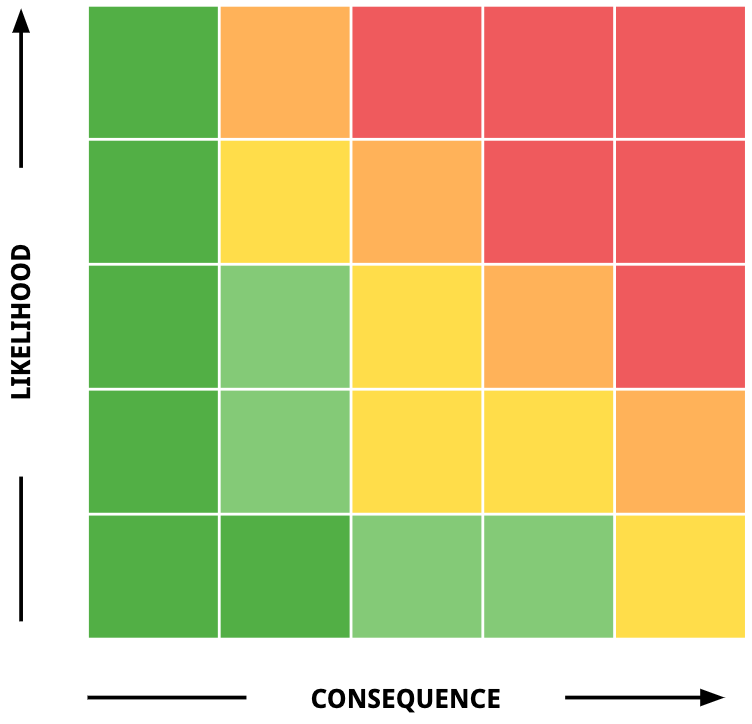
*Source: Managing risk with the NASA Risk Matrix, Ness Labs,
Once you have identified a potential risk, ask two questions: How likely is it that the risk will occur, and how impactful are the consequences?
The Risk Matrix’s logic isn’t specific to NASA as an organization. It can be used by anyone evaluating risk.
Vendor Risk Management Checklist
Download our free vendor risk management checklist to better manage third-party risk and establish stronger vendor lifecycle management practices.
What’s at risk when working with vendors?
Working with vendors exposes your business to many risks, which is why implementing a vendor management policy—ideally supported by vendor management software—is so important. Business continuity, reputation, and data security are the most significant risks.
As we go through these three major forms of risk, we’ll also discuss vendor risk assessments.
When developing a risk management plan for third-party vendors, it’s helpful to have a clear view of the specific risks that may come into play.
A third-party risk assessment questionnaire can help organizations evaluate the risks inherent in outsourcing to a third party. While individual questionnaires should tailor themselves to the organization, the questions below can help you start building a security or supplier risk questionnaire.
Business Continuity
Eighty-seven percent of firms “have experienced an incident with a third party that disrupted their operations,” according to research from Deloitte. Vendor issues such as late deliveries and incorrect orders put your business operations at risk, resulting in unexpected fees or revenue loss.
For example, if you operate a hair salon and your shampoo delivery is delayed, you may have to purchase a replacement product. That product may come at a higher price, resulting in additional, unexpected fees. If you also miss out on retail sales of the delayed shampoo, you’ll incur a revenue loss while the product remains unavailable for sale.
Loss of business continuity can significantly affect your business and its revenue streams. Evaluating the likelihood and consequences of such a continuity gap is important when considering new or untested vendors.
Business continuity risk assessment questionnaire:
- Does your organization carry all required insurance binders? What are the coverage amounts for claims?
- In the event of a critical shipping delay or supply chain issue, what contingency plans does your organization have in place to mitigate business impacts?
- Has a client of yours suffered a business continuity incident or serious delay in receipt of goods?
- In the event of a supply chain issue or delay, what is your communication policy for clients?
Reputation
Reputation is an increasingly important metric for consumers considering a purchase. In fact, 60% of consumers reported that bad reviews have dissuaded them from purchasing from a particular business. Businesses must carefully evaluate the risks of partnering with any outside organization when the stakes are so high.
If your business partners with a vendor that does not share your values or engages in illicit business practices, the media—and consumers—may hold your business accountable.
For example, let’s say one of your vendors is caught importing products illegally. Whether or not your business had anything to do with it, you risk getting tied up in a public-relations nightmare. If the media reports your business as receiving the illegally imported product, you could face permanent damage to your reputation.
Due diligence with new vendors is a vital component of third-party risk management. Take the time to understand a potential partner’s business practices and values to reduce the chance of issues in the future.
Reputational risk assessment questionnaire:
- Do you clearly state policies regarding acceptable corporate practices, materials and product quality standards, vendor selection, and legal/regulatory compliance?
- In the last 12 months, have you had any incidents investigated by a local, state, or federal body?
- If so, what were the outcomes of such investigations?
- Do you have a documented environmental, social, and governance (ESG) policy regarding environmental and social impacts?
- Do you document your ESG data and any environmental issues connected to your product or service?
- Has there been any past or current litigation concerning company practices?
Data Security
Data security may be one of the most significant risks a business faces today. Working with a vendor amplifies this risk, especially in the IT space. In fact, 83% of organizations surveyed by Deloitte in 2020 “experienced an incident at one of their third-party suppliers/partners in 2019.”
According to a new report from IBM Security, the expense of these breaches is immense, costing an average of $4.43 million in 2022. What’s more, 19% of these data breaches resulted from the compromise of a business partner among third parties.
Keep in mind, though, that a breach is a worst-case scenario. Failure to comply with laws that prevent breaches is a risk in itself. Depending on location, businesses must adhere to data-security laws from governing bodies such as the Federal Trade Commission and the European Union. Noncompliance can result in hefty fines.
These laws are often complex, covering both data privacy and security. According to Auth0, a company that provides authentication services for applications, “Even if your data collection policies are strictly in accordance with the law, if you’re not protecting that data with adequate security measures such as authentication and access management, you still may not be in legal compliance.”
With risks and the cost of risks running so high, businesses need to pay close attention to the security policies of their vendors.
Data security risk assessment questionnaire:
- Does your organization have a documented data and cybersecurity policy?
- What policies do you have in place to eliminate compliance risk?
- Do you have documented acceptable-use policies regarding company assets and customer data?
- What security protocols (if any) does your organization use for ensuring data security?
- In the last [X] months, has your organization experienced security breaches, data breaches, or other security risks?
- If so, what remediation steps have you taken?
- If so, what was the breach's cause, outcome, and recovery process?
- What service level agreements (SLAs) are in place for information security?
- Has your organization identified any vulnerabilities with its or a sub-vendor’s systems?
- If so, how were these identified and handled?
Vendor Risk Management Checklist
Download our free vendor risk management checklist to better manage third-party risk and establish stronger vendor lifecycle management practices.
"*" indicates required fields
How can NASA’s Risk Matrix help?
NASA’s framework allows you to define, score, and mitigate risk. These are the three essential components of a vendor management process.
Define risk
NASA uses the following formula to define a risk before applying the matrix, according to Ness Labs:
Given that [CONDITION], there is a possibility of [DEPARTURE] adversely impacting [ASSET], thereby leading to [CONSEQUENCE].
What does that look like in practice?
Let’s say you work for a specialty bakery that produces only gluten-free pastries. You need specific ingredients, such as almond flour, to make your pastries. Your business relies on a vendor to deliver these goods every three days.
A delay of even one or two days can jeopardize your ability to produce enough gluten-free goods to meet your customers’ demands. A week's delay could completely shut down several days’ worth of operations.
During a vendor audit, you discover another vendor offers similar gluten-free baking products at a lower price. Although the new vendor comes highly recommended, there’s a catch: The vendor ships its products from California, and your bakery and current vendor are both located on the East Coast. That means your orders will have to travel an additional 2,000 miles, increasing the likelihood of delays.
Following NASA’s framework, we can define the risk of ordering from the California vendor as follows:
Given that the vendor is located 2,000 miles across the country, there is a possibility of shipping delays adversely impacting our stock of almond flour, thereby leading to our inability to produce gluten-free pastries, meet customer demand, and turn a profit for up to three days.
Score risk
Now, you need to score a vendor’s riskiness according to NASA’s Risk Matrix. We’ll use it to identify, on a scale of 1 to 5, how likely an event will be and how consequential it might be.
Using the example above, the likelihood of a delay in our shipment of almond flour is high, given that the vendor is 2,000 miles away. We’ll rate it 5.
And the consequence that we could lose up to three days of profit isn’t great, but it probably won’t sink the business. Let’s give it a 3.
Mapped out on NASA’s Risk Matrix, they intersect on a point that indicates a level of “highest risk.” Therefore, we should reconsider working with them.
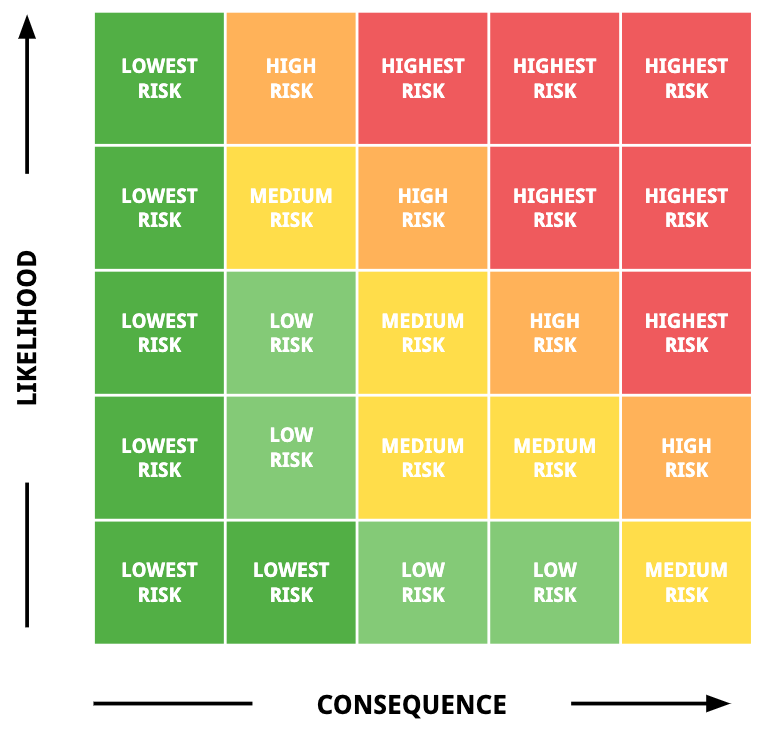
*Source: Managing risk with the NASA Risk Matrix, Ness Labs
Mitigate risk
After using the Risk Matrix to create a risk score, use that score to decide how to mitigate risk. Your business must establish controls for each level of risk across business continuity, reputation, data security, and other potential issues.
For business-continuity issues, controls could include the following:
- Keep an extra day’s worth of supplies in stock at all times.
- Establish a backup plan to acquire supplies if there is a delay.
- Limit reliance on any one vendor by ordering half of your supplies from another vendor.
- Limit orders from your vendor to nonessential items.
- Prohibit use of the vendor.
In our bakery example, a level 5 risk means that we should prohibit use of the California vendor, even though their products are less expensive. The risk of disrupting business continuity is too high.
Vendor risk assessment best practices
It’s impossible to eliminate every aspect of vendor risk, but adhering to a few best practices can greatly reduce the likelihood of risk within your organization.
Consider the following best practices when developing a risk management policy for your company:
Consolidate your vendor list: Prioritize your active vendors to a short, well-managed list of service providers. Consolidating your vendor list allows you to conduct a more robust vendor assessment of potential vendors. It also creates closer working relationships with the vendors you frequently use. This mitigates financial and operational risk.
Use a vendor risk questionnaire: Part of vendor due diligence is obtaining self-reported data from potential vendors. When possible, propose a vendor risk questionnaire to understand the company’s risk and mitigation policies. Additionally, look for any security gaps that could introduce high-risk vendor practices.
Commit to vendor performance reviews: The task of evaluating your chosen vendor doesn’t end once the ink is dry. By conducting regular vendor performance assessments as part of the vendor lifecycle, you can ensure vendors maintain a high level of security and compliance in their internal and external activities.
Track vendor performance metrics: Understanding the performance of your vendor risk management policy becomes easier when you outline and implement vendor performance KPIs. Monitoring these metrics keeps compliance and vendor performance levels strong. Ultimately, it improves vendor relationships.
Insist on strong SLAs in contracts: Service level agreements (SLAs) outline the steps a vendor will take to maintain a certain level of performance. They spell out the consequences and procedures that come into play when a compliance issue arises. SLAs should ensure strict uptime, disaster recovery, and data handling or deletion requirements are outlined and followed during and after the contract term (depending on the SLA in question).
Develop a vendor management policy that eradicates risk
If your business takes a scientific approach to evaluating risk, developing and articulating a vendor management policy should be a straightforward process. A vendor risk management program should consider any areas identified as potentially elevated risks for your company.
Even so, conducting this process for every vendor you work with takes time.
Order.co can save you the hassle. Order.co’s product catalog gives you control over the vendors your team can purchase from to reduce risk, and Order.co’s network includes 15,000+ vetted, reliable vendors that you can trust. Request a demo today to learn more.
Get started
Schedule a demo to see how Order.co can simplifying buying for your business.
"*" indicates required fields
It’s tempting to choose the cheapest vendor without considering the outcome. But race-to-the-bottom decision-making can have unintended consequences.
Nearly half (46%) of firms surveyed in Deloitte’s 2020 Extended Enterprise Risk Management (EERM) Third-party risk management (TPRM) global survey believe that “the financial impact of a failure by a third party or subcontractor has at least doubled over the last five years, with a tenfold increase for one in five.”
This potential for breaks in business continuity (and associated costs) is higher than ever. In addition to losses incurred from the vendor disruption, the firms involved likely pay hefty legal, security, and public-relations fees to mitigate damage.
Businesses can prevent third-party risks and reduce long-term spending by conducting a vendor analysis that focuses on quality—first and foremost. Ask the following five questions during vendor selection to ensure vendors meet your standards for quality.
Download the free tool: Vendor Risk Management Checklist
1. Will the vendor pass a compliance screening?
Third-party fraud is a real risk, and the costs of associating with a vendor that conducts an illegitimate operation can be immense.
Forty-seven percent of the companies surveyed in PwC’s Global Economic Crime and Fraud Survey 2020 said they had experienced fraud in the last two years. Moreover, the cost of these incidents amounted to a whopping $42 billion. These metrics underscore the importance of proactive third-party risk assessment.
A vendor analysis should always determine whether a current or new vendor complies with the law and engages in ethical business practices. One reliable method of determining vendor risk is to require a completed vendor questionnaire from new suppliers.
It’s not safe to assume that potential vendors have been vetted for ethical standards because they sell products on a major e-commerce platform. In a 2020 SEC filing, Amazon said it was “unable to prevent sellers in [its] stores or through other stores from selling unlawful, counterfeit, pirated, or stolen goods,” The Wall Street Journal reported. Most e-commerce platforms behave as just that: a platform. It’s on you, as the buyer, to conduct due diligence.
2. Does the vendor share my business’s values?
Vendor relationships with companies that do not share your values pose a risk to your reputation. Avoid public-relations fees and damage to your brand by prioritizing brand values during vendor analysis.
Think about what your brand actively stands for. For example, if your brand is committed to the environment, pay attention to the vendor’s policies around sustainability. Ask about how products are sourced, stored, packaged, and delivered to ensure they meet your brand standards.
The media frequently calls out major brands for engaging in cost-cutting behavior that deviates from their stated values. Nike, for example, was exposed last year for denying payment to sponsored runners when they became pregnant, while simultaneously championing women’s sports in a series of ads. The backlash that followed these revelations convinced Nike to change its policies, but it lost some customers for life.
Don’t end up in the same place as Nike. Partner exclusively with brands whose leadership and stakeholders meet your business needs and share your values.
Vendor Risk Management Checklist
Download our free vendor risk management checklist to better manage third-party risk and establish stronger vendor lifecycle management practices.
3. Can the vendor scale with my business?
Long-term financial strength relies on scalability. As a best practice, companies should source all products considered essential to brand identity through a vendor who can scale with the business. Make sure your vendor analysis considers business continuity not just today, but as you grow.
Say, for example, you run a Pilates studio. Your first location is a smashing success, so you replicate this business model and open three more. And then another five. But when you try to create an order for the necessary equipment at the third wave of locations, you learn it isn’t possible. Your vendor can’t support the size of your custom order. Reluctantly, you purchase different equipment from the vendor. However, when it arrives, it isn’t up to the same standard of quality your customers have learned to expect. Disappointed by the changes, your customers fall out of the loyalty loop and begin experimenting with other studios.
The right vendor should be able to support larger quantities of your order if/when your business grows. If it can’t, your ability to offer a consistent customer experience across locations is at risk. In addition, inconsistencies are harmful to your brand roadmap and cost you revenue if they result in diminished customer trust.
4. How will the vendor source my product if there is a disruption to its supply chain?
An out-of-stock item can range from a nuisance to a significant blow to business continuity. Vendors source their products from a wide range of suppliers, who, in turn, have suppliers of their own. During your vendor analysis, ask each vendor about their contingency plans for supply chain management issues to avoid surprises if/when you begin working together.
The potential for business disruption is immense, especially for manufacturers located in high-risk geographies. Fortunately, many vendors are large enough that they can offer a similar product if yours goes out of stock.
First, however, you’ll want to know which product they are likely to replace your usual order with. Then, what key differences exist between the two products, and whether there will be additional charges for the swap.
Vendor Risk Management Checklist
Download our free vendor risk management checklist to better manage third-party risk and establish stronger vendor lifecycle management practices.
"*" indicates required fields
5. Does the vendor provide a high-quality experience?
A vendor that gets your order wrong, or can’t guarantee timely delivery, will end up costing your business.
Let’s say your spa relies on bulk procurement of cleaning products and hand sanitizer. Unfortunately, the delivery arrives a few days late, so you ask your receptionist to pick up some cleaning solution from the pharmacy before his shift. Not only do you now have to make an ad hoc purchase with considerable markups, but you also need to pay your receptionist for their time and process their expense report.
Issues like this do occasionally arise. Life—and weather—get in the way of what we plan, and we have to be adaptable. But what happens if this becomes a recurring issue? And what if, when the delivery does arrive, the order is incorrect? Now your receptionist has to run to the pharmacy and return a package, but your business still hasn’t received its cleaning supplies.
Avoid situations like this by asking the vendor for references who can attest to the quality of the vendor’s services. You can also check out online reviews and scorecard reports on sites like Better Business Bureau. During your vendor evaluation, pay attention to reviewers who comment on the accuracy and timeliness of orders, the quality of products, and the willingness of the vendor’s customer service team to resolve issues quickly.
Vendor analysis shouldn’t end with a contract
Vendor analysis is one of your most critical business processes. Your supplier lifecycle analysis should feature annual audits to ensure that current vendors remain cost effective. Determine the expected versus the actual costs of a vendor during these audits, adding in any additional fees incurred from using the vendor’s services.
Examine whether the vendor still meets all relevant use cases and scenarios. You should also assess whether your or the vendor’s values have changed and whether the vendor still meets your compliance standards.
Order.co’s network of more than 3,000 vendors makes ongoing vendor management easy. We work with each customer to identify strategic savings opportunities, improve vendor performance, implement time-saving automation, and ensure that your supply chain is never disrupted. To learn more, schedule a demo with a member of our sales team.
Get started
Schedule a demo to see how Order.co can simplifying buying for your business.
"*" indicates required fields
The thought of choosing a vendor management system might make your skin crawl. When would you even find the time? But like most finance and operations professionals, you know if you don’t do it now, you’ll be wishing you did as your department gets busier.
A vendor management system (VMS) can profoundly impact your business and its day-to-day operations. This solution centralizes purchasing, budgeting, vendor selection, delivery tracking, invoicing, and reporting. Managing these processes is time intensive and costly, which explains why more than half of companies are currently focusing on digital transformation as a top priority.
But how do you choose the right VMS: one within the budget that will address your unique day-to-day challenges?
It isn’t complicated if you are pragmatic in your approach. To help, we’ve created the following roadmap, with an overview of the key features you’ll want in your VMS automation software. Let’s take a look.
Download the free ebook: Choose the Right Procurement Technology With This Decision Matrix
What is a vendor management system (VMS)?
A vendor management system is a cloud-based software tool that helps organizations track and manage the supplier relationships that keep their businesses moving forward. A vendor management system centralizes data for each of the suppliers or service vendors a company works with. Common data stored within a VMS includes the following:
- Supplier contact information
- Supplier payment details and terms
- Copies of vendor agreements
- Standard purchase price data
- Historical purchase requisitions or purchase orders
- Vendor invoice images and due dates
- Payment confirmations
- Vendor lifecycle evaluation data
- Supplier performance evaluations
- Notes and supporting documentation
Why are vendor management systems important?
Organizations conduct business with a growing number of external vendors. Managing dozens or hundreds of vendor relationships manually can lead to costly and time-consuming issues with ordering, compliance, and payment, and overall vendor risk management.
Implementing a software solution for managing and centralizing your vendor data reduces or eliminates these issues.
By using a vendor management system to track supplier agreements and relationships, organizations can reap substantial benefits:
- Reducing spending on materials, goods, and services
- Consolidating suppliers into a preferred program
- Tracking reorder and renewal information
- Improving supplier compliance rates
- Streamlining the procurement strategy and process
- Automating the accounts payable (AP) process
- Improving decision-making through better data visibility
Choose the Right Procurement Technology With This Decision Matrix
Find 15 must-ask questions to narrow down your software search and make your research process MUCH easier.
How vendor management systems save money
Though it may seem contradictory, investing in the right vendor management system can result in net savings for your organization. It can reduce your bottom line, eliminate discrepancies due to human error, and free up your team from manual processes. All of these have the potential to reduce the overhead costs associated with AP department administration, invoice processing, and data entry. With automation, there are many ways to save:
- Reducing the cost to process an invoice by up to 80%
- Increasing invoice processing flow from tens to thousands per day
- Eliminating costly and time-wasting invoice exceptions
- Taking advantage of early payment discounts for timely payments
- Reducing financial liabilities from third-party risk
All this being said, it’s essential to choose the best VMS solution for your business and its unique needs. Let’s look at the features that make a vendor management system useful. What features should a vendor management system have?
Steps to choosing a vendor management system
The process for selecting a vendor management system should be thorough and carefully considered. It should address any pain points your business currently experiences and offer solutions for improving your vendor management processes.
Establish goals for the system
It may sound obvious, but the first step to choosing a vendor management system is understanding why you need one. If you identify the pain points you want to solve before you kick off your search, you’ll bring direction to your research, which will enable you to measure each solution by its ability to meet your specific objectives. Think about this in both the short and the long term.
Ask yourself some questions:
- How much accounts payable automation (if any) do we currently use?
- What are the most pressing problems with our current vendor management and accounting system?
- How often does the accounts payable department deal with issues like invoice exceptions, late payments, double-entry issues, or late fees?
- Has the team encountered wide-scale issues such as fraudulent invoices or missing invoice payments?
Based on the above information, you may determine some short-term or long-term goals for your procurement function.
Assess your current system
Once you determine what you need most, look at what you have currently in place. Understanding how AP automation will fit into the larger tech stack and approval process can help guide decision-making.
If your organization has existing systems in place (either manual or automated), ask the following:
- Do we currently have a procure-to-pay system in place, and is it fit for service according to our current operations?
- What internal controls or workflow options are currently in place for things like invoice approval, three-way matching, vendor payments processing, etc.?
- How do we currently access, edit, and use invoice data? What data formats do we need to incorporate?
Examine integration potential
The vendor management system you select should be compatible with your existing tech stack without jeopardizing your company’s data. Consult with your IT and compliance teams to ensure that the solutions you’re considering work well with the technology you already use and that you can trust each one to protect your data.
- Start by setting up a quick call with someone on your IT team. Let them know you are considering a few software solutions, and ask whether there are any questions you should ask vendors about application programming interfaces (APIs). Your IT team may have documented requirements or supplier questionnaires available to use.
- Then, reach out to your compliance department as part of the interdepartmental approval process. They can help you evaluate whether vendors are housing company data safely. They may even have established criteria that all vendors must meet.
- Based on this information, identify at least three suppliers or AP automation solutions that may fit your current business processes and meet your future goals. Look for a solution that offers a flexible and intuitive platform, a high level of security for sensitive data like financial statements and payment processing, and plenty of integration options.
Prepare for VMS product demos
Once you’ve identified the vendors you want to consider, set up a demo with each. During these demos, control the narrative by focusing on what you need from a vendor management system to succeed.
Before the demo, prepare a list of questions you’ll need answered in order to feel confident enough to make a decision. Have a sense of your budget and estimate how much you hope to save by investing in vendor management software. You can also ask a member of your IT team to join the demo if it makes you feel more confident.
At the beginning of the demo, remind the sales representative of your pain points and goals. This will help ensure that he or she focuses on your unique needs, and it will set up the conversation to address your specific questions.
Choose the Right Procurement Technology With This Decision Matrix
Find 15 must-ask questions to narrow down your software search and make your research process MUCH easier.
"*" indicates required fields
Evaluate vendor management systems with a scorecard
Once you have evaluated the product offering for each shortlisted supplier, you should be close to a decision. If you have difficulty choosing between two closely matched options, consider using a decision matrix to clarify your needs and advance to a final decision.
The following matrix covers key decision criteria for a vendor management solution. To use the matrix, answer each question on the left on a scale of 1 to 5 and note it in the column on the right. Tally up your responses for a final score. Do this for each vendor, and then select the vendor with the highest score.
Question | Rating (1–5) 1: Strongly disagree 2: Disagree 3: Sort of agree 4: Agree 5: Strongly agree |
|---|---|
Is the VMS within my budget? | |
Will the VMS recommend alternative brands and products that may save my business money? | |
Is the VMS likely to bring savings of at least 8% to my business purchasing? | |
Will the VMS reduce the number of people needed to complete a purchase? | |
Will the VMS make the purchasing process faster? | |
Do I trust the VMS to house my company’s data? | |
Will the VMS make it easier to set and enforce budgets? | |
Will the VMS help to integrate finance, operations, and purchasing in one platform? | |
Will the VMS enable my business to make purchases for multiple locations in one order? | |
Will the VMS allow my team members to streamline approvals? | |
Do I trust the business behind the VMS to onboard my team and troubleshoot any issues we may have using the software? | |
Does the VMS provide invoicing data validation and purchasing reports? | |
Does the VMS integrate with other software solutions in my company’s existing tech stack? | |
| TOTAL SCORE |
Feel confident about your VMS decision
By taking the time to evaluate and select the right vendor management system, you can arrive at a decision and implement it with confidence.
Order.co brings together the best features of a vendor management system in an intuitive platform. It works with enterprise resource planning (ERP), finance, and accounting solutions to provide total visibility into your financial life. It offers full automation of the AP process and flexibility to serve your business across all locations and applications. With Order.co, your purchasing department can shed the busywork and build stronger supplier relationships with ease.
To see how Order.co could fit within your organization, schedule a demo.
Get started
Schedule a demo to see how Order.co can simplify buying for your business.
"*" indicates required fields
If your organization still uses manual procurement processes, you already know they’re time-consuming. But many procurement professionals don’t realize how costly and risky they can be—or how dramatically automation changes the game.
This article discusses the benefits of procurement automation. It also addresses common questions you might have when considering moving to automated purchasing, including:
- What is procurement automation?
- How does technology improve procurement?
- Which procurement processes should you automate?
- Which features matter most in a procurement automation tool?
What is procurement automation?
Procurement automation means digitizing and systematizing the sourcing, purchasing, and processing of payments for goods and services. Automation often occurs within a procurement software tool and creates a repeatable and traceable process for every purchase flowing through an organization.
Why should you automate your procurement process?
Businesses use automated procurement strategies to plan purchases while achieving two core objectives: risk reduction and cost efficiency.
Risk reduction
Risk is an inherent part of procurement. Important orders get misplaced, deliveries arrive later than expected, and suppliers fail to meet compliance standards. As companies and their needs grow, room for error and fraud grows exponentially.
Procurement automation reduces risk by creating a secure, repeatable process with high levels of vendor confidence. With automation:
- Purchases occur through thoroughly vetted and onboarded vendors
- The purchase process takes place in an automated system that checks both order and invoice accuracy
- Automatic general ledger (GL) coding ensures purchases are properly categorized and tracked
- Automated payments verify the right vendor is paid on time while preventing duplicate payments
Cost efficiency
As companies grow, maintaining cost efficiency using spreadsheets or manual processes becomes increasingly difficult. Orders become haphazard, accounts payable staff perform unnecessary repetitive tasks, and additional fees for incorrect data entry or missed payments drive up supply costs.
Procurement automation software helps companies avoid many of these issues. Automating procurement processes creates cost efficiency by streamlining the purchase-to-pay process and automatically routing requests to optimize the procurement cycle. It allows accounting to:
- Route purchase requests quickly
- Automate reviews and approvals
- Quickly and accurately account for purchases
- Centralize purchasing data for quick retrieval

Choose the Right Procurement Technology With This Decision Matrix
Find 15 must-ask questions to narrow down your software search and make your research process MUCH easier.
7 Benefits of procurement automation
Technology automates many components of the typical procurement strategy, eliminating inefficiencies and reducing procurement costs and risks.
Compares cost across vendors
One of the most obvious ways to improve cost efficiency in a procurement strategy is to identify the vendors with the lowest prices. However, doing so manually can take days or weeks. Fortunately, vendor management systems automate much of the research, ensuring businesses find the best deals without draining their resources.
Our sourcing engines at Order.co automatically seek vendor and product substitutions that may be more cost-effective. This service identified over 10% in cost-reduction opportunities for Cozen O’Connor, a leading global law firm. The firm saved between $5,000 and $6,000 per month without replacing its preferred products or brands.
The same sourcing technology can also reduce risk. XpresSpa, a health and beauty company, faced the unique procurement challenge of adhering to airport security. With Order.co, XpresSpa filtered vendors to meet compliance standards, resulting in on-catalog compliance growth from 70% to 100% and a cost savings of over 9.6%, or $68,000, per year.
Bundles orders
Another way to achieve cost savings and reduce risk is to consolidate supplier relationships. By bundling orders using automation, companies decrease operational and material costs and reduce the risk of noncompliance.
Automation groups orders across locations so companies can purchase supplies in bulk at a discount. This strategy is especially effective for businesses with strict supplier qualifications because it eliminates the excess work of performing multiple vendor compliance checks.
Keeps information organized
Disorganization is one of the greatest risks to a successful procurement strategy. When information is scattered, not only do employees waste valuable time tracking it down, but the likelihood of human error also increases.
By using a procurement system to centralize the entire process and enable automated vendor and contract management, team members avoid having to visit dozens or hundreds of websites and keep track of countless logins. Placing and approving orders on a single platform keeps information organized and reduces risk.
Reduces time spent on purchasing
Centralizing product orders and purchase order processing through automation saves finance and operations teams considerable time. Streamlining the purchasing process reduces bottlenecks and enables ordering from multiple vendors simultaneously, making procurement faster and more efficient.
Automation also allows buyers to set up repeat purchase requests as subscriptions instead of generating a purchase requisition every time. This decreases the burden on the stakeholder and procurement department and speeds up the ordering process. With faster cycle times come faster deliveries, so businesses also reduce the risk of delayed shipments.
Eliminates maverick spend
Procurement strategies are often thwarted by stakeholders who believe they can save time or money by circumventing the system. If a process is manual or clumsy, stakeholders may see it as an obstacle to meeting their goals. Although most often done without ill intent, unapproved or maverick spend is still harmful to a business. It breaks the budget and increases risk.
With automation technology that organizes and manages spending, employees make purchases using simple, approved processes. These processes are key in reducing tail spend while enforcing guidelines and budget limits that prevent overspending.
Simplifies invoicing
Manually tracking spending across vendors requires finance departments to manage the tedious process of entering and paying individual receipts and invoices. Automation solutions simplify this process by creating a central repository for all invoice data. Simplifying invoicing saves significant time and reduces the risk of manual errors in reporting and tax filing.
Invoice management automation helped ZeroCater, a workplace and event catering company, consolidate and streamline invoice payment processes. “For Amazon alone, we went from 200 invoices a month to maybe three or four,” said Keith Bowles of ZeroCater.
Provides the data needed to measure success
Every sound business strategy should include a plan to measure success. For procurement teams, one of the most telling metrics to measure is spend data. However, manually gathering and organizing this data is tedious and time-consuming.
Vendor management systems simplify this process by automatically tracking spend data in one centralized location, allowing finance and operations teams to run reports and conduct analyses in much less time. With the help of accurate data, companies can track the success of their procurement strategies and flag any issues that may prevent them from reaching their procurement goals.
Choose the Right Procurement Technology With This Decision Matrix
Find 15 must-ask questions to narrow down your software search and make your research process MUCH easier.
"*" indicates required fields
Top procurement processes to automate
Automation can make every step of procurement easier, but a few big-ticket items within the process deliver the most impact. Consider prioritizing these common procurement tasks first:
Purchase order creation: Creating purchase orders from spreadsheets or a Google form is time-consuming and can lead to errors in the procurement process. Automate your order creation and approval processes to streamline purchasing while reducing the time and effort involved.
Supplier onboarding: Simplify the onboarding process for new suppliers with automated workflows, ensuring you collect all necessary documentation. Centralizing vendor data into a platform means you’ll never have to hunt for contact information, payment details, or contracts.
Invoice processing: Leverage automation to match invoices with purchase orders and delivery receipts, approve invoices for payment, and automate the reporting and reconciliation processes. Automating invoicing and payments greatly improves the speed of processing, accuracy of data, and ability to leverage early pay discounts.
Contract management: Use automation tools to manage contracts throughout their life cycles, from creation and signing to renewal or termination. Centralized contract compliance helps companies reduce risk and ensure supplier relationships remain competitive.
Spend analysis: There’s a wealth of data within your procurement function. Using technology, you can get more insights from your purchasing activities to build a stronger procurement process. Aggregate spending data within a procure-to-pay platform and use reporting technology to analyze spend, identify savings opportunities, and make budgeting easier.
Vendor performance tracking: Vendor performance is an important part of long-term procurement efficiency. Implement systems that help you track and evaluate supplier performance against KPIs (key performance indicators) and contracts. This advanced procurement technique can improve your purchasing program.
5 Features to look for in a procurement automation tool
A well-structured, flexible procurement tool is essential to running a successful, automated procurement process. When researching options, look for a tool that offers ease of use, integration capabilities, and features that reduce repetitive and time-consuming tasks.
- User-friendly procurement features: The ideal procurement system balances performance with ease of use. The platform should be simple to learn and navigate, allowing stakeholders to self-serve their procurement needs. Look for a system with guided purchasing features, such as a catalog of in-policy and popular items for easy selection and reordering.
- Comprehensive spend analysis features: Aim to select an automation platform that offers in-depth spend management analysis capabilities, including the ability to categorize spend across different vendors, departments, and projects. The right tool should also provide insights into spending trends and the effectiveness of current procurement strategies.
- Seamless integration with existing systems: Modern procurement software must interact with many other tools in a tech stack, such as your existing financial, ERP (enterprise resource planning), and CRM (customer relationship management) systems. Easy integration ensures data flows smoothly and enables real-time visibility and control over procurement processes.
- Automated workflows: Automation is key to increasing efficiency within procurement functions. Look for a tool that automates routine manual tasks such as purchase request approvals, purchase order generation, and invoice processing. This not only saves time but also reduces the likelihood of errors.
- Advanced reporting and analytics: Generating reports and analytics is an essential part of understanding and refining your procurement process. Select software that offers customizable reporting features for analyzing various aspects of your procurement activities. A tool that provides superior access to data insights will drive more strategic decision-making, help identify cost-saving opportunities, and improve overall procurement performance.
Steps for implementing procurement automation
If you’re at the beginning of your automation process, here are some simple steps to set the project up for success:
1. Set procurement policies
The heart of automation is a solid process. Develop and document a procurement policy that establishes spending guidelines, due diligence in vendor selection, legal and security reviews, and approval workflows. Setting the foundation with well-crafted business processes ensures the automation project works for your business needs.
2. Collect your vendor data in one place
Pull together all available information on the current vendors in your supply chain. This information may come from accounting data, contract management sources, or department heads responsible for ordering. For now, even using a spreadsheet to consolidate vendor information will work.
3. Work toward total digitization
Paper-based systems are incompatible with procurement automation. Transfer all contracts and invoice data into a digital format for easier access. Research partners for procurement automation software.
4. Identify areas for consolidation
Having procurement data in one place provides visibility to identify overlap and redundancy. Find opportunities to reduce necessary vendors and bundle orders across locations to benefit from economies of scale.
How Order.co promotes growth with an automated procurement strategy
When backed by automation, procurement strategies can reduce risk and improve spend management. Procurement automation allows for easy replication of spending processes and efficient order grouping, enabling cost savings. Organizations using procurement process automation create scalability that makes growth and expansion easier.
Order.co automates the key processes that lead to savings and risk reduction across your organization at any stage by:
- Creating an automated procurement workflow to streamline time-consuming purchase requisition and approval processes
- Allowing stakeholders to make purchase requests through a preapproved selection of vendors, which saves money and reduces third-party risk
- Removing manual accounting processes to speed purchase order and invoice processing, fulfillment, and reconciliation
Find out how Order.co can enhance your procurement strategy, reduce risk, and support your business's growth. Request a demo to get started.
Get Started
Schedule a demo to see how Order.co can simplifying buying for your business.
"*" indicates required fields
It’s the burning question for every retail financial officer: how can our business stay afloat after COVID-19?
At Order.co, we hear this often from clients and prospects who are evaluating changes to their operations in light of the pandemic.
Retail sales dropped 8.3% in March and 16.4% in April, according to Reuters—the sharpest decline in retail sales since the government began tracking the data 28 years ago. Although June data showed a decent recovery, 16.4% is an incredible drop to bounce back from, and it’s complicated by the new normal that retail businesses must operate in.
Amid safety concerns, in-store operational costs have risen, but sales may continue to cool. Consumer behavior has also changed irreversibly, with wavering brand loyalty and a much stronger preference for ecommerce.
To adapt to this new normal and succeed long-term in a post-COVID-19 world, businesses must make operational investments everywhere, from their supply chain to their website. It will be up to retail financial officers to pave the way for this evolution.
Understand that consumer behaviors have changed irreversibly
Empty shelves in the lead-up to lockdown left consumers with little choice but to experiment with new products and shopping experiences. The result has been an altered consumer sentiment that will change the future of retail forever. Over 60% of consumers globally have changed their shopping behavior, and between 65-85% of those consumers aren’t planning to revert back, according to research from McKinsey.
These behavioral changes have solidified the domination of ecommerce. Most retail categories saw more than 10% of online growth between March and July 2020, McKinsey data revealed. In May alone, online apparel sales grew 65%, according to Adobe’s Digital Economy Index.
New behaviors also suggest diminished brand loyalty. Consumers who were unable to purchase their favorite products at the peak of the pandemic have adapted to using new ones and are more open to the idea of change.
These behavioral changes cannot be dismissed as a one-off event. While consumer preferences will continue to evolve over time, there is no going back to the way things were before the pandemic.
5 Proven Strategies to Streamline Retail Operations and Create Memorable In-Store Experiences
Creating consistent, measurable, memorable in-store customer experiences is your key to standing out from competitors. Download the guide today to get started!
Evaluate risks in the supply chain
As we’ve seen with decreased brand loyalty in the wake of COVID-19, supply chain failures can have a long-lasting impact on a business. Businesses can guard against this risk by creating redundancy in their supply chains, even if it comes at the cost of everyday efficiencies. Unfortunately, many essential businesses failed to do so before the pandemic. The most obvious examples occurred in grocery stores and pharmacies, where essentials like bread, canned vegetables, and toilet paper completely sold out.
According to Brittain Ladd, who consults for Kroger and Amazon, empty shelves could have been avoided if grocery retailers had focused more on reducing risk in their supply chain than reducing costs.
“The coronavirus has proven the weaknesses in having an efficient supply chain with minimal inventory. Many retailers had only two to three weeks’ worth of safety stock in their facilities when the virus hit,” Ladd, said in an interview with GLG.
The result of this supply chain failure—in addition to chaos—is lost revenue. For essential goods, crises are actually a business opportunity. Failure to meet consumer demand ultimately means leaving money on the table.
Failure to meet consumer demand ultimately means leaving money on the table.
Another key issue the pandemic unveiled is that companies tend to rely too heavily on one geographical area, in spite of geopolitical risks. This became a huge source of disruption when China was quarantined.
Colin Hunter, president of menswear brand Alton Lane, says his company has intentionally created redundancies in the supply chain across multiple countries for this very reason.
“Over the years we have been very thoughtful and methodical about that expansion of our supply chain, and it really has been a benefit for us,” Hunter says.
Whether it’s an abundance of inventory or a lack thereof, each retail category will face unique supply-chain challenges during future crises. That’s why it’s so important now for retail financial officers to pay close attention to how COVID-19 has impacted their own sector and to make adjustments that will safeguard their businesses against future risk.
Digitize the in-store experience
Retail brands have been under pressure to digitally transform their physical spaces for several years, and COVID-19 has served as the catalyst for many to actually do so. With lingering fears of infection and future pandemics, retail brands have little choice but to incorporate digital tools, which, by streamlining facets of the in-store experience, also create an environment where consumers feel comfortable shopping.
Retail businesses should take this opportunity to win customers’ trust and regain some brand loyalty.
One easy way to do this is to incorporate contactless payments so customers can minimize their exposure to other shoppers and in-store associates. Although the United States has been slow to adopt this technology, survey data from Mastercard shows that 8 out of 10 global consumers are already using it, and pressure on merchants to adopt a contactless option is quickly mounting.
Retail brands with cash to play with R&D should also think bigger than existing technologies, as Amazon has with the smart shopping cart it plans to launch later this year in its brick-and-mortar stores.
The “dash cart” will automatically scan a product as it is inserted into the cart, so customers don’t need to check out at all. This, again, is more convenient for shoppers and makes a trip to the grocery store faster and safer.
5 Proven Strategies to Streamline Retail Operations and Create Memorable In-Store Experiences
Creating consistent, measurable, memorable in-store customer experiences is your key to standing out from competitors. Download the guide today to get started!
"*" indicates required fields
Break down any barriers to online purchasing
In the same vein, retail brands need to invest in transforming the digital experience. On average, almost 70% of online shoppers abandon their carts without purchasing, according to Baymard Institute. Of those shoppers who leave behind empty carts, 50% of users do so because extra fees are too high, and 28% abandon because they are asked to create an account. Those are easy barriers to fix, and it would be foolish to overlook them.
But even if the checkout experience appears seamless, retail brands should pay close attention to their conversion rates. If a high volume of web visitors are leaving their carts behind, there may be an underlying issue with the site’s technology.
It could be that the checkout process simply takes too long, which gives the customer time to second-guess their purchase. If this looks like it might be the case, try incorporating digital tools, such as Shopify’s Shop Pay, which increases the speed of checkout up to four times, or another one of Shopify’s best plugins.
Or, if your business is having trouble getting traffic to your site to begin with, consider selling with tech giants, like Amazon, that already have a mass following. While it’s true that Amazon has accelerated the shift to online shopping, it can still be a valuable tool for brick-and-mortar shops that are trying to raise brand awareness and sell to new audiences.
Adapt purchasing decisions to support new operations
While many of the long-term business changes needed to succeed in a post-COVID-19 world require buy-in from the broader organization, the retail financial officer can take steps within their own department to alleviate challenges.
One way to do so is simply to streamline the purchase of new supplies, such as masks and hand sanitizer. In the lead-up to lockdown, individual stores within a franchise likely found themselves rushing to local pharmacies to buy up masks, hand sanitizer, and disinfectant wipes in bulk. Now, those products are an essential part of everyday business and should be treated as such.
Another easy step is to cut existing costs by investing in procurement technology. This technology can centralize ordering, helping businesses identify the best vendors and save money on bulk orders. And, as businesses learn to operate with a leaner staff, procurement technology allows finance managers to streamline their purchasing and accounting processes without sacrificing quality.
Embrace the new normal
The health of the organization depends on the health of the consumer, and that must remain every retail business’s top priority as they navigate through COVID-19. Retail financial officers, however, cannot afford to forget that the new normal is here to stay and that succeeding in a post-COVID-19 world will require the business to make significant operational changes.
Order.co has helped premier retail and fitness brands adapt their operations through major business changes since 2014. Check out our case studies or request a demo.
Get started
Schedule a demo to see how Order.co can simplify buying for your business.
"*" indicates required fields