Best Spend Control Platforms for Multi-Location Businesses (2027)

Best Spend Control Platforms for Multi-Location Businesses (2027)
Ramp and Brex are the best-known spend control platforms for companies that run spending through corporate cards. Coupa and Procurify add formal purchase approvals. For multi-location businesses buying supplies from many vendors, Order.co controls spend before purchases happen, with budgets by location, approval rules, and one consolidated invoice.
Spend rarely gets out of control all at once. It slips away one location at a time: a manager buys from whichever vendor has stock, another site pays more for the same product, and finance finds out when the invoices arrive. For multi-location businesses, the right spend control platform stops that drift by setting the rules before money moves.
This guide compares five platforms (Order.co, Ramp, Brex, Coupa and Procurify) on the capabilities multi-location teams rely on most: approvals, budgets, corporate cards, vendor catalogs and consolidated invoicing.
Evaluating your options? Take a self-guided tour of Order.co
What multi-location businesses need from spend control platforms
Spend control is harder across locations because buying decisions are spread across many people, vendors and budgets. Five capabilities matter most:
- Approvals: Routing that adjusts by user, location, cost center or dollar amount, so a routine reorder and a large purchase don't follow the same path.
- Budgets: Limits and visibility by location, department or cost center, so overruns show up before month-end.
- Corporate and virtual cards: Cards with built-in limits, vendor restrictions and expiration dates.
- Vendor catalogs: Pre-approved products and suppliers, so the compliant choice is also the easy one.
- Consolidated invoicing: Fewer invoices for AP to process, with spend coded correctly at the source.
The main question is where each platform applies control: at the point of purchase, at the card swipe, or after the fact. Order.co's own comparison of spend management tools also separates all-in-one platforms from point solutions. All-in-one platforms combine purchasing and payments in one system. Point solutions do one job well, such as cards or approvals, and leave you to connect the rest.
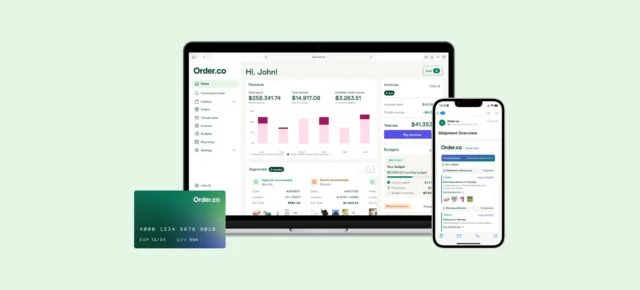
See how Order.co stacks up
Tour the product yourself now — no demo request, no waiting.
The best spend control platforms for multi-location businesses
1. Order.co: best for indirect spend across many locations
Order.co is an AI-powered procurement and spend management platform built for mid-market and enterprise organizations buying across multiple departments or locations. It combines spend data and line-item coding with the fulfillment side of procurement, so requests, approvals and vendor orders happen in one system.
The difference is timing. Order.co's approach to spend control applies approvals, budgets and vendor-locked virtual cards before a purchase happens, not after the invoice arrives.
- Approvals: Workflows can be configured by user, location, cost center or spend threshold.
- Vendor catalogs: Curated, pre-approved catalogs keep compliant purchasing the default path. Order.co describes this as a guided marketplace where every product is pre-approved to meet budgets, sourcing needs and approval policies.
- Budgets: Real-time tracking and predefined limits, set with budgets and virtual cards, keep each location within its allocation.
- Cards: Vendor-locked virtual cards come with custom spend limits and expiration dates.
- Consolidated invoicing: Centralized billing is designed to cut the number of invoices finance has to process.
- Accounting: Line-item GL coding syncs to QuickBooks, NetSuite or Sage Intacct.
In practice: CorePower Yoga struggled to control unapproved purchases across more than 200 studios. After centralizing purchasing and approvals with Order.co, it eliminated about $50,000 a month in rogue spend and reduced the invoice load on its AP team.
Trade-off: Order.co is best for indirect spend, such as vendor purchasing, supplies and operational categories. Teams whose spend runs mainly through employee cards and reimbursements will need a dedicated travel and expense tool alongside it.
Best for: Multi-location operators with high-volume purchasing of physical goods and services.
2. Ramp: best for card-led spend control
Ramp consolidates corporate cards, expense management, bill payments, accounting and reporting in one platform, aimed at helping finance teams close their books faster. It offers physical and virtual cards, automated expense capture, global spend management tools and cashback on card spend.
Ramp is a strong choice for card-based spend. Order.co's comparison credits it with granular, multi-location spend rules, which suits teams that run most purchasing through cards.
Trade-off: Bill payments are currently limited to domestic vendors, which adds friction for organizations that buy internationally.
Best for: Small to mid-market teams whose spend runs mostly through cards and who buy mainly from domestic vendors.
3. Brex: best for card-based budgets and travel
Brex offers a card-based system for managing budgets and expenses. Individual credit limits draw on company cash flow rather than personal liability, and managers can approve by exception instead of reviewing every purchase. The platform also includes travel management, a mobile app for approvals and bill pay. For companies that run spending through corporate cards, it is a strong option.
Trade-off: Reporting for individual users requires manual sorting instead of on-demand spend reports, and mobile receipt uploads don't always work reliably.
Best for: Small businesses scaling toward mid-market that want cards, travel and expense management in one place.
4. Coupa: best for broader procurement suites
Coupa is a source-to-pay and AP automation platform that, in its own AWS Marketplace listing, is described as covering both direct and indirect spend. It is the broadest suite of the five, with purchasing, approvals and supplier management in one workflow.
- Approvals: Built-in approval workflows run through purchasing and payment processes.
- Budgets: Spend is tracked against budgets, with the aim of catching budget overruns.
- Invoicing and AP: Touchless invoice processing, automated exception routing and fraud detection are part of the AP automation offering.
- Supplier collaboration: Buyers and suppliers work together on purchase order creation, confirmation, shipping, receiving and invoicing.
Trade-off: Coupa is a full suite, and that shows in the price. Pricing starts at $50k per year, billed annually, on 3- or 5-year terms, so it is a significant commitment to weigh against the size of your operation.
Best for: Finance, procurement and AP teams that want one source-to-pay suite covering direct and indirect spend.
5. Procurify: best for structured purchasing workflows
Procurify is a cloud-based purchasing platform that helps mid-market businesses manage spending through customizable approvals and real-time budget tracking, replacing manual paper requisitions. Its multi-stage approval workflows can route by dollar amount, department or location, and it supports catalog-style reordering of previously purchased items.
It covers the intake-to-pay cycle, from purchase requests and approvals through AP automation and payment. According to Order.co's comparison, it doesn't offer a pre-approved product catalog or centralized vendor billing the way Order.co does. Operators with heavy physical goods spend may need that extra layer of catalog control.
Trade-off: Changing purchase orders that are already in progress is reportedly difficult, and there is no dashboard view of in-progress orders.
Best for: Mid-market teams moving off spreadsheets and paper requisitions that need approval routing and budget tracking.
Side-by-side comparison
| Tool | Best for | Controls before purchase (approvals, budgets) | Corporate cards | Vendor catalog | Consolidated invoicing |
|---|---|---|---|---|---|
| Order.co | Multi-location supply purchasing | Yes: approvals by user, location, cost center or spend threshold; budgets and spend limits | Yes: vendor-locked virtual cards with custom limits and expiration dates | Yes: curated, pre-approved catalog | Yes: centralized billing |
| Ramp | Card-based spend | Yes: spend rules, including multi-location rules | Yes: physical and virtual cards | Yes: punchout to connected suppliers’ catalogs (Ramp Procurement add-on) | No: bills handled per vendor; payments batch only within a single vendor |
| Brex | Card-based budgets and travel | Yes: individual card limits, with approval by exception | Yes: corporate cards | No native catalog found; procurement intake runs through partners like Zip and Vendr | No: vendor invoices processed individually |
| Coupa | Broad source-to-pay suites | Yes: built-in approval workflows; spend tracked against budgets | Yes: virtual cards through Coupa Pay (partner banks) and Coupa Card | Yes: hosted and punchout supplier catalogs | No: suppliers invoice individually |
| Procurify | Structured purchasing workflows | Yes: multi-stage approvals by amount, department or location; real-time budget tracking | Yes: prepaid physical and virtual Spending Cards | Partial: catalog-style reordering of past purchases, no pre-approved catalog | No centralized vendor billing |
See how Order.co stacks up
Tour the product yourself now — no demo request, no waiting.
How to choose the best tool for your team
- Start with your biggest spend category. If most of your spend is physical goods and operational supplies across many sites, favor catalog control and consolidated billing. If it is software, travel and employee expenses, a card-led platform is a closer fit.
- Decide where you want control to happen. Controlling spend before an order is placed prevents problems that after-the-fact reporting can only flag.
- Check approvals against your structure. Look for routing by location, cost center and dollar amount, not a single fixed chain.
- Confirm accounting integration. Line-item coding that syncs to your ERP reduces month-end reconciliation.
- Plan for more than one tool if needed. Many teams pair a procurement platform with a card or expense tool to cover all of their spend.
Bring control to every location with Order.co
Ramp and Brex are strong when spending runs through corporate cards, and Coupa and Procurify add formal purchase approvals. But if your team buys supplies from many vendors across many locations, reviewing spend after the fact is too late. Order.co sets approvals, location budgets and vendor-locked virtual cards before the purchase happens, then rolls everything into one consolidated invoice. CorePower Yoga used that model to eliminate about $50,000 a month in rogue spend across more than 200 studios.
See how Order.co controls spend before it happens, and what that would look like across your locations. Book a demo today.
Frequently asked questions
A spend control platform sets the rules for how money gets spent, then enforces them. Those rules typically include approval workflows, budgets, card limits and pre-approved vendors, so purchases are checked against policy before or as they happen instead of being reviewed afterward.
When many sites buy independently, the same product can be bought from different vendors at different prices, and finance has little visibility until invoices arrive. Spend control gives each location room to buy what it needs while keeping purchasing inside company-wide rules.
For multi-location teams, the most useful capabilities are approvals that route by location, cost center and dollar amount, budgets by site or department, cards with built-in limits, vendor catalogs, and consolidated invoicing. Accounting integration matters too, because it reduces reconciliation work at month-end.
Before is generally more effective. Approvals, catalogs and card limits can stop an off-policy purchase from happening, while after-the-fact reporting can only show you that it did.
Yes. Many teams pair a procurement platform for vendor purchasing with a card or expense tool for travel and employee spend. The key is making sure budgets and coding stay consistent across both, ideally by syncing to the same accounting system.
Spend control governs money before it is spent. It uses approvals, budgets, card limits and pre-approved vendors to keep purchases within policy. Expense management deals with spending that has already happened or is happening. It captures receipts, categorizes transactions, processes reimbursements and reports on where the money went. The two overlap, especially in card-based platforms, but they solve different problems. Spend control prevents overspending, and expense management documents and reconciles it. Multi-location businesses usually need both.
Get started
Schedule a demo to see how Order.co can simplify buying for your business.
"*" indicates required fields