Choosing the Right Indirect Procurement Software for Your Team + 5 Top Tools

Choosing the Right Indirect Procurement Software for Your Team + 5 Top Tools
Managing indirect spend without a unified system often means ordering office supplies on Amazon, requesting software in Slack, sending maintenance contracts by email, and putting urgent purchases on corporate cards. When it's time to close the books, you're left reconciling scattered invoices and chasing missing approvals just to piece together details about what was purchased.
The right indirect procurement software can make a major difference by embedding control at the point of purchase, so your team can buy what they need while staying compliant.
Key takeaways: Indirect procurement software
- Rogue spend and uncontrolled tail spend accumulate quickly in the absence of proper purchasing controls, leading to compliance gaps and budget overruns.
- Real-time spend visibility requires capturing purchase data at the source rather than waiting for invoices that arrive weeks later.
- Effective approval workflows route requests based on spend thresholds and department policies to prevent bottlenecks and ensure every purchase is routed to the appropriate queue.
- Strong integration with accounting and ERP systems eliminates duplicate data entry and keeps procurement and finance aligned without manual reconciliation.
- Order.co centralizes indirect purchasing with curated catalogs of pre-approved vendors, policy-based approvals with real-time budget checks, and line-item GL tagging that keeps procurement and finance aligned from purchase through payment.
Download the free ebook: The Procurement Strategy Playbook for Modern Businesses
Why do you need indirect procurement software?
Fragmented purchasing impacts operational efficiency, complicates risk management, and increases administrative cleanup. Implementing indirect procurement software provides several key improvements:
- Reduced rogue spend and improved compliance: When employees can't find what they need in approved systems, they resort to workarounds like expensing purchases after the fact or using personal cards.
- Real-time spend visibility: Indirect spend often represents a significant share of total company spend, yet it's the hardest category to track. Without visibility into what's committed, pending approval, and already invoiced across departments and vendors, informed decision-making about renewals, consolidation, or cost savings is impossible.
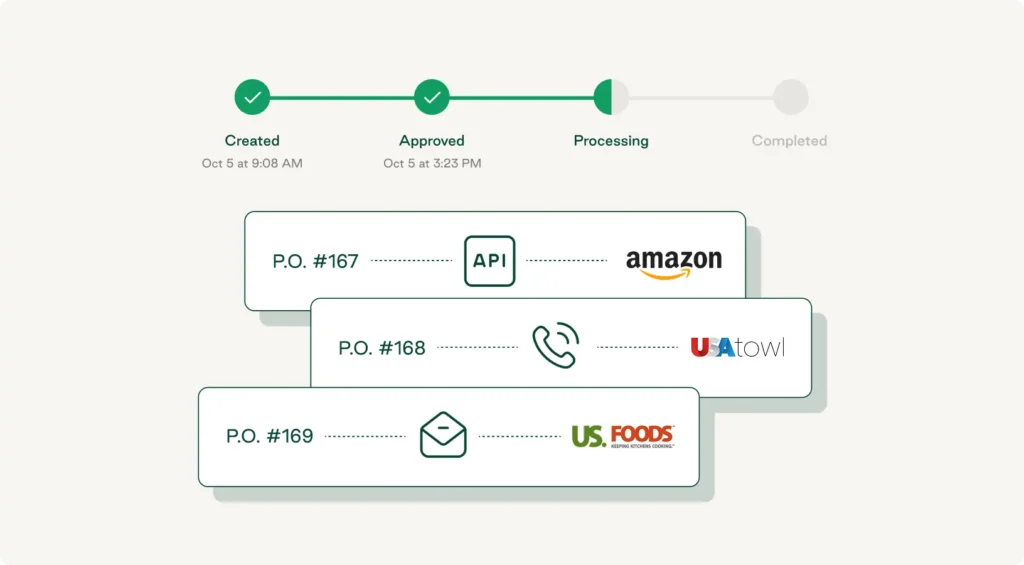
- Faster purchasing cycles that don't sacrifice control: Slow indirect procurement processes frustrate employees and create operational risk. When spend controls lack structure, simple purchases get stuck in the same workflow as complex contracts, stretching cycles from days to weeks.
- Centralized purchasing across departments: If each department has its own purchasing process, it becomes impossible to see total spend with any vendor, negotiate volume discounts, or enforce consistent policies.
According to The Hackett Group, "Digital World Class" procurement leaders (the top quartile of performers) achieve 1.9x more cost savings and 2.4x greater ROI than peers, largely through integrated systems and centralized control.
The Procurement Strategy Playbook for Modern Businesses
Want to know more about strategic buying? Read our Procurement Strategy Playbook for even more valuable insights.
Key features to look for in indirect procurement software
When evaluating platforms, focus on capabilities that solve operational problems. Use these five criteria to guide your shortlist.
Vendor management and catalog integration
Look for catalog tools that let you curate exactly what's visible to buyers, pointing employees to preferred vendors and pre-negotiated contracts, rather than dropping them into a supplier's full catalog. The strongest platforms also let you onboard new suppliers without manual data entry, so curated catalogs scale as your vendor list grows.
Approval workflows that match your policies
Effective software lets you set routing rules based on spend thresholds, departments, cost centers, or vendor types, and adjust them as your business changes. Your system should automatically handle exceptions, escalate requests when approvers are unavailable, and provide clear audit trails.
Budget controls and spend visibility
Look for software that shows remaining budget at the point of request, flags purchases that would exceed allocations, and rolls up spend analysis data across departments without requiring manual exports. High-quality systems let you set rules that match how your organization manages budgets.
Integration with accounting and ERP systems
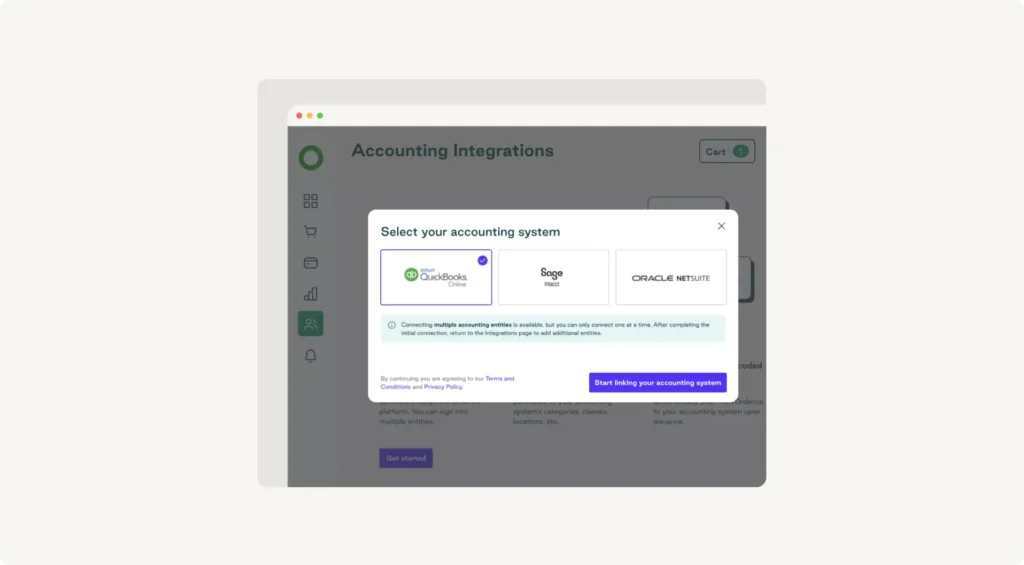
Your procurement platform should sync cleanly with your ERP and accounting systems so POs, invoices, and payment data flow into your general ledger without manual entry. Before committing, confirm the platform supports your system (NetSuite, QuickBooks, Sage Intacct, etc.) and works with your chart of accounts and budget hierarchies.
User experience that drives adoption
Prioritize intuitive interfaces, mobile-friendly request flows, and minimal steps from need to approval. Managers often need to approve requests from their phones, and requesters require visibility into order status without logging into a desktop application. When the system works with your people rather than against them, you get faster cycles, better compliance, and fewer workarounds.
5 indirect procurement software solutions to consider in 2026
The tools below represent different approaches to indirect procurement, each with distinct strengths depending on your team's size, existing systems, and operational priorities.
Indirect procurement software comparison table
| Platform | Vendor management | Approval workflows | Budget controls | ERP integration | Best for |
| Order.co | Curated catalogs of pre-approved vendors and products; 40,000+ vendor network with BYO-vendor support | Line-item- level approvals with AI-powered recommend- ations | Real-time budget tracking and alerts | Compatible with all ERPs but native connections to QuickBooks, NetSuite, Sage Intacct | Mid-market to enterprise teams seeking fast deployment and adoption |
| Coupa | Guided buying with supplier network access | Configurable multi-tier approvals | Advanced spend analytics dashboards | Deep integration with enterprise ERPs | Large enterprises with complex procurement needs |
| SAP Ariba | Global supplier network and discovery tools | AI-powered workflow automation | Real-time spend visibility across categories | Seamless SAP S/4HANA integration | SAP-centric organizations requiring global scale |
| Procurify | Vendor catalog and PO management | Customizable approval chains | Budget tracking by department | Integrations with QuickBooks, NetSuite, others | Growing companies formalizing procurement |
| Zip | End-to-end vendor orchestration | Automated request routing and approvals | Finance system sync for budget data | Robust ERP and finance tool connections | Enterprises managing high-volume software spend |
1. Order.co
Order.co is an indirect procurement platform built for teams that need control without complexity. It centralizes purchasing across departments and locations, automates approval routing based on your policies, and connects directly to your accounting system to provide real-time visibility into purchases and remaining budgets.
- Curated catalogs: Only pre-approved products and vendors are visible to buyers, so off-catalog purchases aren't an option
- Policy-based approvals with real-time budget checks: Requests route automatically based on spend thresholds, categories, or departments, and remaining budget appears at the point of purchase to prevent overspend before it happens
- Line-item GL tagging: Every line item is coded to the correct GL account, cost center, and entity for accurate reporting across multi-location setups
- Automated ordering and fulfillment: When a request is approved, Order.co automatically generates and routes the PO to the vendor.
- Built-in invoice matching: Because every order flows through the same platform as your bill, there's no separate step to match POs to invoices. Accuracy is embedded from the start, not reconciled after the fact
- Accounting system sync: Direct connections to QuickBooks, NetSuite, Sage Intacct, and other accounting systems eliminate manual data entry
Best for: Order.co is ideal for mid-market to enterprise teams managing high volumes of indirect purchases across multiple locations or departments.
Considerations: Teams already embedded in large enterprise procurement suites may need to evaluate how Order.co fits alongside existing systems rather than replacing them entirely.
2. Coupa
Coupa is a cloud-based procure-to-pay platform designed for mid-to-large enterprises managing high volumes of indirect spend across categories such as IT services, office supplies, and facilities management. It enforces compliance through guided buying and automates invoicing at scale.
- Guided buying: Directs employees to approved catalogs and suppliers, reducing maverick spending
- AI-powered invoice automation: Automates three-way matching between invoices, purchase orders, and receipts
- Real-time spend analytics: Uses customizable dashboards to track indirect spend and flag cost-savings opportunities
- Supplier network access: Connects you to Coupa's global supplier network for vendor discovery
- Deep ERP integration: Syncs with major ERP systems to reduce reconciliation at month-end
Best for: Coupa is a fit for large enterprises (500+ employees) with complex indirect procurement needs and resources to support a longer implementation.
Considerations: Implementation typically takes 6-12 months, which may create barriers for mid-sized teams seeking faster deployment and a lower total cost of ownership.
3. SAP Ariba
SAP Ariba is a modern procurement platform that offers end-to-end source-to-pay capabilities for enterprise organizations already operating in the SAP ecosystem. It provides access to a vast global supplier network and automates strategic sourcing, supplier management, and indirect buying.
- Global supplier network: Connects you to SAP Ariba's supplier directory for faster vendor discovery
- Workflow automation: Automates supplier discovery, requisition approvals, and routine procurement tasks
- Deep SAP S/4HANA integration: Enables accurate spend tracking without manual reconciliation
- Catalog and contract management: Supports the full supplier lifecycle while reducing off-contract purchases
- Global scalability: Accommodates multi-region, multi-currency procurement for international business operations
Best for: SAP Ariba is well suited to large enterprises (1,000+ employees) already using SAP systems and requiring global-scale procurement capabilities.
Considerations: The platform is optimized for SAP-centric environments, which may create implementation complexity and higher costs for organizations without existing SAP infrastructure.
4. Procurify
Procurify is a spend management platform designed to help mid-sized organizations control purchasing through request-to-pay workflows. It focuses on giving procurement and finance teams visibility into spending before it occurs.
- Purchase request workflows: Allows employees to submit requests through a centralized system with customizable approval chains
- Budget tracking by department: Provides real-time budget visibility so you see available funds before approving requests
- Vendor catalog integration: Guide employees toward compliant providers using pre-approved vendor catalogs
- Three-way matching: Automates invoice reconciliation between purchase orders, receipts, and invoices
- Mobile access: Lets reviewers review and authorize requests from mobile devices
Best for: Procurify is a good match for mid-sized companies (100-1,000 employees) transitioning from spreadsheets or email-based purchasing.
Considerations: Procurify automates the request-and-approval side of purchasing, but the actual ordering still falls to your team. POs typically have to be sent to vendors manually, which can create delays for high-volume buyers.
5. Zip
Zip is a procurement orchestration platform that unifies intake, approvals, and purchasing into a single workflow. It's designed primarily for teams managing software and other indirect spend.
- Unified intake and approval orchestration: Routes requests through customizable workflows based on spend thresholds, department policies, and budget availability
- Finance system integrations: Connects to ERP and accounting tools like QuickBooks and SAP, syncing budget data in real time
- Scalable workflow automation: Supports enterprise-level request routing and approval chains
- Centralized contract and supplier relationship management: Provides a single repository for vendor information and contract terms
- Real-time spend visibility: Uses dashboards to show budget utilization and spending patterns across departments
Best for: Zip works for mid-to-large enterprises managing significant software spend and other indirect categories.
Considerations: The platform is built primarily as an orchestration and intake layer. It routes requests and approvals well, but doesn't automate order placement or fulfillment, so your team still owns the actual purchasing motion downstream.
How to choose and implement indirect procurement software
Choosing the right indirect procurement software is about finding a system that fits how your team works, and that can be easily implemented without months of disruption. Evaluate vendors based on the following key criteria.
Evaluate integration capabilities with existing systems
Before committing to any platform, get a technical integration assessment. Don't accept a feature list as proof. Ask vendors to demonstrate how:
- POs flow into your ERP
- Invoices sync to your AP system
- Spend data appears in your financial reporting tools
Pay attention to whether the integration is native or relies on third-party connectors. Native integrations typically offer faster sync times and fewer points of failure—critical distinctions when you consider that research from Ardent Partners reveals the average AP team takes 9.2 days to process just one invoice and that 41% of AP leaders feel these bottlenecks erode value.
Order.co connects natively to accounting systems and ERPs like QuickBooks, NetSuite, and Sage Intacct, syncing pre-coded invoices and GL data in real time rather than through batch uploads or third-party middleware. POs live in Order.co, and what flows to your ERP is a clean, line-item-coded bill, so AP doesn't spend month-end matching documents.
The Procurement Strategy Playbook for Modern Businesses
Learn the key pillars of a strong strategy, valuable procurement metrics to track, and initiatives you can start implementing today.
"*" indicates required fields
Assess user experience and adoption
During vendor demos, ask to see the actual purchase request flow. How many steps are there to submit a request? Does the approval process make sense to someone who has never used procurement software before?
Request a pilot with actual end users, not just procurement team members. Track whether they revert to old habits, such as emailing managers directly. Low adoption almost always signals a UX problem and not a training gap. The right system should make compliance easy.
Order.co is a good example: buyers browse a curated catalog of approved products and vendors, submit a request in a few clicks, and get tracking and fulfillment in one place. When the compliant path is also the easiest one, buyers don't look for workarounds.
Consider implementation timeline and support
Ask vendors for realistic timelines based on your company's size and existing tech stack. Enterprise platforms often require 6–12 months for full deployment, while mid-market solutions typically move faster. Confirm whether your quoted timeline includes data migration, user training, and workflow configuration, or if those require additional weeks or months.
Support quality matters just as much after you go live as the rollout plan. Before choosing, confirm:
- Who owns your account. A dedicated success manager beats a shared support queue, especially through the first 90 days.
- What onboarding actually includes. Configuring approvals, mapping GL accounts, and training buyers on the catalog are the work, not the paperwork before it.
- How edge cases get handled. The integration gaps that don't show up in demos always surface in week three.
Order.co pairs every customer with a dedicated success manager through onboarding and early rollout, so there's one person who knows your setup when those edge cases come up.
Gain more control over indirect procurement with Order.co
The teams that get indirect procurement right stop enforcing spend policy request by request and start building it into how buyers buy. When catalogs, approvals, and budget rules are built into the purchasing workflow, compliance becomes the default path rather than a policy document people work around.
That's what Order.co is built for. Buyers see only approved products and vendors. Approvals route themselves based on rules you set once. Every line item arrives pre-coded. Finance closes the books faster because there's nothing to chase down.
Whether you're evaluating indirect procurement software for the first time or replacing a system that didn't deliver, book a demo to see how Order.co fits your procurement model and where you'd see results first.
FAQs about indirect procurement software
Direct procurement software manages the purchase of raw materials and components used to make finished products, while indirect procurement software handles everything else: office supplies, IT, maintenance, travel, and professional services. Direct procurement focuses on supplier quality and production continuity, while indirect procurement focuses on spend visibility, policy compliance, and reducing rogue purchases across departments. Because employees across every department make indirect purchases, this software typically serves a much wider user base.
Indirect procurement software integrates with ERP systems via APIs that sync invoices, vendor records, GL coding, and budget data. The strongest integrations eliminate duplicate entry by pushing pre-coded invoices into your ERP's accounts payable module and updating GL codes without manual intervention. Look for pre-built connectors to your specific ERP rather than custom development, and confirm the platform pulls live budget availability before approving requests.
Organizations typically see ROI from indirect procurement solutions through three measurable metrics: reduced processing costs, recovered spend from better compliance, and faster cycle times. Automating approvals and invoice matching can significantly cut AP workload and shorten invoice processing time. Steering purchases to approved vendors and contracts recovers spend that would otherwise go off-contract. Simpler platforms often show returns within a few months, while enterprise systems may take a year or more to fully deploy.
Get started
Schedule a demo to see how Order.co can simplify buying for your business.
"*" indicates required fields