AI Procurement Software: How to Choose the Right Platform

AI Procurement Software: How to Choose the Right Platform
Every procurement platform on your shortlist now says it has AI. The question that separates them is simpler. When the AI finds a better price or spots a problem, does it tell someone, or does it place the order, source the cheaper option, and reconcile the payment for you?
That difference shows up in your team's week. AI that recommends still leaves your buyers logging into vendor sites, chasing approvals over email, and matching invoices by hand. AI that executes takes those steps off their plate.
The platforms worth your time make buying easy enough that your teams actually use them, move requests to delivered orders faster, and cut costs on the products you already buy. Here's how six platforms compare on what their AI does, which tasks it can take over, and the questions that separate a strong fit from a strong demo.
Quick answer:
- AI procurement software uses AI to handle purchasing work like sourcing, approvals, ordering, and payments, from the first request to the paid invoice.
- The biggest difference between platforms is whether the AI recommends actions for a person to take or completes the work on its own.
- The capabilities that matter most remove manual tasks across the whole buying cycle, including price comparison, order placement, tracking, and line-item reconciliation.
- When you evaluate vendors, test what the AI does without a person, and check whether your teams will buy through it day to day.
- Order.co is the pick for multi-location organizations simplifying purchasing as they grow, with AI fulfillment that places orders with any of your vendors and manages them through delivery, plus line-item coding on every purchase.
Evaluating your options? Take a self-guided tour of Order.co
At-a-glance comparison of AI procurement software
| Platform | Best for | Core AI capabilities | Where it fits in the buying process |
| Order.co | Multi-location organizations that want one simple way to buy across every location, with AI taking on the manual work | Sourcing algorithm, AI fulfillment, AI approvals, AI tracking, AI payments with line-item reconciliation, AI catalog management | Every step from purchase request to paid invoice |
| Zip | Enterprises that want one front door for purchase requests | Conversational intake, preferred vendor agent, price negotiation agent, invoice compliance checks | Intake, approvals, and negotiation |
| Ivalua | Large enterprises that run the full source-to-pay process | IVA agent for plain-language S2P tasks, supplier risk response, IVA Studio for agent governance | Sourcing through payment in a full suite |
| Procure AI | Enterprises with an existing ERP or S2P stack that want an agent layer | Autonomous tail spend sourcing and negotiation, generative intake, supplier risk monitoring | Intake and sourcing, on top of existing systems |
| Suplari | Enterprise procurement teams that want deeper spend intelligence | Spend anomaly detection, savings opportunity scouting, supplier risk monitoring, contract renewal tracking | Analysis and planning |
| Amazon Business | Organizations that can buy a large share of their supplies on Amazon | Business Assistant, Savings Insights, Spend Anomaly Monitoring | Purchasing within the Amazon marketplace |
6 leading AI procurement software platforms
The following six platforms come up most often when you evaluate AI for procurement. They range from end-to-end purchasing platforms to suites, agent layers, and analytics tools, so the right pick depends on where you need artificial intelligence to do the work.
1. Order.co
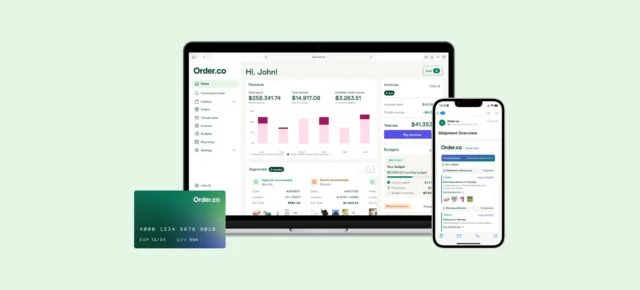
Order.co is a procurement and spend management platform built for multi-location organizations. It covers the full purchasing workflow, from curated catalogs and approvals through ordering, tracking, and payment, with Order.co AI working at each step.
- AI catalog management. Builds your custom catalog from past purchases so buyers start with products they already order
- Sourcing algorithm. Surfaces better-priced vendors, weighing delivery speed, availability, and reliability, for an average of 5% savings on products
- AI fulfillment. Places orders with any vendor, including those that only take orders by email or phone, plus vendor portals and e-commerce sites, then manages fulfillment through delivery
- AI approvals and tracking. Guides which orders get approved or need extra attention within customizable approval workflows, then scans vendor updates for tracking and delivery changes
- AI payments. Processes vendor payments and delivers line-item reconciliation
Best for: Multi-location organizations that want one simple way to buy across every location, with AI taking on manual work from sourcing through payment
Proof points:
- Order.co was named AI Procurement Platform of the Year in the 2025 RetailTech Breakthrough Awards.
- At AvantStay, Order.co AI sourcing saved $190K on products. "Sourcing replacements and substitutions saves the company time and money," says Jack Langenhorst, Senior Manager of Onboarding & Supply Chain.
See how Order.co stacks up
Tour the product yourself now — no demo request, no waiting.
2. Zip
Zip is an agentic procurement orchestration platform that gives employees a single front door for purchase requests. Its AI focuses on getting each request to the right approver, vendor, and price.
- Conversational intake. Lets employees submit requests and ask policy questions in plain language
- Preferred vendor agent. Surfaces approved vendors while the request is being made
- Price negotiation agent. Compares past purchases with market benchmarks and suggests negotiation tactics for contracts
- Finance agents. Checks invoices against contracts for compliance
Best for: Enterprises that want to unify intake and approvals across many teams and tools
Tradeoff: Zip orchestrates requests and approvals, but placing the order and managing fulfillment usually happens in another system.
3. Ivalua
Ivalua is an enterprise source-to-pay suite that large organizations use to manage spend and vendors. Its AI agent, IVA, runs source-to-pay tasks from plain-language requests.
- IVA agent. Pulls together the skills, tools, and data a task needs and creates sub-agents for complex work
- Background automation. After a supplier risk event, IVA aids risk management by identifying affected contracts and proposing alternative vendors
- IVA Studio. Gives admins one place to manage agent skills, permissions, and integrations
- Built-in governance. IVA inherits each user's permissions and logs every action it takes
Best for: Large enterprises running full source-to-pay programs across complex categories
Tradeoff: As a full suite, Ivalua typically involves a larger implementation than a purchasing-focused platform.
4. Procure AI
Procure AI is an AI procurement platform that adds AI agents on top of the ERP and source-to-pay systems you already run, including SAP, Ariba, and Coupa.
- Autonomous sourcing and negotiation. Identifies vendors, runs tactical tenders, and negotiates on tail spend
- Generative AI (GenAI) intake. Interprets requests, collects missing details, and guides requesters to compliant buying paths
- Supplier risk monitoring. Tracks financial, cyber, and performance signals across your vendor base
Best for: Enterprises with an established ERP or source-to-pay stack that want an AI agent layer for tail spend
Tradeoff: Procure AI depends on an existing ERP or source-to-pay system, and its autonomy is aimed mainly at tactical and tail spend.
5. Suplari
Suplari is a procurement intelligence platform that turns spend, contract, and supplier data into predictive analytics, spend analysis, and recommendations for enterprise procurement teams.
- Spend anomaly detection. Flags spend that deviates from expected patterns
- Savings opportunity scout. Surfaces places to cut costs across categories
- Supplier risk monitor. Watches for risk signals across your vendor base
- Contract renewal and obligation manager. Tracks renewals and obligations before deadlines pass
Best for: Enterprise procurement teams that want deeper spend intelligence across their existing systems
Tradeoff: Suplari focuses on analysis, so its agents act with human approval while the purchasing itself happens in other systems.
6. Amazon Business
Amazon Business is Amazon's B2B marketplace, with business pricing, purchasing controls, and a growing set of AI tools layered onto its catalog.
- Business Assistant. Guides account setup and points out purchasing efficiencies based on past buying
- Savings Insights. Surfaces bulk-buying discounts and lower-priced alternatives
- Spend Anomaly Monitoring. Flags irregular reorder cycles and sudden spending spikes for admins
Best for: Organizations that buy a large share of their supplies through the Amazon marketplace
Tradeoff: Amazon Business's AI works within its own marketplace, so spend with your other vendors sits outside its view.
What AI procurement software can automate
Most purchasing work is a chain of manual handoffs. Someone builds the product list, someone checks prices, someone approves, someone logs into a vendor site to order, and someone else matches the invoice weeks later. In Deloitte's 2025 Global CPO survey, the most digitally mature procurement organizations reported an average 3.2x return on their generative AI investments.
AI only pays off when people actually buy through the platform, though. If ordering takes longer than the workaround, your teams go back to personal cards and email threads, and every capability below sits idle. Ease of ordering is what makes the rest of the AI worth having. Here’s what procurement automation can take off your team’s plate.
Catalog management
Building a catalog by hand means pulling past orders into spreadsheets and updating SKUs as vendors change them.
Order.co AI creates your custom catalog from past purchases. Because buyers only see curated, pre-approved options, the compliant choice is also the easiest one.
Sourcing and price comparison
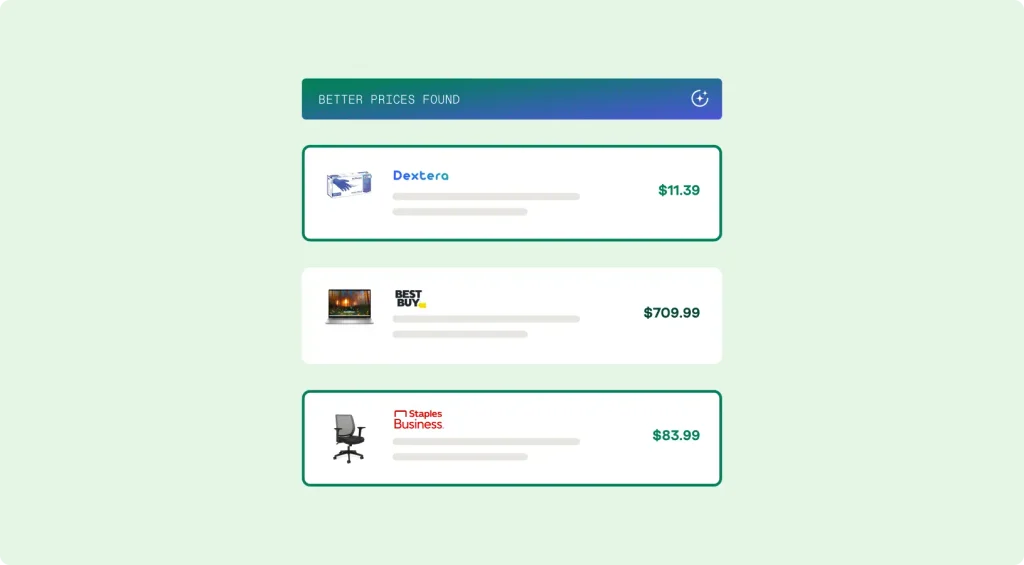
Without AI, comparing prices means checking three or four vendor sites per item, which rarely happens for routine reorders. AI sourcing compares options automatically and finds substitutes when an item is out of stock. The Order.co sourcing algorithm weighs price alongside delivery speed, availability, and reliability.
Purchase approvals
Manual approvals live in email threads and chat messages, where a request can stall for days while a manager is out. AI can apply your policies at the point of purchase, moving routine orders through and flagging the ones that need a closer look.
Order.co AI guides which orders get approved and which need additional attention so your budget holders can focus on the exceptions. Approval workflows are customizable by order size, vendor, product category, user, location, cost center, and more.
Order placement and fulfillment
Once a request is approved, someone still has to log into the vendor's site, re-enter the order, and save the confirmation. Order.co AI places orders with any vendor, including those that only take orders by email or phone, plus vendor portals and e-commerce sites, and manages fulfillment through delivery. With an automated purchasing system in place, approved requests become placed orders without anyone retyping them.
Order tracking and issue resolution
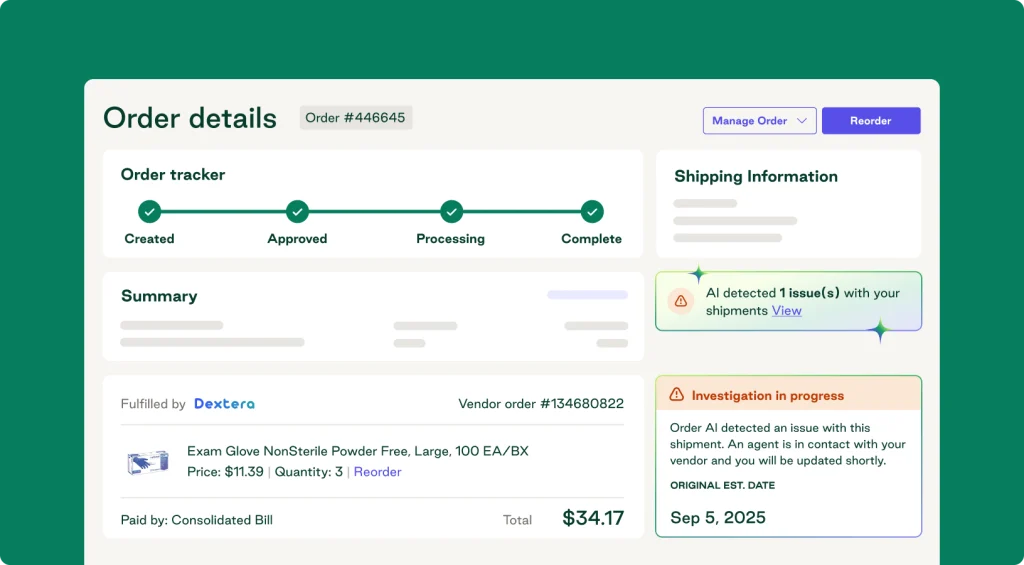
Tracking usually means digging through vendor emails for shipping updates and finding out about a backorder when the delivery doesn't show up. Order.co AI scans vendor updates for delivery changes, then detects order issues and resolves them, so your team isn't chasing backorders.
Payments and line-item reconciliation
Manual reconciliation and invoice processing means matching invoices to orders line by line, then coding each line to the right GL account.
Order.co pays each vendor directly via its preferred method, with payments rolled into customized bills that fit your bookkeeping. Because spend is coded at the line-item level when the order is placed, your accounts payable team spends less time on month-end cleanup.
See how Order.co stacks up
Tour the product yourself now — no demo request, no waiting.
How to choose AI procurement software for your team
AI adoption in procurement is moving fast, but depth is lagging. The Hackett Group's 2026 Procurement Key Issues Study found that 43% of organizations are actively pursuing AI deployment in procurement, while only 12% are pursuing large-scale implementation.
Use these questions to narrow your shortlist, and in every demo, separate what the AI does on its own from what still needs a person.
Questions to ask internally
Start with where purchasing slows down today. Is it sourcing, approvals, order placement, or reconciliation? Then look at how your teams actually buy. If location managers use personal cards or order straight from vendor sites, that's usually because the official process is slower. Any new platform has to beat that workaround to get used.
From there, decide which tasks you want AI to complete on its own and which still need a person to sign off. Map how many locations, departments, and budget holders the platform has to support, and confirm which accounting software it needs to work with, such as QuickBooks Online, NetSuite, or Sage Intacct.
Questions to ask vendors
- Which tasks does your AI complete without a person? Ask the vendor to show its product placing an order or reconciling a payment live in the demo.
- What happens when the AI gets something wrong? Look for clear exception handling and an audit trail of every action.
- Can the AI work with vendors outside your network? You shouldn't have to drop the vendors your locations rely on.
- How long until your team places its first order? Ask who manages implementation and what you need to prepare.
- What does ordering look like for an everyday employee? If it isn't easier than their current workaround, adoption will stall.
For a longer list to bring into vendor conversations, use these procurement software RFP questions.
Choose AI your teams will actually use
AI can only take work off your team’s plate if your team buys through the platform. When ordering is faster than logging into a vendor site or reaching for a personal card, every request flows through one place, giving the AI real work to take on, like placing orders, tracking deliveries, and reconciling invoices.
Order.co is built around that. Buyers at every location shop a curated catalog of approved products, budget holders sign off through customizable approval workflows, and Order.co AI places the order with any of your vendors, manages fulfillment through delivery, and codes every line item for your books. Your team stays in charge of the decisions while the AI handles the manual steps in between.
At EPIC4, a dental organization with 55 locations, office managers spend 50% less time on procurement. "We've been able to do a good job in driving compliance to the tool," says Sam Jenio, Director of Procurement & Business Development.
Want to see an order go from request to approval to delivery without anyone logging into a vendor site? Schedule a demo.
FAQs about AI procurement software
AI procurement software is a purchasing platform that uses AI to handle procurement tasks such as building catalogs, comparing prices, routing approvals, placing orders, tracking deliveries, and reconciling payments. Some tools use AI mainly for spend analytics and to recommend actions, while others complete the work directly. The most useful platforms take routine purchasing work off your team while still surfacing the decisions that need a person's judgment.
Implementation depends on the platform's scope and your setup. A full source-to-pay suite can take months because it touches strategic sourcing, supplier management, contract management, and ERP integrations. A purchasing-focused platform usually moves faster, often getting teams to their first orders within weeks. Ask each vendor for a realistic timeline to first order, who manages implementation, and what your team needs to prepare, such as vendor lists, approval rules, and GL codes.
No. AI procurement software takes over repetitive work like price checks, order entry, tracking updates, and invoice matching, so your procurement team spends less time on data entry and more time on vendor strategy, negotiations, and policy. The Hackett Group expects procurement workloads to rise in 2026 while headcount and budgets shrink, which makes automation a practical way to keep up.
It can be, but security varies by vendor. Look for role-based permissions so the AI can only take actions a user is authorized to take, audit logs that record every action, and independent security certifications such as SOC 2. For payments, ask how card and bank details are protected and whether virtual cards are locked to specific vendors.