5 Best Automated Spend Management Platforms for CFOs

5 Best Automated Spend Management Platforms for CFOs
Every quarter, the same pressure builds. Budgets drift, rogue purchases surface during reconciliation, and forecasting relies on data that's already outdated by the time it reaches your desk. Sound familiar?
For CFOs, spend management is a priority that directly affects profitability and compliance. Deloitte's Q4 2025 CFO Signals survey found that 53% of CFOs ranked cost management as a top internal risk — the number one response ahead of efficiency, productivity, and talent concerns.
The good news is that automated spend management software can replace reactive damage control with proactive control. But not every platform solves the same problem, and choosing the wrong one creates new issues rather than eliminating old ones.
This guide breaks down the five best automated spend management platforms for CFOs, what makes each one unique, and how to select the right fit for your organization.
Evaluating spend management software? Start your self-guided tour of Order.co
Benefits of automated spend management for CFOs
What does a CFO actually gain from automating spend management? Here are the advantages that most directly impact your ability to drive strategy and protect margins.
Real-time financial visibility
Manual processes produce stale data. By the time spreadsheets are reconciled and reports compiled, the numbers are already outdated. Automated spend management software delivers real-time dashboards that track every transaction as it happens, so you'll have accurate data for forecasting and board reporting.
Reduced maverick spending
Decentralized purchasing leads to rogue spend, off-contract purchases, and budget overruns that only surface at month-end. Automated approval workflows and pre-set spending limits ensure every purchase follows your policies before money leaves the organization. That's the difference between discovering a problem and preventing it.
Faster, cleaner month-end close
When invoices are auto-coded, approvals are documented, and spend data syncs directly to your ERP, the month-end close stops being a multi-week scramble. Finance teams can go from tracking down old receipts to analyzing spend patterns and identifying savings.
Stronger audit readiness and compliance
Regulatory requirements aren't getting simpler. Automated platforms maintain detailed records of every transaction, approval, and policy exception, creating a searchable audit trail. SOC 2-certified solutions like Order.co ensure your data governance meets enterprise standards.
Improved vendor leverage
When all purchasing data lives in one system, you can identify consolidation opportunities, benchmark pricing, and negotiate from a position of strength. Scattered data across dozens of vendor portals and email chains makes that negotiation power invisible.
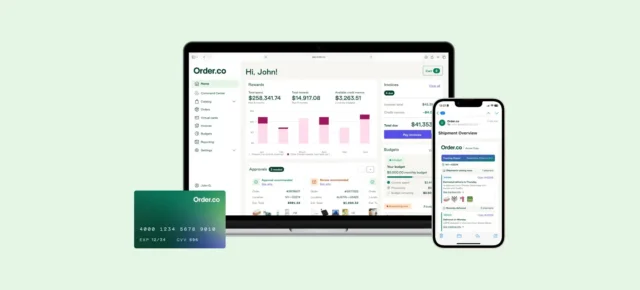
See automated spend management in practice
Order.co gives CFOs one place to forecast spending, manage budgets, and ensure compliance with financial regulations.
5 best automated spend management platforms for CFOs
1. Order.co — Best for end-to-end purchase-to-pay automation
Rated 4.4/5 based on 145 user reviews
Order.co is a procurement and finance automation platform built for growing, multi-location businesses that need to control spend from the point of purchase through final payment. Unlike tools that only track expenses after they happen, Order.co intervenes at the requisition stage — where purchasing decisions can still be shaped, vendors optimized, and costs reduced.
Key features:
- Automated spend management workflows with customizable budget limits and approval routing
- AI-powered strategic sourcing that scans prices across 40,000+ vendors, saving businesses an average of 5-10% on product costs
- Centralized billing that eliminates invoice overload; what you order is always what you're invoiced for, removing discrepancies entirely
- Robust integrations with major financial systems, including Sage Intacct, NetSuite, and QuickBooks Online
- SOC 2 Type 2 certification for audit-ready compliance
What sets it apart for CFOs: Order.co acts as the merchant of record for all transactions and automatically syncs invoice data into your ERP. This eliminates manual 3-way matching because line items are pre-coded, verified, and approved before the purchase is made. One business that drove measurable benefits by leveraging Order.co's automated cost allocation capabilities is 10 Fitness, the largest gym franchise in Arkansas. Their CFO, Kerra Murphy, used to receive multiple invoices from vendors across each of their fourteen separate entities. Now, with invoice management centralized, '[Order.co] has saved us at least six hundred invoices a month,' Kerra shared.
2. SAP Concur — Best for enterprise travel and expense compliance
Rated 4.0/5 based on 7,185 user reviews
SAP Concur is an enterprise-grade platform focused on automating travel, expense reporting, and invoice management. It's a strong choice for large organizations where travel and entertainment (T&E) represent a significant portion of discretionary spend.
Key features:
- Automated expense report creation with receipt scanning and data extraction
- Integrated travel booking with policy enforcement at the point of booking
- Multi-level approval workflows and audit rules
- Global tax compliance and VAT reclamation across jurisdictions
- Mobile app for on-the-go approvals and submissions
What sets it apart for CFOs: SAP Concur's strength lies in its deep compliance engine and global scale. If your organization operates across multiple countries and needs to enforce complex T&E policies, Concur's established infrastructure and integration with the broader SAP ecosystem can provide the governance layer finance teams require.
Limitations to consider:
- Implementation timelines can stretch across several months, particularly for multi-country or multi-module rollouts, and typically require significant IT involvement
- The interface has a steeper learning curve than newer platforms, and users frequently report that basic tasks like expense report itemization require more clicks than expected
- Integration flexibility with modern, non-SAP tools can be more limited than some organizations anticipate
3. Rippling — Best for unifying spend with HR and payroll data
Rated 4.8/5 based on 13,267 user reviews
Rippling combines spend management with HR, payroll, and IT on a single platform. Corporate cards, expense reimbursements, and bill pay all connect to employee data, so spend controls adjust automatically when roles or departments change.
Key features:
- Corporate cards with spend limits that auto-adjust based on employee role, department, or policy
- Expense policies that self-enforce using real-time employee data
- Bill pay approvals routed based on organizational structure
- Unified reporting across payroll, expenses, and vendor payments
- Starting at $11 per employee per month (PEPM)
What sets it apart for CFOs: Rippling's differentiator is the connection between workforce data and financial controls. When an employee changes roles or leaves the company, card limits, approvals, and permissions update without manual intervention. For CFOs who want spend governance tied directly to headcount and organizational changes, that automation reduces both risk and administrative overhead.
Limitations to consider:
- Modular pricing means costs can escalate quickly as you add capabilities beyond the base plan, and final pricing typically requires a sales conversation
- The spend management and expense modules are newer compared to Rippling's core HR and payroll products, so some advanced finance features may be less mature
- The platform's depth works best for companies already using (or planning to adopt) Rippling for HR and IT — standalone spend management buyers may not see the full value
4. Payhawk — Best for multi-entity global spend control
Rated 4.5/5 based on 907 user reviews
Payhawk is an AI-powered spend management platform designed for multi-entity companies operating across borders. It consolidates corporate cards, expenses, invoice processing, and purchase orders into a single interface with entity-level controls.
Key features:
- Real-time spend tracking across multiple subsidiaries and currencies
- AI-powered receipt matching, auto-categorization, and anomaly detection
- Purchase order management with full procurement workflows
- Native ERP integrations with NetSuite, Sage Intacct, and others
- Entity-level compliance controls and audit trails
What sets it apart for CFOs: Payhawk treats multi-entity management as a core design principle rather than an add-on. Each subsidiary gets its own billing, local bank account funding, and expense policies — all visible from a single dashboard. For CFOs overseeing international operations, this means granular control per entity without sacrificing centralized visibility.
Limitations to consider:
- Onboarding and initial setup can be complex, with multiple users noting a learning curve during implementation, even though day-to-day usage is well-reviewed
- Corporate card credit limits max out at $1 million and vary by region, which may not be sufficient for organizations with high monthly spend volumes
- Customization options for complex or highly specific expense policies can feel constrained compared to more flexible enterprise platforms
5. Navan — Best for travel and expense automation with built-in payments
Rated 4.7/5 based on 9,297 user reviews
Navan is an AI-powered platform that unifies corporate travel booking, expense management, and payments. It works well for organizations where business travel represents a major spend category and the finance team needs real-time T&E visibility.
Key features:
- Integrated travel booking with automated expense reconciliation
- Virtual corporate cards that auto-generate at the point of booking, matched to specific trips and policies
- Built-in expense policies that enforce compliance before purchases occur
- Automated receipt capture and real-time transaction monitoring
- Up to 1.5% cashback on corporate card spend
What sets it apart for CFOs: Navan tightly integrates travel booking and expense data so payment information automatically reconciles with booking and invoice records, which streamlines month-end close.
Limitations to consider:
- Navan's strength is T&E spend, so organizations looking for broader procurement or indirect spend controls will likely need additional tools
- Automated expense categorization can occasionally misclassify transactions, requiring manual corrections during review
- As a cloud-only platform, teams with limited digital workflows or complex on-premise system requirements may face a longer adjustment period
See automated spend management in practice
Order.co gives CFOs one place to forecast spending, manage budgets, and ensure compliance with financial regulations.
Rated 4.8/5 based on 13,267 user reviews
How to choose the right spend management software
Not every platform solves the same problem, and the "best" solution depends on where your biggest spend control gaps exist. Here's a framework for evaluating your options.
Identify your primary spend category
Are you managing mostly indirect spend on physical goods and consumables? Travel and entertainment? SaaS subscriptions? The answer informs which platform architecture fits best:
- Physical goods and operational supplies: Look for platforms with procurement automation, vendor management, and catalog controls (e.g., Order.co)
- Travel and entertainment: Prioritize integrated booking and expense platforms (e.g., SAP Concur, Navan)
- Employee expenses and card-based spend: Consider platforms that combine corporate cards with real-time policy enforcement (e.g., Rippling, Payhawk)
Evaluate ERP and accounting integrations
Your spend management tool shouldn't create a data silo. Confirm that any platform you evaluate offers native integrations with your ERP or accounting system — whether that's NetSuite, Sage Intacct, QuickBooks, or Workday. The goal is automated data flow, not another system that requires manual exports.
Assess the depth of spend control
There's a meaningful difference between "visibility into spend" and "control over spend." Some platforms show you where money went after the fact. Others embed controls at the point of purchase — approval workflows, budget limits, and curated catalogs — that prevent overspending before it happens. For CFOs focused on compliance and financial governance, the distinction matters.
Consider multi-location and multi-entity needs
Does your business operate across multiple locations, subsidiaries, or regions? If so, your spend management solution needs to handle entity-level budgets, local vendor relationships, and consolidated reporting without manual workarounds. Test how each platform handles multi-entity scenarios before committing.
Measure total cost of ownership
Look beyond subscription pricing. Factor in implementation timelines, integration costs, training requirements, and the operational hours you'll reclaim. A platform that deploys in weeks and automates AP workflows will deliver faster ROI than one that requires months of customization.
Bring spend management under one roof with Order.co
Each platform above addresses a different piece of the spend management puzzle. But for most CFOs, the underlying challenge is the same: spend data is scattered, processes are manual, and financial oversight depends on retrospective reporting rather than proactive controls.
Order.co was built to solve that challenge at its source. Unifying the entire purchase-to-pay lifecycle in a single platform gives CFOs one place to forecast spending, manage budgets, and ensure compliance with financial regulations. AI-powered sourcing finds better prices automatically, and real-time spend analysis tools make every dollar visible with minimal manual intervention.
Schedule a demo with Order.co to see how automated spend management works in practice.
Frequently asked questions
Automated spend management software uses technology to track, control, and optimize an organization's spending. For example, Order.co replaces manual processes like spreadsheet tracking, email-based approvals, and paper invoices with automated workflows that enforce policies, route approvals, and sync data to accounting systems in real time.
Expense management is a subset of spend management. Expense tools typically focus on employee reimbursements, receipt capture, and corporate card transactions. Spend management platforms like Order.co cover the full lifecycle — from purchase requests and vendor sourcing to invoice processing, payment, and reconciliation.
Focus on five areas: integration with your existing ERP or accounting system, depth of spend controls (pre-purchase vs. post-purchase), real-time reporting and forecasting capabilities, multi-entity and multi-location support, and the platform's ability to scale with your organization.
Yes. Automated platforms maintain detailed audit trails for every transaction, approval, and policy exception. Order.co offers features like role-based permissions, approval hierarchies, and automated GL coding help ensure purchases comply with internal policies and external regulations.
Implementation timelines depend on your rollout scope, location count, ERP integration depth, and approval workflow complexity. Most mid-market companies get core features, integrations, and custom catalogs live within four to six weeks, though larger, multi-entity organizations should expect a longer runway. Ask each vendor directly what their team owns during implementation versus what falls to yours, since that split varies significantly across platforms.