How to Create a Vendor Onboarding Process

How to Create a Vendor Onboarding Process
Adding a new vendor shouldn't be a significant source of stress for your team. Yet for many finance and operations leaders, vendor onboarding represents dozens of back-and-forth emails between stakeholders who are already busy managing their core responsibilities. When every vendor onboarding feels like starting from scratch, scaling your operations becomes exponentially harder.
The stakes are higher than finance leaders might realize. Without a standardized process, businesses expose themselves to vendor fraud and data breaches that can cost millions. So, how can your organization avoid these risks and protect your bottom line? This guide provides a step-by-step framework for building a consistent, repeatable vendor onboarding process that protects your business from fraud and eliminates the tedious administrative work that holds finance and operations teams back.
Download the free tool: Vendor Onboarding Checklist
The high cost of manual vendor onboarding
Manual vendor onboarding exposes businesses to significant compliance and financial risks. When finance teams manually track vendor setup across emails, spreadsheets, and shared drives, critical information falls through the cracks. A missing W-9 delays payment. Unverified banking details create openings for invoice fraud. Duplicate vendor profiles in your ERP lead to double payments.
The financial impact is substantial. According to a report on vendor fraud, organizations lose 5% of annual revenue to fraud, translating to potential worldwide losses exceeding $5 trillion annually. Billing schemes, which exploit weak vendor vetting, typically go undetected for eighteen months and cause a median loss of $145,000.
Security risks compound the financial exposure. Third-party vendors account for 15% of data breaches through supply chain compromises. The average cost of a data breach reaches $5.05 million in 2026, not including reputational damage and regulatory fines.
Payment redirection fraud has become particularly costly. Fraudsters gain access to a vendor's email system or create look-alike domains, then send updated banking information to your accounts payable team. Without proper verification procedures, payments intended for legitimate suppliers end up in criminal accounts.
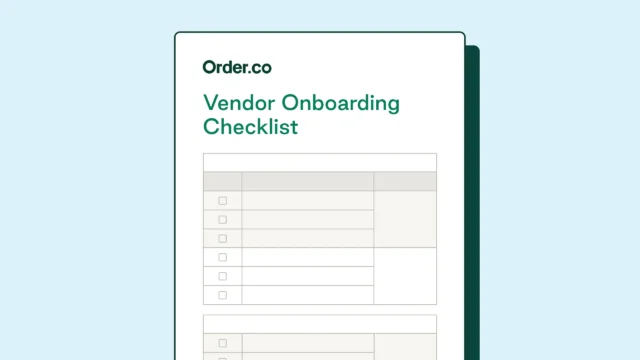
Vendor Onboarding Checklist
Create a consistent, repeatable vendor onboarding process that strengthens supplier relationships and safeguards your business. Download the checklist.
Step 1: Define sourcing requirements and standards
Start by establishing pricing benchmarks, quality standards, and compliance criteria that every potential vendor must meet before entering your supply chain.
Before engaging any new supplier, identify the specific business need driving the request. Is this vendor filling a gap in your existing supply chain, or duplicating capabilities you already have? Redundant vendors only reduce your negotiating leverage and make performance tracking more challenging.
Define clear selection criteria for new vendors:
- Evaluate pricing benchmarks relative to market rates
- Specify product quality standards, certifications, or service level agreements
- Determine acceptable payment structures and credit terms
- Confirm geographic coverage for all necessary locations
- Identify industry-specific regulations or internal policies the vendor must satisfy
Require internal stakeholders to submit a formal purchase requisition to initiate the onboarding process. Vendor sourcing should follow a consistent framework that ensures only qualified vendors enter your pipeline. This formalization prevents departments from independently onboarding vendors that haven't been properly evaluated, which is how rogue spend begins.
Step 2: Conduct due diligence and risk assessments
Verify vendor legitimacy through business licenses, financial statements, and reference checks before onboarding to protect your organization from fraud and compliance violations.
You can confirm the vendor's credentials through objective third-party sources:
- Verify business licenses and legal registrations
- Review credit reports, financial statements, or Dun & Bradstreet ratings to assess solvency
- Read existing customer reviews to validate service quality and reliability
- Ensure the vendor holds required industry certifications
To ensure a supplier is the right fit, check their compliance with regulatory and security standards relevant to your business. If you handle healthcare data, verify HIPAA compliance. If you operate in the EU, confirm GDPR adherence. For vendors accessing your network or systems, review their information security policies and request evidence of cybersecurity insurance.
Step 3: Standardize data collection and compliance
Use a standardized checklist to systematically collect tax forms, banking information, insurance certificates, and compliance documentation from every vendor. Consistent data collection is the foundation of accurate financial reporting and the first line of defense against fraud.
Gather essential documents through a structured process:
- Collect tax forms (W-9 for U.S. vendors or W-8BEN for international suppliers)
- Obtain banking information for ACH payments, verified through a secure portal
- Request insurance certificates (general liability, workers' compensation, or industry-specific coverage)
- Gather compliance documentation (certifications, licenses, or attestations)
Use a vendor onboarding checklist to ensure no critical document is missed. Validate banking information independently through a separate communication channel, such as a phone call to a verified company number, to prevent fraud schemes. This simple step prevents payment redirection fraud that costs businesses hundreds of thousands of dollars annually.
You'll also want to verify that the legal name on tax forms matches the business name in your ERP system and the name on banking information. Mismatches may indicate data entry errors or attempts at fraud. Your checklist should also include document expiration dates and trigger automatic renewal reminders, since insurance certificates and certifications expire and require tracking.
Centralize all vendor data in a secure, searchable repository rather than leaving documents hidden across email inboxes. A centralized repository ensures every stakeholder works from the same vendor data, compliance documentation is easily retrievable, and audit trails demonstrate your due diligence during regulatory reviews.
Step 4: Configure approval workflows and system setup
Establish approval hierarchies based on spend thresholds and enter verified vendor data into your ERP to ensure seamless payments and accurate bookkeeping from the first transaction.
Define approval levels based on spend, budget ownership, or vendor risk:
- Route low-risk, low-spend vendors (under $5,000) to department managers
- Require CFO or procurement director sign-off for high-spend vendors (over $50,000)
- Add security or legal review for high-risk vendors with access to sensitive data
Enter verified vendor data into your vendor management software to create a master vendor record:
- Legal business name exactly as it appears on tax documents
- Tax identification number for 1099 reporting
- Primary contact including name, phone, and email
- Payment terms negotiated during onboarding
- Preferred payment method including ACH routing information
- General ledger codes for proper expense categorization
Establish payment terms during setup to avoid friction later. Clearly document whether the vendor requires payment upfront, offers standard net-30 or net-60 terms, or participates in early payment discount programs. These terms affect your cash flow planning and should be consistently applied from the first invoice.
Then, test the vendor setup by processing a small test transaction before rolling out the vendor to your entire organization. This validation step confirms that orders route correctly, approvals trigger as configured, and payments process without errors. Catching setup mistakes during a test transaction is far easier than discovering them after processing dozens of live orders.
Vendor Onboarding Checklist
Create a consistent, repeatable vendor onboarding process that strengthens supplier relationships and safeguards your business. Download the checklist.
"*" indicates required fields
How Order.co streamlines vendor onboarding
Partnering with an end-to-end procurement automation platform like Order.co streamlines your vendor onboarding processes. With Order.co, your business can:
- Gain instant access to 40,000+ pre-vetted suppliers. Many of your existing vendors are likely already in the network, ready to transact without the delay of manual onboarding. For vendors not yet in the system, Order.co's dedicated onboarding team manages the entire setup process, handling document collection, compliance verification, and system integration on your behalf.
- Improve fraud prevention. Every vendor in the platform has already undergone thorough due diligence, including business verification, financial stability checks, and compliance validation. The platform's secure payment infrastructure eliminates payment redirection fraud by centralizing vendor banking information and payment processing in a controlled environment.
- Centralize vendor visibility. Instead of vendor data scattered across email, spreadsheets, and multiple procurement systems, everything lives in Order.co's unified platform. You get 100% visibility into spend, order status, and compliance across all locations—so you can instantly see which vendors are being used, what they're supplying, how much you're spending, and whether all compliance documentation remains current.
- Unify purchasing and payments. The platform eliminates common vulnerabilities like unverified vendor changes and payment processing outside established controls. Every transaction flows through Order.co's controlled environment where approvals are enforced, budgets are respected, and payments are processed securely.
- Achieve multi-location consistency. Instead of each location independently onboarding vendors and negotiating terms, the entire organization benefits from centrally negotiated contracts, standardized compliance requirements, and consolidated purchasing power.
Book a demo to see how Order.co streamlines your vendor onboarding and gives you instant access to a trusted supplier network.
FAQs
The following frequently asked questions address the primary concerns regarding vendor vetting, documentation, and automation.
Get started
Schedule a demo to see how Order.co can simplify buying for your business.
"*" indicates required fields