Best AP Automation Software for Increasing ROI (2026)

Best AP Automation Software for Increasing ROI (2026)
The most effective tools for increasing AP ROI cut the time and errors involved in processing each invoice. Bill.com and AvidXchange automate invoice capture, approvals, and payments for small and mid-sized businesses; Stampli focuses on invoice collaboration; Coupa covers AP as part of a broader procurement and spend management suite for large enterprises; and Tradeshift connects buyers and suppliers through an e-invoicing network.
Order.co raises ROI earlier in the process. It pays vendors directly and sends itemized, pre-coded statements set up for the organization's AP workflow, so far fewer invoices reach AP in the first place.
At enterprise scale, AP cost follows volume. A multi-entity organization buying operating supplies across dozens or hundreds of locations accumulates a long tail of vendors, and each one can send several invoices per site, every month. Each invoice carries its own capture, coding, approval, matching, and payment step. Accounts payable software lowers the cost of those steps. The larger return comes from deciding which steps the organization can remove entirely.
Evaluating your options? Take a self-guided tour of Order.co
Where AP ROI comes from
AP automation returns value through four levers. Most tools are strongest on one or two of them, so the right choice depends on which lever carries the most weight in a given AP operation.
- Hours saved per invoice. Automated capture, GL coding, and approval routing cut the minutes an AP specialist spends on each document.
- Fewer late fees and duplicate payments. Duplicate detection and scheduled payment runs close the small cash leaks that build up in manual queues during close.
- Early-payment discounts captured. Faster approvals put more invoices inside discount windows. On 2/10 net 30 terms, a 2% discount for paying 20 days early works out to an annualized return of roughly 37% (2 ÷ 98 × 365 ÷ 20).
- Fewer invoices to process. When a purchasing platform pays vendors directly and bills the organization in a format built for its AP workflow, AP stops receiving a separate invoice from every vendor at every site. The workload shrinks before any automation runs.
A simple labor-savings formula
Monthly labor savings = invoices per month × (minutes saved per invoice ÷ 60) × fully loaded hourly cost
As a hypothetical example, consider an AP team that processes 6,000 invoices a month and saves 10 minutes per invoice. That team recovers 1,000 hours. At an assumed fully loaded cost of $45 an hour, the savings come to $45,000 a month. Each organization should substitute its own volumes and labor rates.
The formula also shows why invoice volume matters. Automation saves part of the handling time on each invoice. An invoice that never reaches AP saves all of it. If the same team spends 15 minutes on an average invoice, each invoice removed from the queue saves 15 minutes rather than 10, and it can no longer generate an exception. Labor is one input to a complete AP automation ROI model, which also accounts for error reduction, discount capture, and software cost.
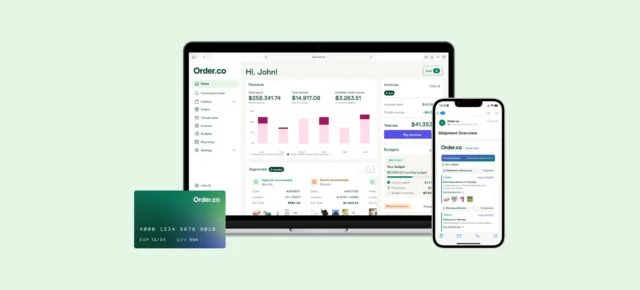
See how Order.co stacks up
Tour the product yourself now — no demo request, no waiting.
Cost-per-invoice benchmark
Cost per invoice = total AP processing cost (labor, technology, and overhead) ÷ invoices processed in the same period
Ardent Partners' State of ePayables 2025 puts the average cost to process a single invoice at $9.84. The same research found that Best-in-Class AP teams, the 20% of enterprises with the lowest processing costs and fastest cycle times, process invoices at a 79% lower cost than their peers. Ardent also notes wage inflation over the past five years, so the benchmark works best as a directional target. Each organization should measure its own baseline by entity before a vendor's ROI projection enters the business case.
AP automation software compared
| Tool | Best for | How it drives ROI | Pricing model |
|---|---|---|---|
| Order.co | Multi-location, multi-entity organizations buying operating supplies across many vendors | Pays vendors directly and sends itemized, pre-coded statements, which cuts invoice volume before it reaches AP | Confirm during evaluation |
| Bill.com | Small and mid-sized finance teams that want AP and payments in one subscription | AI invoice capture cuts manual entry, and electronic payments replace paper checks | Tiered per-user subscription, with transaction fees by payment method |
| AvidXchange | Mid-market companies, especially in real estate and property management | Automates capture and approvals, and moves check payments to electronic methods through its supplier network | Quote-based, typically scaled to invoice and payment volume |
| Stampli | AP teams with heavy approver back-and-forth on each invoice | Keeps questions, approvals, and coding on the invoice itself, which shortens cycle time | Quote-based, scaled to invoice volume |
| Coupa | Large enterprises standardizing procurement and AP on one suite | Raises the rate of PO-backed, touchless invoices through a supplier portal and automated matching | Quote-based enterprise subscription |
| Tradeshift | Global enterprises with large supplier bases and e-invoicing obligations | Replaces PDF and paper invoices with structured e-invoices, which reduces capture errors | Quote-based buyer subscription, with suppliers typically joining at no cost |
Pricing models change often. Buyers should confirm current terms directly with each vendor.
The best AP automation software for increasing ROI
1. Order.co: best for reducing invoice volume before it reaches AP
For Order.co, ROI starts before the invoice. Operating-supplies purchases across vendors and locations run through one procurement platform, and Order.co pays each vendor directly. AP receives itemized, pre-coded statements instead of a separate invoice from every vendor, so far fewer invoices reach AP. AKIRA, a fashion retailer with more than 35 stores, reclaimed more than 160 hours a month on AP after moving supplies purchasing onto Order.co, with each purchase GL-coded at the point of purchase and synced to NetSuite already itemized. The variable to measure is the share of current invoice volume that comes from operating-supplies spend, since that is the spend the platform covers.
2. Bill.com: best for small and mid-sized finance teams
Bill.com, now marketed as BILL, combines invoice capture, approval routing, and vendor payments in one subscription. It syncs with ERPs such as NetSuite and Sage Intacct. Most of its return comes from minutes saved per invoice and from moving vendors off paper checks. Cost structure is the main ROI variable, because per-user fees and per-payment fees both scale with use. Teams evaluating mid-market invoice-to-pay automation should model the cost at projected volume rather than current volume.
3. AvidXchange: best for mid-market payment-heavy AP
AvidXchange automates invoice capture and approvals, and its strength is the payment side. Its supplier network lets AP move check payments to electronic methods, which helps property management and real estate portfolios with long vendor lists. Supplier enrollment drives the return. Each vendor that accepts electronic payment is one fewer check to print, which makes enrollment rate the core metric in vendor payment automation projects.
4. Stampli: best for invoice collaboration
Stampli centers the workflow on the invoice itself. Approvers ask questions, attach context, and sign off in a thread tied to the document, while AI suggests GL coding. It sits on top of the existing ERP rather than replacing it, which keeps implementation lighter. The return concentrates in organizations where approvals cause more delay than data entry does. Approval cycle time is the baseline to measure before shortlisting invoice approval software.
5. Coupa: best for enterprise-wide spend management suites
Coupa runs AP inside a broader suite that also covers procurement, expenses, and payments. When PO compliance is high, suppliers convert purchase orders into invoices through its portal, and matching runs without manual touch. The ROI depends on adoption across procurement, finance, and IT, so implementation is a cross-functional program rather than an AP project. Mid-sized organizations that want procurement-led AP without a full suite rollout often compare mid-market Coupa alternatives.
6. Tradeshift: best for global e-invoicing networks
Tradeshift connects buyers and suppliers through an e-invoicing network and supplier portal, and it helps organizations meet country-level e-invoicing mandates. Structured e-invoices skip the OCR step that scan-based invoice automation software relies on, so capture errors fall at the source. As with AvidXchange, the return scales with supplier onboarding. Enterprises with long supplier tails should plan the onboarding effort for those vendors in advance.
How to choose AP automation software for ROI
An evaluation team can put each control below to any vendor on the shortlist.
- Baseline cost per invoice by entity. Measure current cost per invoice and exception rate for each entity before any demo, so vendor projections can be checked against real numbers.
- Invoice count, not just handling time. Ask how the tool changes the number of invoices AP receives. Controls that act before the invoice exists, such as pre-invoice procurement control, change the count instead of the minutes spent on each invoice.
- ERP sync fidelity. Require line-level GL, entity, and location coding to post to NetSuite, Workday, or Sage Intacct without re-keying. A purchasing and payments platform that posts the purchase and the invoice from one record removes a reconciliation step entirely.
- Payment-side terms. Confirm who funds early payment, how float is handled, and whether the vendor or the organization carries payment risk. These terms decide whether discount capture is realistic.
See how Order.co stacks up
Tour the product yourself now — no demo request, no waiting.
How Order.co increases AP automation ROI by cutting invoice volume
The tools above lower the cost of handling each invoice. Order.co lowers the number of invoices AP handles. Operating-supplies purchasing from many vendors across every location runs through one platform. Order.co pays each vendor by its preferred method on Net 1 terms, then sends the organization itemized, pre-coded statements set up for its AP workflow, cutting the number of bills AP processes by up to 50x. The volume reduction applies to spend that runs through the platform, so evaluators should map which invoice categories that covers in their own environment.
- Custom billing. Order.co pays each vendor by its preferred method and sends an itemized statement set up for the organization's AP workflow, with each line item already coded. Spend can be split by location, and further by property where needed. Per-vendor payment runs drop off AP's calendar.
- Automated GL coding at the time of purchase. Order.co applies automated GL coding at the time of purchase, and each purchase is assigned to the correct entity. Month-end re-coding and cross-entity allocation entries drop out of the close.
- Matching enforced in the workflow. Purchases placed on the platform populate the invoice, so the PO and the invoice agree from the start. Line items are validated against the approved request, and exceptions are flagged before payment, which reduces the standalone matching AP has to run.
- ERP invoice sync. Invoice data syncs to NetSuite, Sage Intacct, and other ERPs through Order.co's accounting integrations, and to Workday through its Workday procurement integration, with multi-entity sync across ledgers. Financial records reflect actual purchasing activity without manual entry.
- PO compliance and audit trail. Every purchase starts from an approved request, with approval workflows and budget controls applied before the order is placed, so each invoice that arrives represents spend that was already approved. SOC 2 Type 2 certification and searchable transaction records support audit readiness across business units.
To see how pre-coded statements would work with your invoice volume, schedule a demo.
Get started
Schedule a demo to see how Order.co can simplify buying for your business.
"*" indicates required fields